
What Long-Term Care Really Costs—and Who Pays for It
LONG-TERM CARE PLANNING SERIES | PART 2 OF 3
Understanding the financial side of care before a family has to make decisions
In Part 1, we looked at the human side of long-term care: care often begins quietly, families frequently become part of the care system, and the impact can spread across work, retirement, relationships, and household finances.
Part 2 asks the next unavoidable question: What can long-term care cost, and where does the money come from?
There is no single price for long-term care. The cost depends on where care is delivered, how much help is needed, how long it is needed, and where the person lives. But current national figures make one point very clear: even a partial need for paid care can become a major household expense.
Long-Term Care Is a Continuum, Not a Single Place
Many people still hear “long-term care” and picture a nursing home. In reality, care can begin at home and progress through several settings as needs change.
Home and personal care — help with household tasks, supervision, mobility, bathing, dressing, eating, or other daily needs.
Adult day services — structured daytime supervision, activities, meals, and, in some programs, personal or health-related support.
Assisted living — residential housing combined with personal care and support services.
Nursing-home care — a higher level of ongoing supervision, personal assistance, and nursing services.
A family may use only one of these settings, or several over time. That is why planning around one assumed destination—such as a nursing home—can miss how care actually develops.
What Does Care Cost Today?
CareScout’s 2025 Cost of Care Survey provides a useful national benchmark. Actual costs vary widely by state, region, provider, and amount of care, but the national medians illustrate the scale families may face.
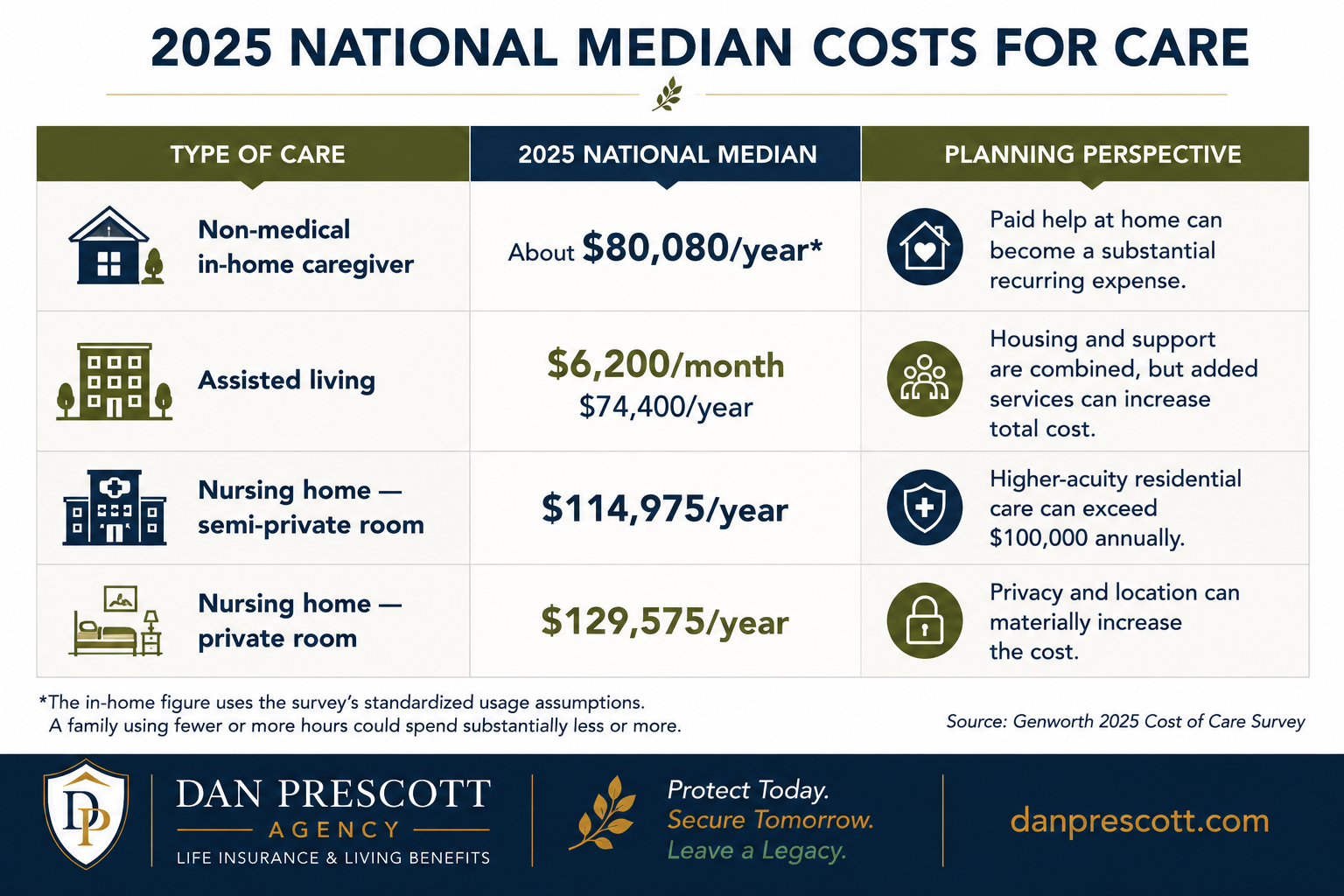
Median Cost For Care
These figures should not be read as a prediction of what one family will spend. They are planning benchmarks. The financial impact depends on the duration and intensity of care—and whether unpaid family members absorb part of the workload.
The Cost Is More Than the Care Bill
Part 1 emphasized that family caregiving has an economic value even when no invoice is generated. That matters here because families often combine paid services with unpaid help.
A care plan may therefore involve two kinds of cost at the same time:
Direct costs — caregivers, assisted living, nursing care, transportation, home modifications, and other services.
Indirect costs — reduced work hours, unpaid leave, lost income, delayed retirement savings, travel, and time spent coordinating care.
A family can appear to be “saving money” by providing care themselves while still absorbing a very real financial and personal cost.
The Medicare Misunderstanding
One of the most important distinctions in long-term care planning is the difference between medical or rehabilitative care and ongoing custodial or personal care.
Medicare can cover qualifying short-term skilled nursing or rehabilitation services when its requirements are met. But Medicare generally does not pay for long-term custodial care when help with activities such as bathing, dressing, or eating is the only care needed.
For qualifying skilled nursing facility care, Medicare coverage can extend up to 100 days in a benefit period, but that is not the same as 100 days of guaranteed long-term care coverage. Eligibility rules apply, cost sharing can begin before day 100, and Medicare does not become an open-ended payer for ongoing custodial care.
Planning takeaway: Medicare should not be treated as a family’s primary long-term care funding plan.
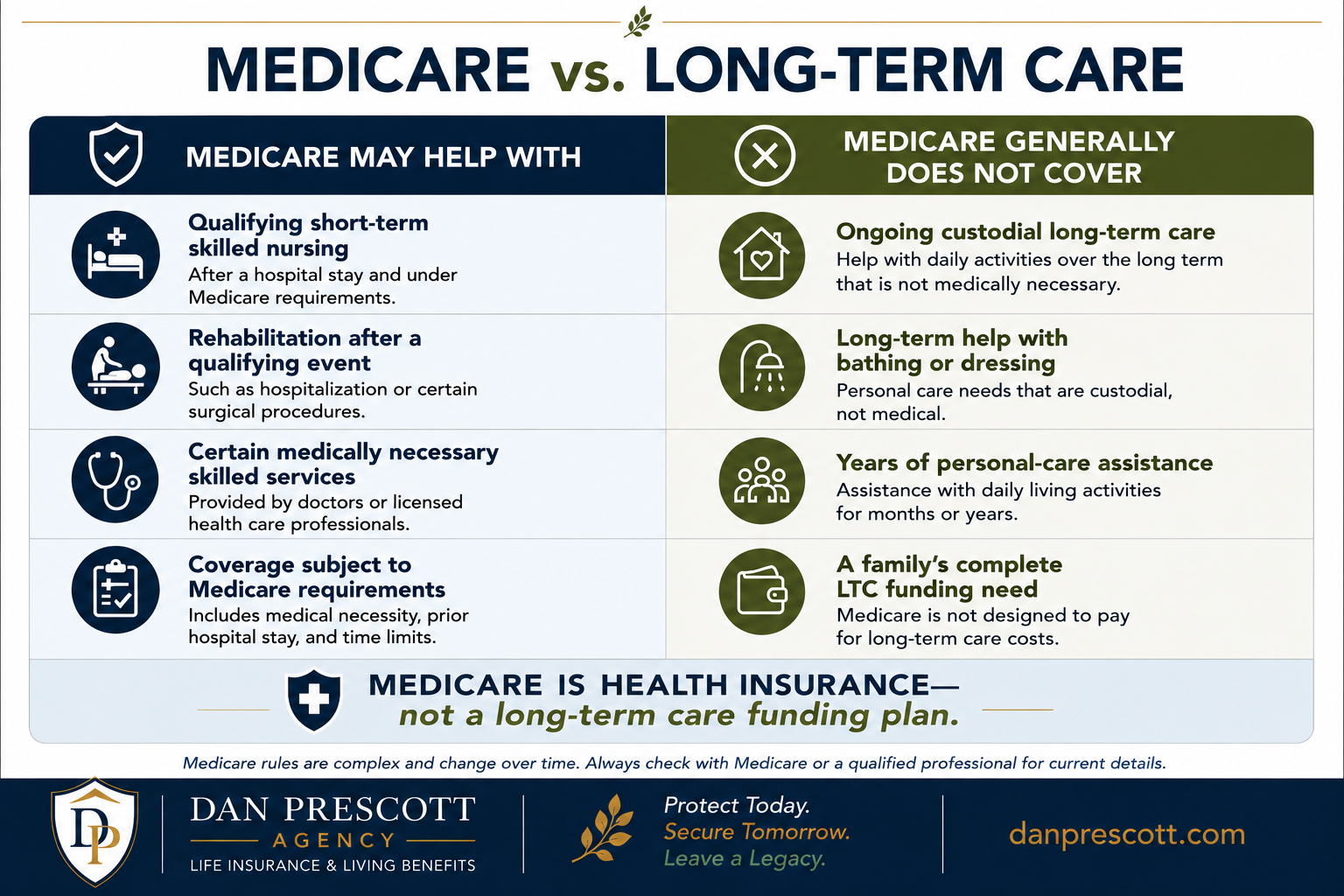
Medicare vs Long Term Care
Where Medicaid Fits
Medicaid is fundamentally different. It is the nation’s primary public payer for long-term services and supports, and it can cover care across institutional and home- and community-based settings.
However, Medicaid is a means-tested program. Eligibility rules involve financial requirements as well as care-related requirements, and the details vary by state and individual circumstances.
That makes Medicaid an essential safety-net program, but not the same thing as having a privately designed long-term care plan. Families should understand their state’s rules rather than assume Medicaid will function like private insurance.
What About Health Insurance?
Traditional health insurance is also commonly misunderstood. Federal long-term care guidance notes that most private or employer health coverage generally follows the same pattern as Medicare: it may cover limited, medically necessary skilled care, but it typically does not pay for extended custodial or personal care.
This is one reason a serious long-term care need can expose a gap that ordinary health insurance was never designed to fill.
So Who Ultimately Pays?
For many families, the answer is not one source. Long-term care is often funded through a combination of resources.
Personal income, savings, and assets
Families may pay directly from current income, savings, investments, retirement assets, or other property. The key planning question is how much can be used without undermining other financial goals or the security of a spouse.
Family and unpaid caregiving
Relatives may provide transportation, supervision, personal help, or daily care. This can reduce direct expenses but can shift the cost into time, employment, and family finances.
Medicare and health coverage
These may pay for qualifying skilled or rehabilitative services, but generally should not be expected to fund extended custodial long-term care.
Medicaid
Medicaid is the primary public payer for long-term services and supports, subject to state eligibility and program requirements.
Long-term care insurance and other private planning solutions
Private insurance can be designed to help fund qualifying long-term care needs. Standalone LTC insurance, Partnership-qualified policies, certain life-insurance LTC riders, and linked-benefit or hybrid approaches are addressed in Part 3.
A Simple Example: Why Duration Matters
Suppose a family needs paid care averaging $75,000 per year. One year of care is a significant expense. Three years approaches $225,000. Five years approaches $375,000—before considering future inflation, home modifications, uncovered medical expenses, or lost income for a family caregiver.
This is not a prediction or a recommendation for a particular amount of insurance. It simply demonstrates why the length of a care event can matter as much as the monthly price.
Four Financial Questions to Ask Before a Care Event
What resources could we use first?
Income, savings, investments, insurance, family support, or some combination?
What assets or goals do we want to protect?
A spouse’s retirement security? The family home? Retirement income? An inheritance or legacy goal?
How much unpaid care could the family realistically provide?
Who has the time, proximity, health, skills, and financial flexibility to help—and for how long?
What happens if care lasts longer than expected?
A plan that works for six months may not work for three or five years.
The Goal Is Not to Predict the Future
No family can know exactly whether care will be needed, where it will occur, or how long it will last. Long-term care planning is not about guessing the future perfectly.
It is about understanding the size of the potential financial obligation, knowing what public programs do and do not cover, and deciding in advance which resources the family would want available.
The question is not only, “Can we pay for care?” It is also, “What would paying for care require us to give up?”
For Washington Residents
Washington has additional long-term care programs and planning considerations, including WA Cares, Apple Health/Medicaid long-term services and supports, and the Washington Long-Term Care Partnership Program. A separate Learning Center article will explain how these programs fit into long-term care planning in Washington.
LINKING NOTE: Leave this as plain text until the Washington companion article is published, then link it.
Still Have Questions About Long-Term Care Planning?
Long-term care decisions involve more than estimating a future bill. Understanding what different programs may cover, what your family could realistically provide, and which financial resources you want to protect can make the conversation much clearer. If you have questions, I’m happy to help you understand the options and the questions worth asking.
EDUCATIONAL DISCLAIMER: This article is provided for general educational purposes only and is not legal, tax, financial, medical, Medicaid-planning, or individualized insurance advice. Long-term care costs, public-program eligibility, insurance benefits, and available planning options vary by individual, location, insurer, policy, and jurisdiction. Medicare and Medicaid rules can change; consult the applicable government program and qualified professionals for current eligibility and coverage information.