
The Long-Term Care Problem Most Families Don’t See Coming
LONG-TERM CARE PLANNING SERIES | PART 1 OF 3
Why planning for care is about more than paying for a nursing home
Long-term care is often treated as an issue for old age—something to think about after retirement or when health begins to decline. For many families, that is too late.
The long-term care problem often begins much earlier and much more quietly. A parent needs a ride to an appointment. Someone starts helping with groceries or medications. Bills become harder to manage. A family member begins checking in every day. Eventually, occasional help can become an ongoing caregiving responsibility.
Long-term care is rarely one person’s problem. It can affect a spouse, adult children, siblings, careers, retirement plans, family relationships, and the financial security of everyone involved.
The Probability Is Too Large to Ignore
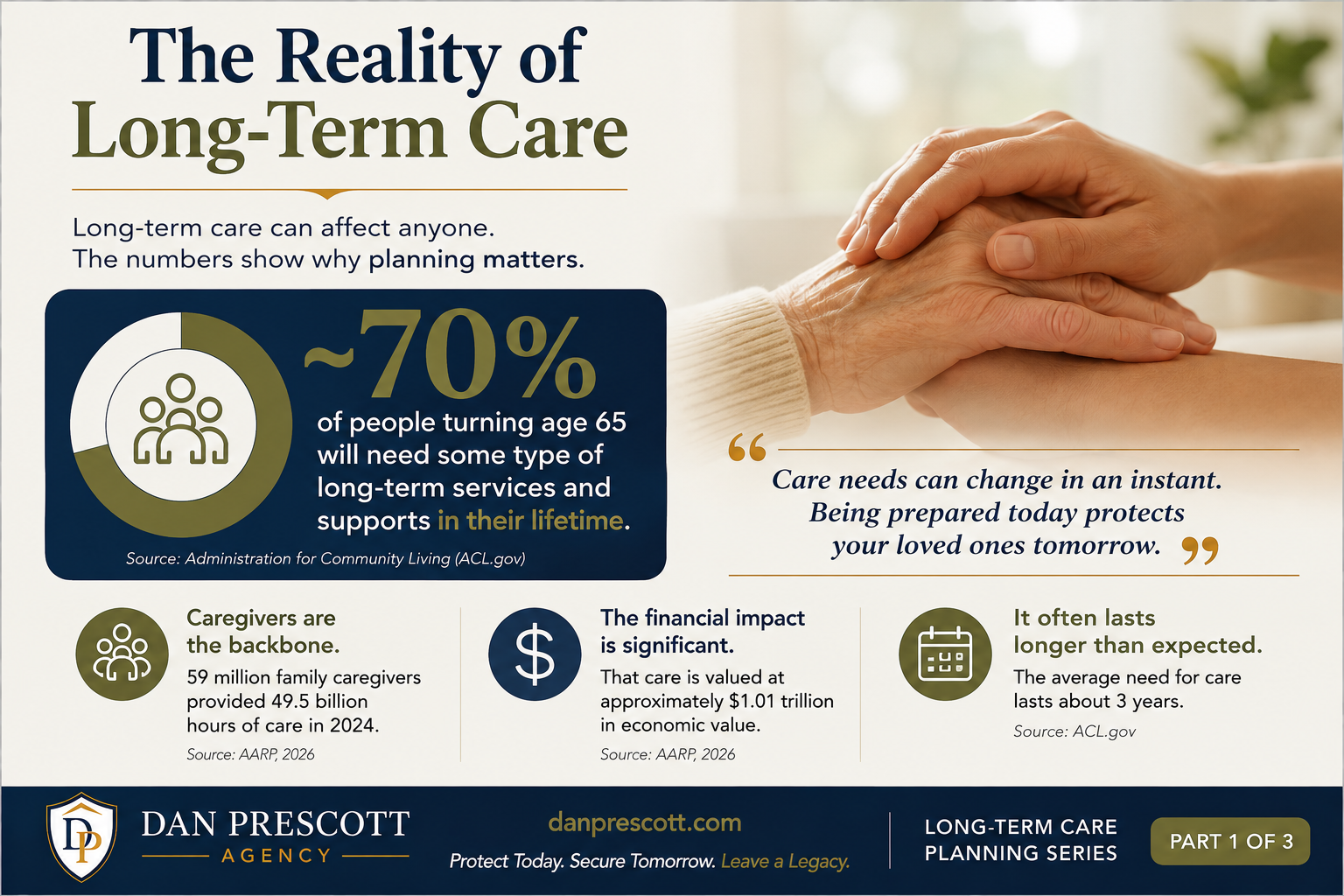
According to the U.S. Administration for Community Living, someone turning age 65 today has almost a 70% chance of needing some type of long-term care services and supports during the remainder of life.
That does not mean 70% of people will spend years in a nursing home. Long-term care includes assistance delivered at home, in the community, in assisted living, and in nursing facilities. Federal long-term care data indicate that more people use long-term care services at home than in facilities.
The duration also varies widely. The same federal estimates put the average need for any long-term care services at about three years. Some people need no long-term support; others may need it for five years or longer.
The important planning question is not simply, “Will I go to a nursing home?” It is, “If I or someone in my family needs help for an extended period, what will that require from the rest of us?”
The Reality of Long-Term Care
Care Often Begins Before Anyone Calls It Long-Term Care
One reason families are caught unprepared is that care does not always begin with a dramatic medical event. It may develop gradually.
Transportation and errands
Groceries and meal preparation
Help with mail, bills, or finances
Medication reminders or management
Home safety and supervision
Help with dressing, bathing, eating, or mobility
What begins as a few hours of help can grow into a regular commitment. At that point, the family is not merely helping occasionally—it may be providing long-term services and support, even if no one has used that term.
America Already Relies Heavily on Family Caregivers
The scale of family caregiving is difficult to overstate. AARP’s 2026 Valuing the Invaluable report estimates that 59 million Americans provide care to adults. Together, they supplied approximately 49.5 billion hours of care in 2024.
If those hours had been purchased in the marketplace, AARP estimates their economic value at approximately $1.01 trillion.
Those numbers reveal something important: much of America’s long-term care system is not contained inside an insurance policy, government program, nursing home, or assisted living community. It is taking place inside families.
The cost of care is therefore not measured only in dollars. It can also be measured in time away from work, reduced savings, postponed retirement, emotional stress, and changes in family responsibilities.
If You’re 35, Why Should You Care?
For someone in their 30s or 40s, personal long-term care may seem decades away. But the first long-term care event you encounter may not be your own.
You may experience it as a son or daughter helping an aging parent, as a spouse supporting a partner, or as the family member whose schedule is flexible enough to take on increasing responsibility.
That is why long-term care belongs in a broader family financial conversation. Planning is not only about protecting your future self. It is also about deciding what happens if someone you love needs care while you are still working, raising children, paying a mortgage, and saving for retirement.
The Financial Pressure Is Growing Too
Professional care can be expensive. CareScout’s 2025 national medians put assisted living at about $6,200 per month and a private nursing-home room at about $10,798 per month. Non-medical in-home caregiving can also exceed $6,000 per month at commonly surveyed usage levels.
Actual costs vary substantially by location and by the amount and type of care needed. The point is not that every family will face those exact numbers. It is that even a partial professional-care need can place meaningful pressure on household finances—especially when combined with unpaid family caregiving.
This is why the financial discussion cannot begin only after care is needed. By then, the family may be making decisions under time pressure with fewer choices.
BUILD NOTE: Keep this section short. Part 2 will carry the detailed cost and funding discussion.
Four Questions Every Family Should Discuss Before a Crisis
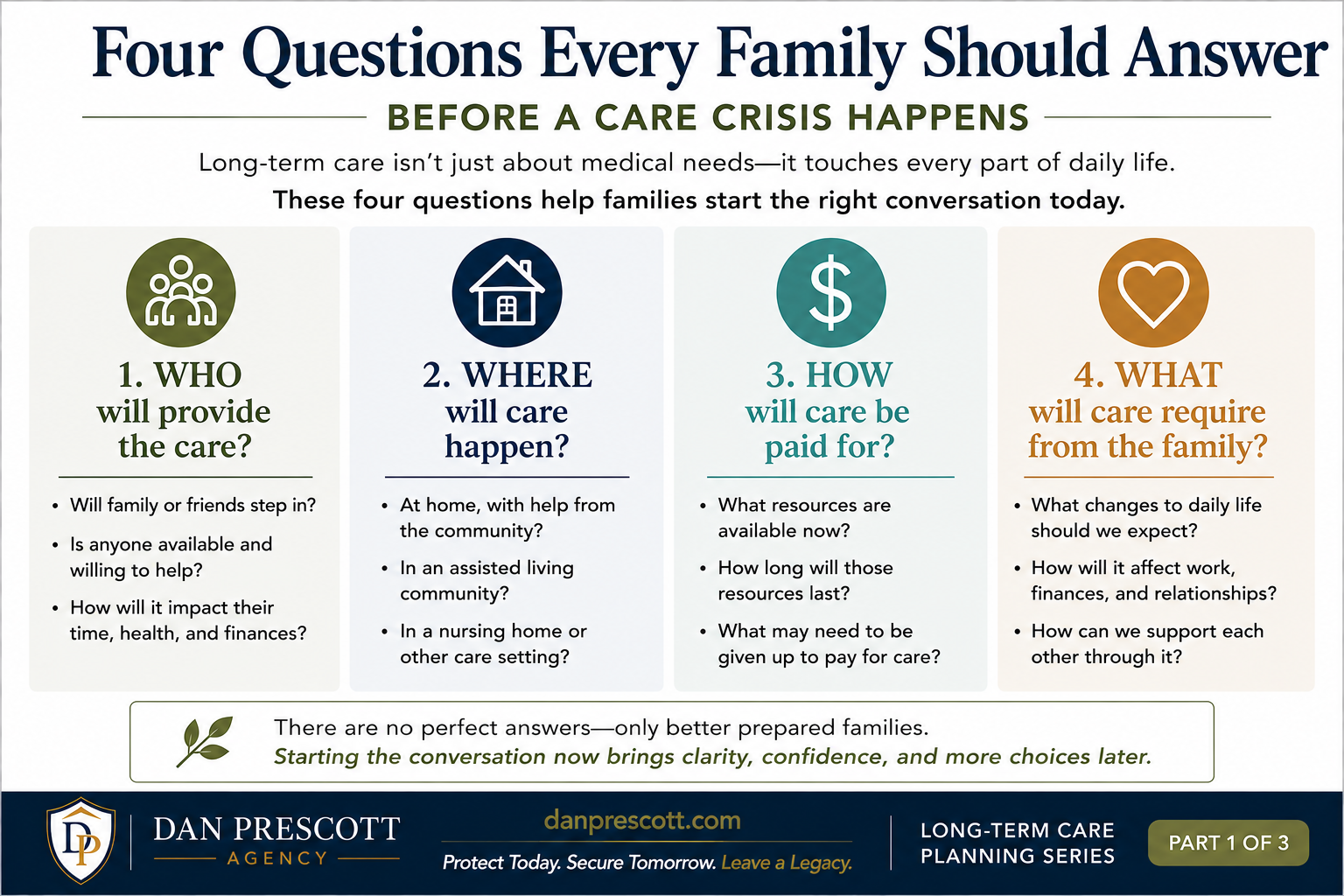
Who will provide the care?
Would a spouse, adult child, other relative, or professional caregiver be expected to help? What happens if the preferred caregiver cannot do it?
Where will care happen?
Is remaining at home the priority? What changes might the home require? At what point would assisted living or another care setting become necessary?
How will care be paid for?
Which resources could realistically be used without undermining the financial security of the person receiving care—or the family members helping them?
What will care require from the family?
Could someone reduce work hours, take leave, travel regularly, manage finances, coordinate medical care, or become responsible for daily tasks?
Four Questions
Planning Is Different From Buying Insurance
A long-term care plan and long-term care insurance are not the same thing.
A plan begins with the family: preferences, possible caregivers, where care might occur, financial resources, legal documents, and the responsibilities different family members may be willing or able to assume.
Insurance may be one way to fund part of that plan. Depending on individual circumstances, planning approaches can include personal assets, standalone long-term care insurance, Partnership-qualified coverage, life insurance with qualifying long-term care benefits or riders, and linked-benefit or hybrid solutions.
Those choices deserve their own discussion. Before comparing solutions, however, families need to understand the problem they are trying to solve.
The Advantage of Starting Before You Need Care
Planning early does not mean predicting exactly what will happen decades from now. No one can do that.
It means having the conversation while there is still time to consider preferences, understand costs, evaluate financial resources, explore insurance eligibility where appropriate, and decide how much responsibility the family is prepared to assume.
The best time to talk about long-term care is not when care begins. It is while your family still has time, choices, and flexibility.
Have You Started the Long-Term Care Conversation?
Long-term care planning begins with understanding what care could mean for you and your family. If this article raises questions about where to start, Dan Prescott Agency can help you understand the planning considerations and the questions worth asking before decisions become urgent.
EDUCATIONAL DISCLAIMER: This article is provided for general educational purposes only and is not legal, tax, financial, medical, Medicaid-planning, or individualized insurance advice. Long-term care needs, costs, eligibility, insurance benefits, public-program rules, and available planning options vary by individual, location, insurer, policy, and jurisdiction.