
Planning for Long-Term Care Before You Need It
LONG-TERM CARE PLANNING SERIES | PART 3 OF 3
Understanding the choices families can consider while time, health, and flexibility are still on their side
Part 1 examined why long-term care is a family problem as much as an individual one. Part 2 looked at what care can cost and why Medicare, Medicaid, personal resources, and family caregiving each play different roles.
Part 3 brings those ideas together: How can a family prepare before a care event forces the decision?
There is no single long-term care strategy that is right for everyone. Some families will rely heavily on personal assets. Some will purchase standalone long-term care insurance. Others may use life insurance or annuity-based solutions that include qualifying long-term care benefits. Many plans will combine several resources.
The goal is not to buy a particular product. The goal is to decide, in advance, how care would be provided, how it would be funded, and what you want to protect.
Start With the Plan—Not the Product
Before comparing insurance policies, begin with the four questions introduced earlier in this series: Who would provide care? Where would you prefer to receive it? How would it be paid for? What would providing care require from the family?
Those answers help define the problem. Only then does it make sense to compare ways to fund it.
How important is remaining at home?
How much care could family members realistically provide?
Which savings or retirement assets would you be willing to use?
Which assets, income streams, or legacy goals would you prefer to protect?
How much of the potential risk do you want to retain yourself—and how much would you prefer to transfer to an insurer?
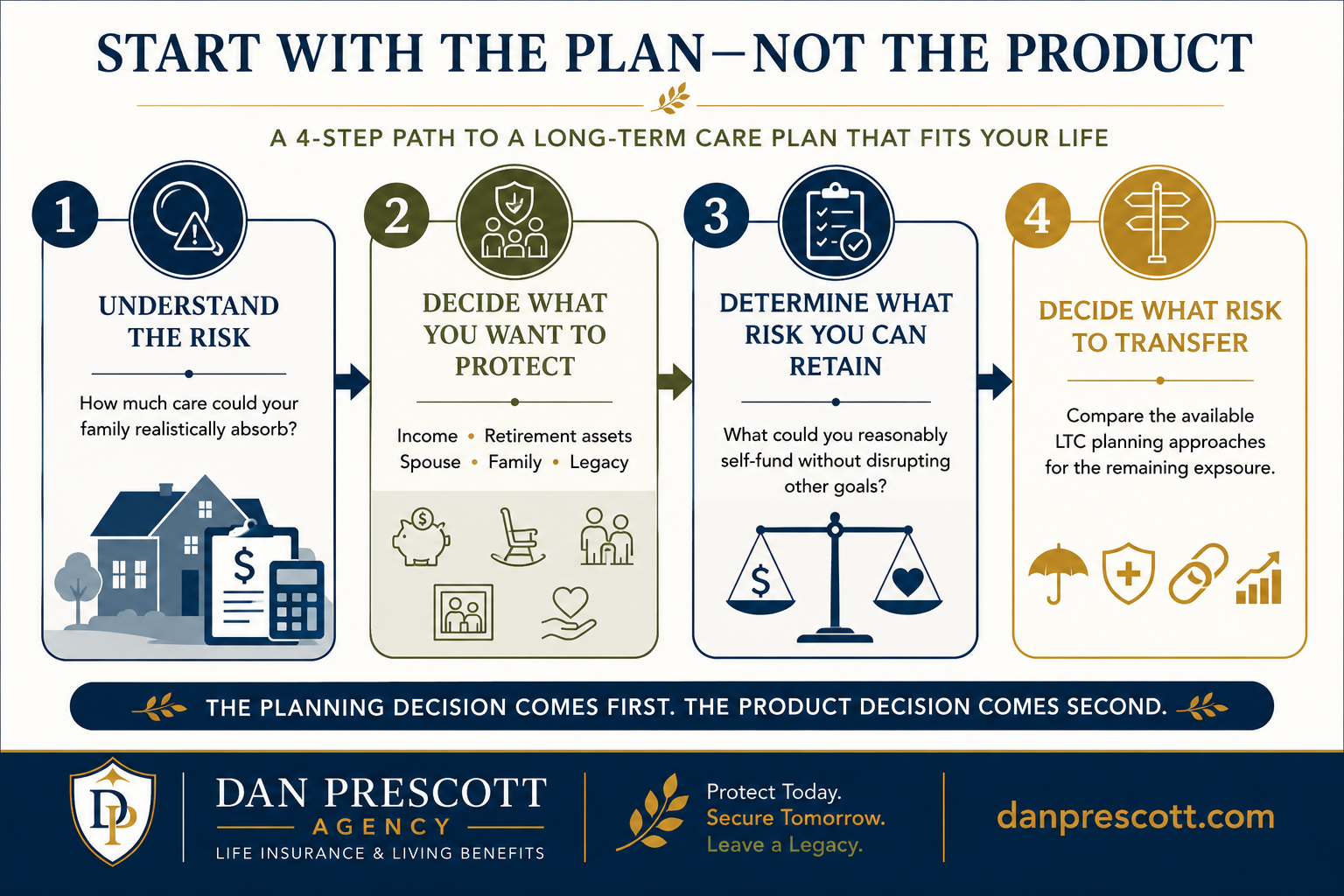
Start With The Plan - Not The Product
Option 1 — Personal Assets and Self-Funding
Some households choose to retain all or part of the long-term care risk. They may plan to use income, savings, investments, retirement assets, home equity, or other resources if care is needed.
Self-funding offers flexibility, but the family should test the plan against more than a short care event. A strategy that comfortably covers six months may look very different if care continues for three, five, or more years.
The key question is not simply whether the household has assets. It is how much of those assets can be redirected to care without creating a second financial problem for a spouse, dependent, retirement plan, or legacy objective.
Option 2 — Standalone Long-Term Care Insurance
Standalone long-term care insurance is designed specifically to help pay for qualifying long-term services and supports. Depending on the policy, benefits may apply to care at home, adult day services, assisted living, nursing-home care, and other covered services.
Traditional LTC policies commonly let the buyer select important design elements such as the benefit amount, benefit period or pool of money, elimination period, and inflation protection. Benefits generally begin only after the insured satisfies the policy’s benefit trigger and any required elimination period.
A common benefit trigger is the inability to perform at least two Activities of Daily Living without substantial assistance, or the need for substantial supervision because of severe cognitive impairment. The exact policy language controls.
Option 3 — Partnership-Qualified Long-Term Care Insurance
A Long-Term Care Partnership policy is a specially qualified private LTC policy connected to a state’s Medicaid asset-protection rules. In participating states, benefits paid by a qualifying Partnership policy can allow certain assets to be disregarded when Medicaid eligibility is later determined, subject to the state’s rules and all other Medicaid requirements.
Partnership status does not mean someone automatically qualifies for Medicaid, and not every LTC policy is Partnership-qualified. The policy must meet applicable requirements, which can include inflation-protection provisions based on age.
Because Partnership rules are state-specific, readers should verify the current program in the state where they are planning. Washington-specific programs—including the Washington Partnership Program and WA Cares—will be covered separately in a companion Learning Center article.
Option 4 — Life Insurance With a Long-Term Care Rider
Some life insurance policies can include a rider designed to provide qualifying long-term care benefits. This can allow one policy to address both a death-benefit need and a potential long-term care need.
The important word is qualifying. A true LTC rider is not simply any provision that allows early access to a life insurance death benefit. Benefit triggers, reimbursement or indemnity structure, benefit amounts, remaining death benefit, charges, and tax treatment can differ by contract.
This is an area where policy terminology matters. Consumers should confirm whether a rider is actually filed and regulated as long-term care insurance in their state.
ADB and Chronic-Illness Benefits Are Not Automatically LTC Insurance
Life insurance may also include an Accelerated Death Benefit (ADB) or a chronic-illness benefit that allows part of the death benefit to be accessed while the insured is living after a qualifying event.
These benefits can be valuable, but they should not automatically be described as long-term care insurance. An accelerated benefit may use different eligibility rules, payment structures, restrictions, or regulatory treatment than an LTC rider.
Option 5 — Linked-Benefit or Hybrid Life + LTC
Linked-benefit or hybrid products intentionally combine life insurance with meaningful long-term care benefits. They are designed for people who want an asset to serve more than one potential purpose.
If qualifying care is needed, the policy can provide LTC benefits according to its terms. If care is never needed—or only part of the available care benefit is used—there may still be a life insurance death benefit for beneficiaries, depending on the product and claims paid.
Some designs also offer extended long-term care benefits beyond the initial life insurance amount. Features vary substantially, so the comparison should focus on guarantees, benefit duration, inflation options, payment structure, liquidity, and what value remains if care is never needed.
Option 6 — Annuity-Based Long-Term Care Solutions
Certain annuity contracts can also be structured with long-term care benefits. These designs may leverage an existing premium or asset to provide a larger pool of money for qualifying care while retaining annuity value if the LTC benefit is not fully used.
Like hybrid life/LTC products, these are not interchangeable with standalone LTC insurance. They solve a different planning problem and should be evaluated based on the source of funds, guarantees, liquidity, benefit triggers, tax considerations, and the amount of care protection provided.
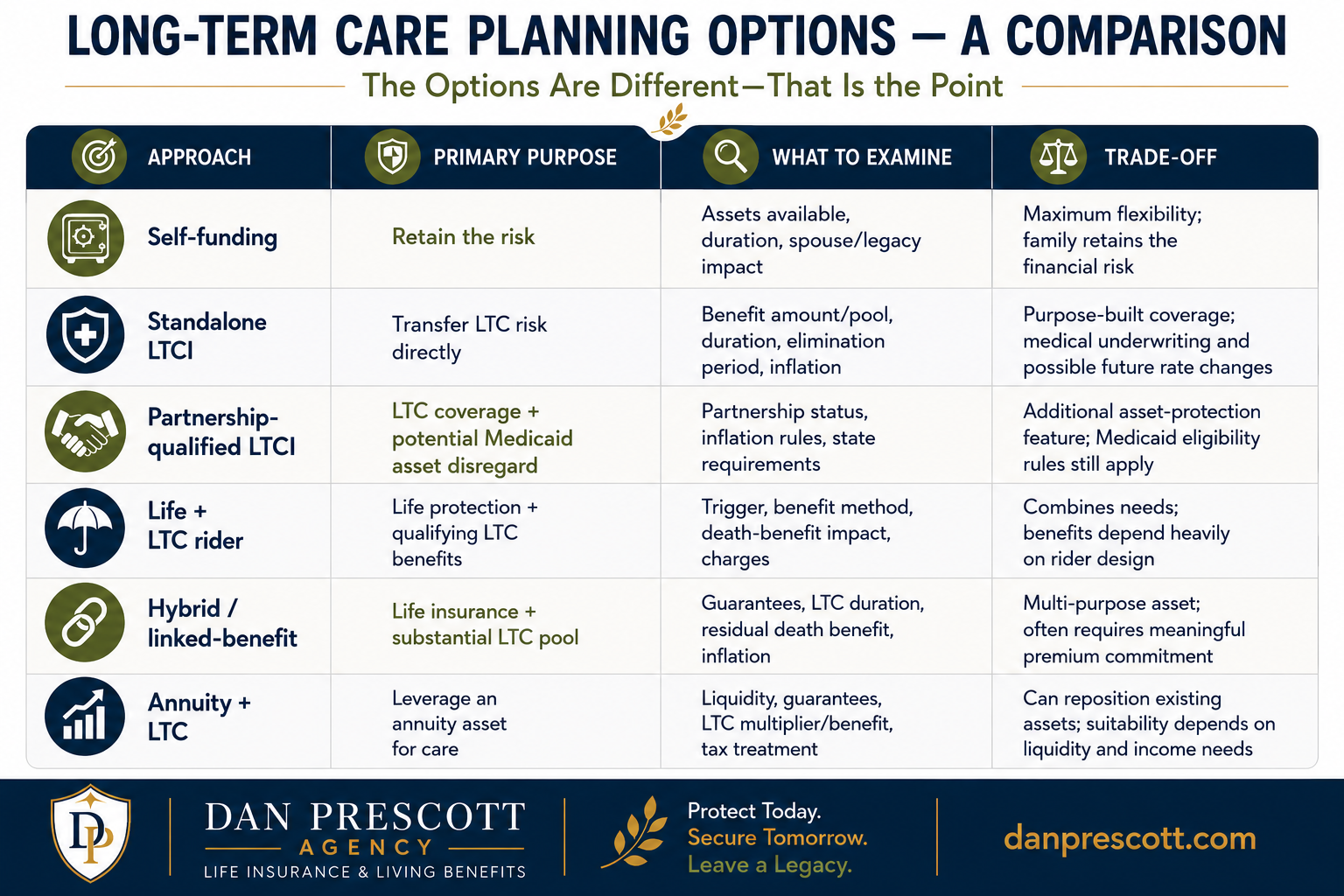
Long-Term Care Planning Comparison
Why Waiting Can Reduce Your Choices
Private long-term care insurance is generally medically underwritten. Health changes can affect eligibility, available benefits, or cost—and in some cases can make new coverage unavailable.
Age also matters. Waiting may mean paying for coverage at an older issue age, while delaying too long can narrow the products or benefit designs for which someone qualifies.
That does not mean everyone should purchase LTC insurance at a young age. It means the conversation is most useful while a person still has choices.
Affordability Matters Just as Much as Coverage
A long-term care strategy should not create financial strain today in an attempt to solve a possible future problem.
Whether considering standalone insurance, a rider, or an asset-based solution, the premium or funding commitment should fit comfortably within the broader financial plan. A policy that cannot realistically be maintained may not accomplish its purpose.
This is another reason to begin with the plan rather than the product: determine the risk the family wants to transfer, the resources it is willing to commit, and the protection it wants to preserve.
Seven Questions to Compare Any Long-Term Care Strategy
What event or condition triggers benefits?
Where can covered care be received—home, community, assisted living, nursing facility, or all of these?
How much benefit is available each month or over the life of the policy?
Is there an elimination or waiting period before benefits begin?
How does the plan address rising care costs and inflation?
What happens to premiums, cash value, or the death benefit if care is never needed—or if only part of the benefit is used?
Can I reasonably maintain this strategy without compromising other financial priorities?
A Long-Term Care Plan Can Use More Than One Resource
Families do not necessarily have to choose between “insurance” and “self-funding.” A plan can intentionally combine resources.
For example, a household might retain enough assets to cover an elimination period or a portion of care, use insurance to protect against a longer event, and rely on family support for selected non-medical tasks. Another family may decide that preserving retirement income for a healthy spouse is the priority and transfer more of the care risk to insurance.
The appropriate mix depends on the family—not on a universal formula.
The Most Important Decision Is to Have the Conversation
Long-term care planning is ultimately about protecting choices: where care can happen, who provides it, how it is paid for, and how much of the burden falls on the family.
The three articles in this series are intended to move that conversation in a logical order: first understand the human problem, then understand the financial exposure, and finally understand the choices available to address it.
You do not need to predict exactly what care will look like. You need a plan that gives your family more options if care becomes necessary.
For Washington Residents
Washington has additional long-term care programs and planning considerations, including WA Cares, the Washington Long-Term Care Partnership Program, Apple Health/Medicaid long-term services and supports, and a developing supplemental LTC insurance framework. A separate Learning Center article will explain how these pieces may fit together for Washington residents.
Not Sure Which Long-Term Care Planning Approach Fits?
The right starting point is not a product. It is understanding what you want to protect, what resources you are willing to use, and how much of the long-term care risk you want to keep or transfer. If you have questions, Dan Prescott Agency can help you understand the choices and the questions worth asking before you make a decision.
EDUCATIONAL DISCLAIMER: This article is provided for general educational purposes only and is not legal, tax, financial, Medicaid-planning, medical, or individualized insurance advice. Insurance definitions, benefit triggers, underwriting requirements, premiums, guarantees, tax treatment, Partnership rules, product availability, and policy provisions vary by insurer, product, state, and individual circumstances. Always review the actual policy and current state and federal requirements before making a decision.