
Understanding Participating Whole Life Insurance
LISTEN TO THIS ARTICLE · Approx. 13 minutes
Audio narration generated from the written article using an automated voice.
Why the Contract—and Its Design—Matter
Guarantees • Dividends • Paid-Up Additions • Term Riders • Living Benefits • Liquidity • Retirement Design
The Foundation: A Contract Built on Guarantees
Life insurance is generally described as a unilateral, conditional contract. The insurer makes contractual promises when the policy is issued; the policyowner receives those guarantees as long as the conditions of the contract are satisfied. The policyowner is not forced to continue the contract forever, but changing or stopping required premiums can activate the policy’s contractual options and consequences.
In traditional whole life, the guaranteed foundation can include a stated premium schedule, a guaranteed death benefit and a schedule of guaranteed cash values. Think of the guaranteed cash-value schedule as the policy’s contractual minimum cash value at specified points in time, assuming the contract requirements are met.
A participating policy’s actual cash value may become higher when declared dividends are retained in the policy or used to purchase paid-up additions. Those contractual guarantees do not depend on whether the stock market rises or falls or whether the insurer declares a dividend. They do depend on the issuing insurer’s claims-paying ability and on the policy being maintained according to its terms.
KEY IDEA
The guarantees establish the contractual floor. Participation and policy design can create additional value above that floor, but nonguaranteed values should never be confused with contractual guarantees.
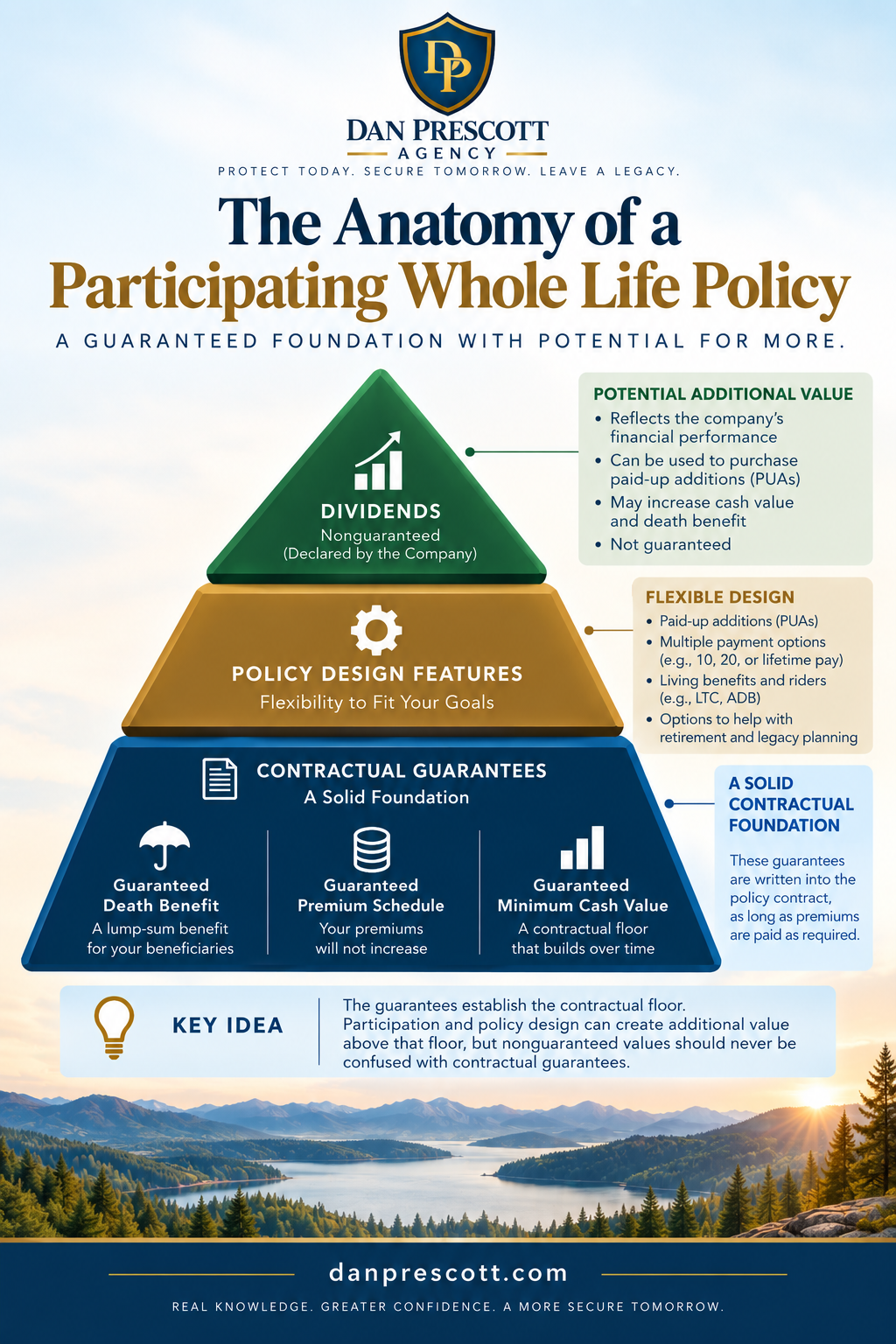
Paticipating Whole Life Policy Foundation
Participation and Dividends: Not Guaranteed, but History Matters
A participating whole life policy is eligible to receive policyholder dividends when declared by the insurer. Dividends are not guaranteed. They reflect factors such as investment experience, mortality, expenses and the insurer’s overall experience, and future dividend scales can change.
That does not make dividend history meaningless. When evaluating a participating carrier, a long record of paying dividends to eligible policyowners can provide useful historical context about how the company has operated across changing economic environments. MassMutual states that it has paid dividends to eligible participating policyowners every year since 1869. Lafayette Life has also reported a long history of whole life policyholder dividends dating to its early years.
These histories span wars, depressions, recessions, financial crises, inflation and major changes in interest rates. Past dividend history is not a promise of future results, but it can be an important part of a thoughtful carrier review.
When a dividend is declared, policyowners may have several options, depending on the contract: receive cash, reduce out-of-pocket premium, accumulate at interest, repay policy indebtedness where available, or purchase paid-up additional insurance. A carrier’s published dividend interest rate should not be confused with the policy’s rate of return and should not be used by itself to rank competing policies.
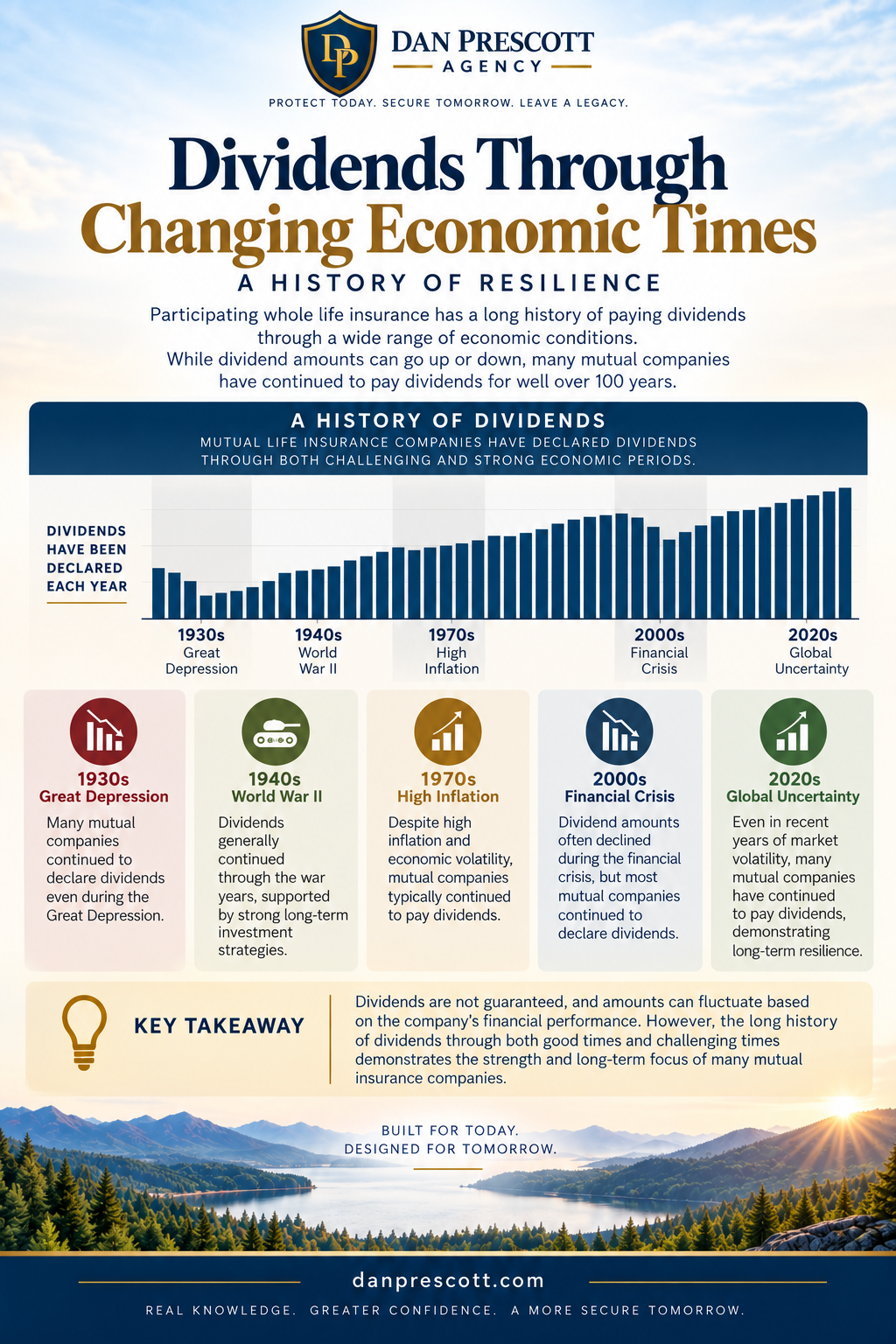
Dividends Through Changing Economic Times
Designing the Coverage: Paid-Up Additions + Term Protection
Participating whole life can be designed rather than simply purchased as one large block of permanent coverage. Two important tools are paid-up additions and term riders.
Paid-Up Additions: Additional Permanent Insurance
A Paid-Up Addition (PUA) is a small increment of fully paid permanent life insurance added to the base policy. Each addition has its own death benefit and cash value. Once purchased, no additional premium is required for that particular addition.
PUAs may be purchased with declared dividends or, when the contract includes an appropriate rider, with additional premium. Carrier materials describe PUAs as additional paid-up life insurance that can increase death benefit and cash value without a new medical exam for each purchase when made under the existing policy provision.
This does not mean underwriting never applies. Rider limits and rules vary, and adding a PUA rider after policy issue can require a new application and underwriting. The amount of additional insurance purchased is governed by the policy or rider’s applicable rates and terms.
The important distinction is that the policyowner is not merely adding money to an account. The premium is purchasing additional paid-up life insurance, which in turn increases the policy’s death benefit and cash value.
Term Riders: Temporary Protection Around a Permanent Base
A family may need a large death benefit during working and child-raising years but also want a smaller amount of permanent coverage. A term rider can provide the temporary layer while the whole life policy provides the permanent foundation.
Illustrative example: $150,000 of permanent whole life coverage plus an $850,000 20- or 30-year term rider could provide $1 million of initial death-benefit protection. The appropriate mix depends on Human Life Value, budget, time horizon, health, insurability and long-term objectives.
Determining the appropriate amount of protection starts with understanding the financial value of the income being protected. Human Life Value Calculator

One Policy for Your Whole Life
Living Benefits and Liquidity
Accelerated Death Benefits
An Accelerated Death Benefit (ADB) provision may allow access to part of a policy’s death benefit while the insured is living if specified conditions are met. Depending on the carrier and rider, qualifying events may include terminal illness, chronic illness or other defined medical conditions. Definitions, charges, underwriting and benefit calculations vary, and an accelerated benefit generally reduces the amount ultimately payable at death.
Policy Loans: Accessing Cash Value
Whole life cash value can also support policy loans. A policy loan is different from a withdrawal: the insurer lends money with policy value serving as collateral, and interest is charged. It is useful to distinguish the policy’s gross cash value, the outstanding loan balance and the net value available after indebtedness.
How a carrier treats borrowed values can vary by policy. The important consumer point is to read the actual contract and illustration rather than assume every participating whole life policy handles loans in the same way.
Loans require careful management. Unpaid loan balances and interest can reduce cash surrender value and the death benefit and can contribute to policy lapse. A lapse or surrender with outstanding indebtedness can also create tax consequences.
Designing Toward Retirement: Finish the Premium, Keep the Policy
A meaningful way to understand limited-pay whole life is to connect the premium schedule to retirement. A person in peak earning years may choose a design intended to complete required premiums before or around retirement, when earned income may decline and predictable expenses become more important.
If the policy is fully paid according to its contract, the required premium obligation can end while the permanent insurance continues. Guaranteed cash values remain part of the contract, previously purchased PUAs remain paid up, and a participating policy can remain eligible for future dividends if declared. The policy may therefore continue to develop after the owner has stopped making required premium payments.
This does not mean every policy should be designed as a short-pay contract. Shorter premium schedules generally require substantially higher payments during the funding years. The right schedule has to remain affordable and fit the policyowner’s protection priorities.

Your Working Years - Paid Up at Retirement
Tax Rules and Guardrails
A Modified Endowment Contract (MEC) is a life insurance contract that has been funded beyond limits established under federal tax law and fails the applicable seven-pay test. It remains life insurance, but distributions—including certain withdrawals and policy loans—are subject to different tax treatment. Understanding that definition first makes the funding limits easier to understand.
Permanent life insurance has important federal tax characteristics, but the language needs to be precise. Cash value generally grows without current income taxation while it remains inside the policy. Death benefits paid because of the insured’s death are generally excluded from the beneficiary’s gross income, subject to exceptions. Properly managed non-MEC policies can also provide potentially tax-advantaged access to policy value through withdrawals and loans.
Those advantages are not unlimited. Withdrawals above tax basis, policy surrender, lapse with outstanding loans and other circumstances can create taxable income. Policy loans are loans—not automatically “tax-free retirement income.” Individual circumstances should be reviewed with a qualified tax professional.
The MEC Line and the IRS Seven-Pay Test
The IRS seven-pay test is a federal tax test used to determine whether a life insurance contract becomes a Modified Endowment Contract. It should not be confused with a limited-pay whole life design. A policy can have a 10-pay, 20-pay or other contractual premium schedule while still being subject to MEC testing under federal law.
PUA funding makes this especially relevant because additional premium must remain within the policy’s allowable funding limits if preserving non-MEC tax treatment is an objective. A MEC remains life insurance, but distributions are taxed under different rules. Material policy changes can also require renewed testing.
What to Compare Before You Buy
Participating whole life should be evaluated as a contract and as a design—not simply by comparing premiums or a headline dividend rate.
What death benefit, premium schedule and cash values are guaranteed?
What values depend on future dividends?
How long has the insurer paid dividends to eligible participating policyowners, and how does it explain its dividend scale?
How can dividends be used?
Does the policy permit additional PUA funding, and what are the contractual limits?
Can temporary term insurance be layered around the permanent base?
What living-benefit provisions are actually included?
How do policy loans work, including loan interest and their effect on policy values?
When are required premiums scheduled to end?
How is the design monitored to avoid unintended MEC status?
Closing Perspective
A participating whole life policy is not defined by one feature. Its value begins with the contractual guarantees and then depends on how the policy is designed: the amount of permanent insurance, temporary protection, PUA funding, living benefits, loan provisions, premium schedule and dividend options.
For some families, term insurance alone may be the appropriate answer. For others, participating whole life may provide a useful permanent foundation. And for some, a blended design can combine substantial temporary protection with permanent guarantees and long-term flexibility
THE QUESTION TO ASK
Not simply: “Is whole life good or bad?” Instead, ask: “What does this contract guarantee, what is not guaranteed, and how has the policy been designed to meet the need?”
Continue Learning: Understanding Insurance Companies
Educational Disclaimer: This article is for general educational purposes only and is not individualized insurance, legal, tax or financial advice. Policy guarantees, riders, dividend treatment, underwriting, availability and costs vary by insurer, policy form and state. Guarantees are subject to the claims-paying ability of the issuing insurance company. Dividends are not guaranteed. Consult the actual policy and illustration and appropriate professional advisers before making a decision.
Sources & References
National Association of Insurance Commissioners (NAIC) — Life Insurance Illustrations
https://content.naic.org/insurance-topics/life-insurance-illustrationsWashington State Office of the Insurance Commissioner — Types of Cash Value Life Insurance
https://www.insurance.wa.gov/insurance-resources/life-insurance/types-cash-value-life-insuranceWashington State Office of the Insurance Commissioner — Learn How Life Insurance Works
https://www.insurance.wa.gov/insurance-resources/life-insurance/learn-how-life-insurance-worksInternal Revenue Service — IRC §7702A / Modified Endowment Contract and seven-pay guidance
https://www.irs.gov/irb/2006-46_IRBMassMutual — Whole Life Insurance and participating-policy dividend history
https://www.massmutual.com/insurance/life-insurance/whole-lifeMassMutual — 175th Anniversary / dividends paid to eligible participating policyowners since 1869
https://www.massmutual.com/about-us/news-and-press-releases/press-releases/2026/05/massmutual-turns-175Lafayette Life / Western & Southern — Whole Life Insurance product information
https://www.westernsouthern.com/lafayette/products/life-insurance/whole-life-insurance