
Understanding Insurance Companies
EDUCATIONAL ARTICLE
8 min read | Category: Life Insurance Basics
Mutual, Stock, and Participating Life Insurance
When people shop for life insurance, they usually focus on the policy itself: How much coverage do I need? Should I choose term or permanent insurance? What will the premium cost?
There is another important question that is sometimes overlooked:
What kind of insurance company stands behind the policy?
Life insurance can represent a financial promise that lasts for decades. Understanding how insurance companies operate, who owns them, and how they manage their financial obligations can help you make a more informed decision—especially when considering permanent life insurance.
A Brief History of Insurance
Insurance is built around a simple concept: sharing risk among a large group of people so that one individual or family does not have to bear a major financial loss alone.
Early forms of insurance developed as merchants, property owners, tradespeople, and communities pooled resources to protect themselves against losses from events such as fires, maritime disasters, illness, and death.
As insurance became more formalized, different organizational structures developed. Some insurance companies were financed and owned by investors. Others were organized under a mutual structure designed to operate for the benefit of their members or policyowners.
Those approaches eventually helped create two major organizational structures that remain important today: mutual insurance companies and stock insurance companies.
How Does an Insurance Company Work?
Although insurance products can become complicated, the basic insurance model is relatively straightforward.
An insurance company collects premiums from many policyholders. In exchange, it assumes specific financial risks defined by its insurance contracts.
The company must manage its assets and obligations carefully enough to pay current claims, maintain reserves for future benefits, cover operating expenses, invest assets prudently, and maintain adequate capital and surplus.
This is particularly important for life insurance. A policy issued today could remain in force for several decades.
That means you are not simply purchasing a product. You are entering into a long-term contract with the insurance company responsible for fulfilling the promises contained in that policy.
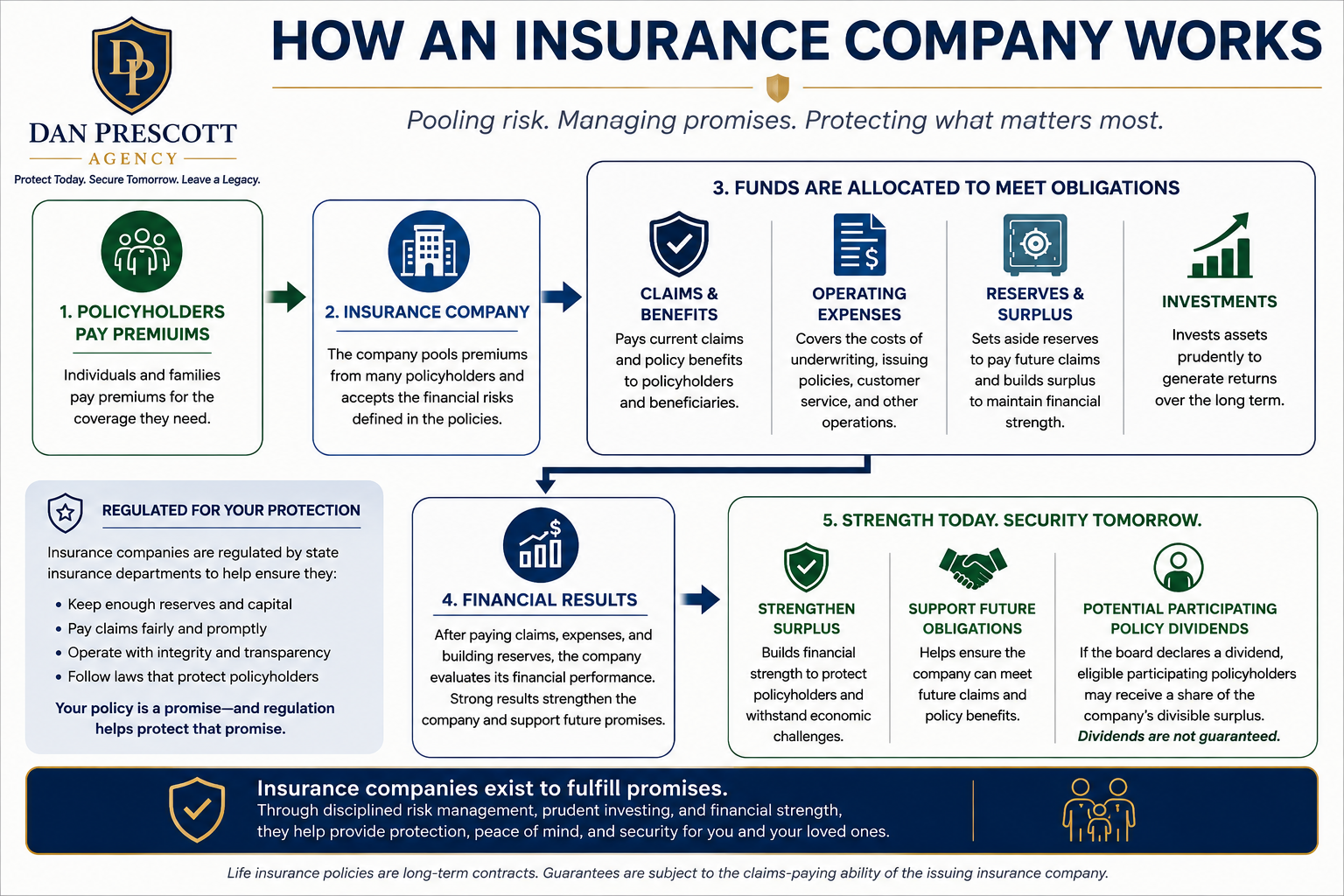
How An Insurance Company Works
Mutual vs. Stock Insurance Companies
One of the primary differences among insurance companies is ownership.
A mutual insurance company does not have outside stockholders in the traditional sense. It operates under a mutual structure for the benefit of its members or policyowners. Depending on the company and policy, eligible members may also have certain voting rights.
Because a mutual company does not have traditional outside shareholders, earnings can be retained to strengthen the company or, when appropriate, a portion of divisible surplus may be distributed to eligible participating policyowners through policy dividends.
A stock insurance company, on the other hand, is owned by shareholders. Investors own shares of the company and generally elect its board of directors. The company must fulfill its obligations to policyholders while also operating within a corporate structure that takes shareholder interests into account.
Both mutual and stock insurance companies can be financially strong, well-managed, and capable of fulfilling long-term policy obligations.
The ownership structure is therefore one consideration—not a determination of which company or policy is automatically better.
Participating vs. Non-Participating Policies
There is another distinction that is especially important when discussing mutual insurance companies:
The company structure and the policy structure are not the same thing.
A participating life insurance policy may be eligible to participate in certain financial results of the insurer through policy dividends when dividends are declared.
A non-participating policy does not provide the same participation in policy dividends.
This means you should not assume that purchasing insurance from a mutual company automatically means your particular policy will receive dividends.
A useful question to ask when comparing permanent life insurance is:
Is this particular policy participating or non-participating?
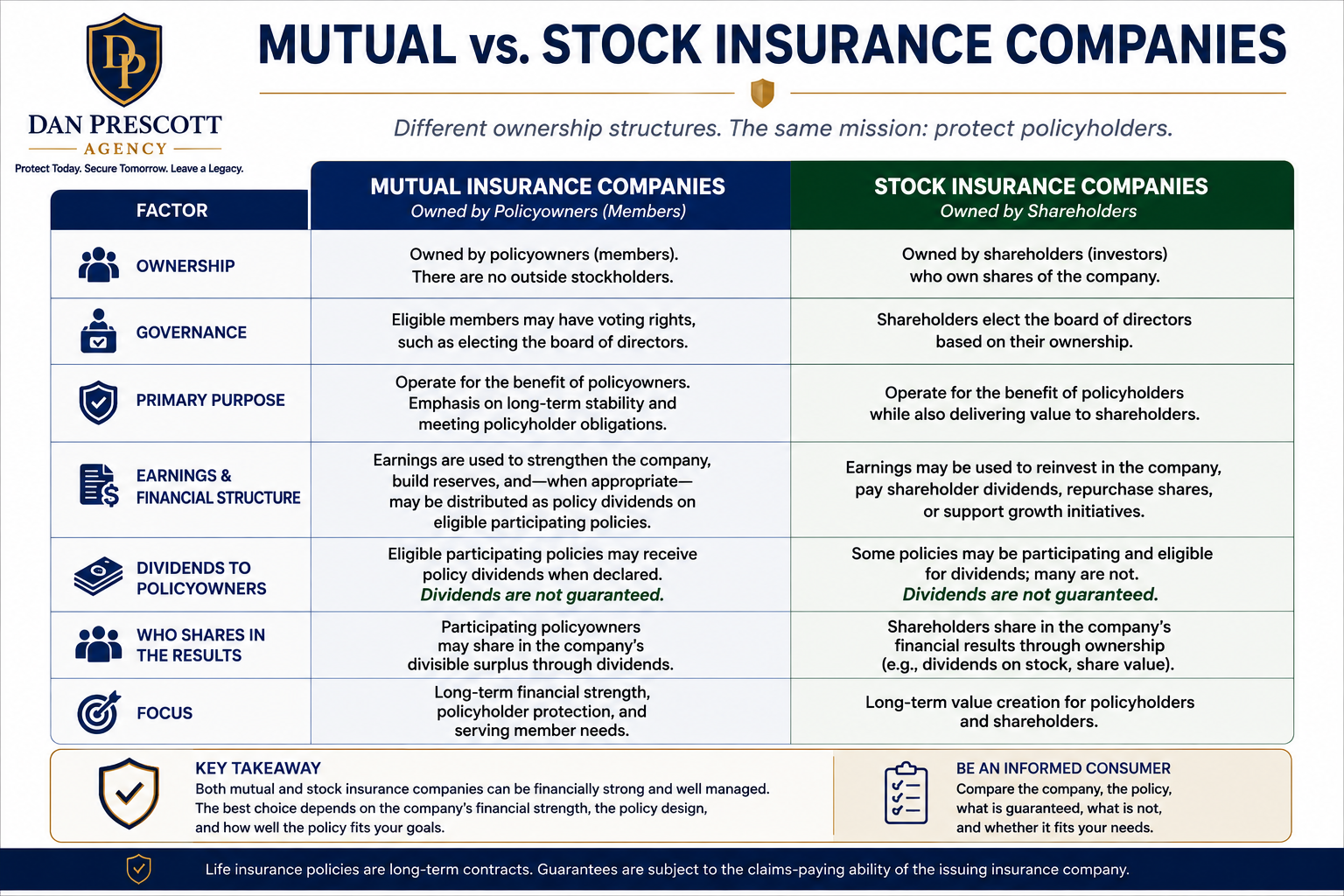
Mutual vs Stock Insurance Companies
How Participating Whole Life Dividends Work
Participating whole life insurance combines contractual policy guarantees with the potential for non-guaranteed policy dividends.
An insurance company establishes assumptions when pricing and managing its policies. Its actual financial experience can later differ from those assumptions.
Factors affecting that experience can include investment results, mortality and claims experience, operating expenses, policy activity, and other financial results.
After accounting for the company's obligations and financial requirements, the insurer may determine that a portion of surplus is available for distribution to eligible participating policyowners. When the company's board declares a dividend, eligible policyowners may receive a share based on the insurer's dividend methodology and their particular policies.
Depending on the insurer and policy, dividend options may include:
receiving the dividend in cash;
applying it toward premiums;
leaving it with the insurer under an available accumulation option; or
purchasing paid-up additional life insurance.
Using dividends to purchase paid-up additions can increase the policy's death benefit and cash value over time.
However, there is one important principle every consumer should understand:
Policy dividends are not guaranteed.
A company's history of paying dividends may be useful information when evaluating a participating policy, but past dividend performance does not guarantee future results.
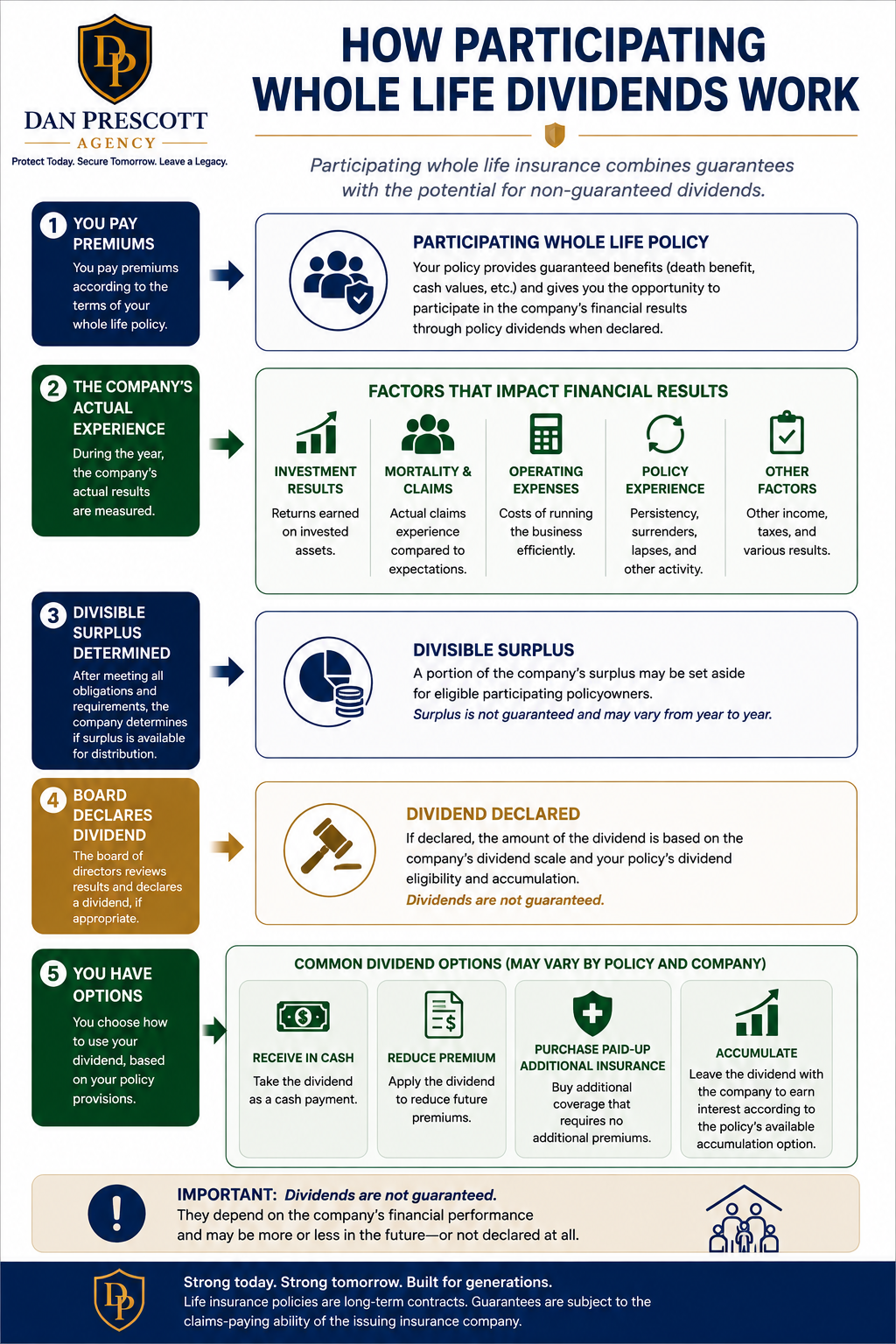
HOW PARTICIPATING WHOLE LIFE DIVIDENDS WORK
Guaranteed vs. Non-Guaranteed Values
When reviewing permanent life insurance, it is important to distinguish between contractual guarantees and non-guaranteed illustrated values.
Traditional whole life insurance may provide contractual guarantees, such as a guaranteed death benefit, a guaranteed premium schedule, and guaranteed cash values, when the policy's requirements are met.
Participating whole life adds the potential for dividends.
Those dividends may enhance the policy's long-term values, but they are separate from the contractual guarantees and should not be treated as guaranteed investment returns.
When reviewing a life insurance illustration, ask your insurance professional to clearly identify:
What is guaranteed?
and
What is based on current or non-guaranteed assumptions?
Understanding that distinction can make life insurance illustrations much easier to evaluate.
What Makes an Insurance Company Financially Strong?
Ownership structure alone does not determine an insurer's financial strength.
Life insurance companies must successfully manage underwriting, pricing, mortality experience, investments, operating expenses, risk, capital, surplus, and long-term policy obligations.
When evaluating an insurance company, consider more than its name or whether it is mutual or stock-owned.
Important questions include:
What type of company is issuing the policy?
Is the specific policy participating or non-participating?
What policy benefits and values are guaranteed?
Which illustrated values are not guaranteed?
What are the insurer's financial-strength ratings?
How long has the company operated?
If dividends are important to the strategy, what is its history of paying dividends on eligible policies?
How is the policy designed and funded?
Does the policy provide flexibility if your needs change?
Most importantly, does the policy fit the reason you are purchasing life insurance?
The Company Is Only Part of the Decision
Choosing a financially strong insurance company is important, but being strong does not automatically yield the right life insurance strategy.
Coverage amount, policy type, underwriting classification, premiums, guarantees, riders, cash-value objectives, and policy design can all materially affect the outcome.
Two policies issued by financially strong insurers can perform differently because their guarantees, premiums, dividend scales, riders, and overall designs are different.
Likewise, a participating whole life policy is not automatically appropriate simply because it is issued by a mutual insurance company.
The policy still needs to fit your protection needs, financial objectives, budget, and long-term plans.
The Bottom Line
Mutual insurance companies have played an important role in the development of the life insurance industry, and participating life insurance offers eligible policyowners the potential to share in certain financial results of an insurer through policy dividends.
But mutual ownership does not automatically make one insurance company or policy better than another.
Likewise, dividends should never be confused with guaranteed policy values.
A well-informed life insurance decision considers the insurance company, financial strength, ownership structure, policy guarantees, non-guaranteed elements, costs, underwriting, and policy design together.
Instead of simply asking:
“Which insurance company should I choose?”
A better question may be:
“Which company and policy structure best fit what I am trying to protect and accomplish?”
Need Help Comparing Your Options?
If you are considering term or permanent life insurance, understanding the company behind the policy is only one part of the decision.
Dan Prescott Agency can help you compare your options, understand what is guaranteed and what is not, and evaluate how different policy structures may fit your protection and long-term financial goals.
Protect Today. Secure Tomorrow. Leave a Legacy.
Educational information only. Life insurance products, policy features, guarantees, dividend options, and availability vary by insurer and state. Dividends are not guaranteed. Policy guarantees are subject to the claims-paying ability of the issuing insurance company. Review the applicable policy contract and consult a licensed insurance professional when evaluating coverage.