
Life Insurance Underwriting From Age 30 to 60
EDUCATIONAL ARTICLE
8 min read | Category: Life Insurance Basics
What Changes With Age — and Why Preparation Matters
When people compare life insurance, they usually begin with two questions: How much coverage do I need, and what will it cost? Before an insurance company can answer the second question, it must evaluate the risk represented by the applicant. That process is called underwriting.
Life insurance underwriting can consider age, health and medical history, nicotine use, medications, family history, driving history, occupation, hobbies, and other information related to mortality risk. The insurer then uses its guidelines to determine whether coverage can be offered and, if so, at what risk classification and premium.
Underwriting today may be traditional, accelerated, or simplified. Some qualifying applicants can complete an accelerated process without a traditional medical exam, using application information and approved external data. Others may still need medical records, an exam, or laboratory testing. The process varies by insurer, product, coverage amount, and applicant.
Understanding Age and Coverage Bands
Insurance companies often organize underwriting requirements into ranges commonly described as bands. An age band groups applicants within an age range; a face-amount or coverage band groups applications according to the amount of insurance requested.
These bands can act as breakpoints. A younger applicant requesting a moderate amount of coverage may qualify for a streamlined process, while an older applicant or someone requesting a larger death benefit may require additional evidence. The exact thresholds are not universal and can change by insurer and product.
Face amount can also affect pricing. Some policies use premium bands in which the rate per $1,000 of coverage changes after certain death-benefit thresholds. This is one reason a professional comparison should look at the actual premium for the desired coverage—rather than simply assuming that every additional dollar of death benefit is priced at the same unit rate.
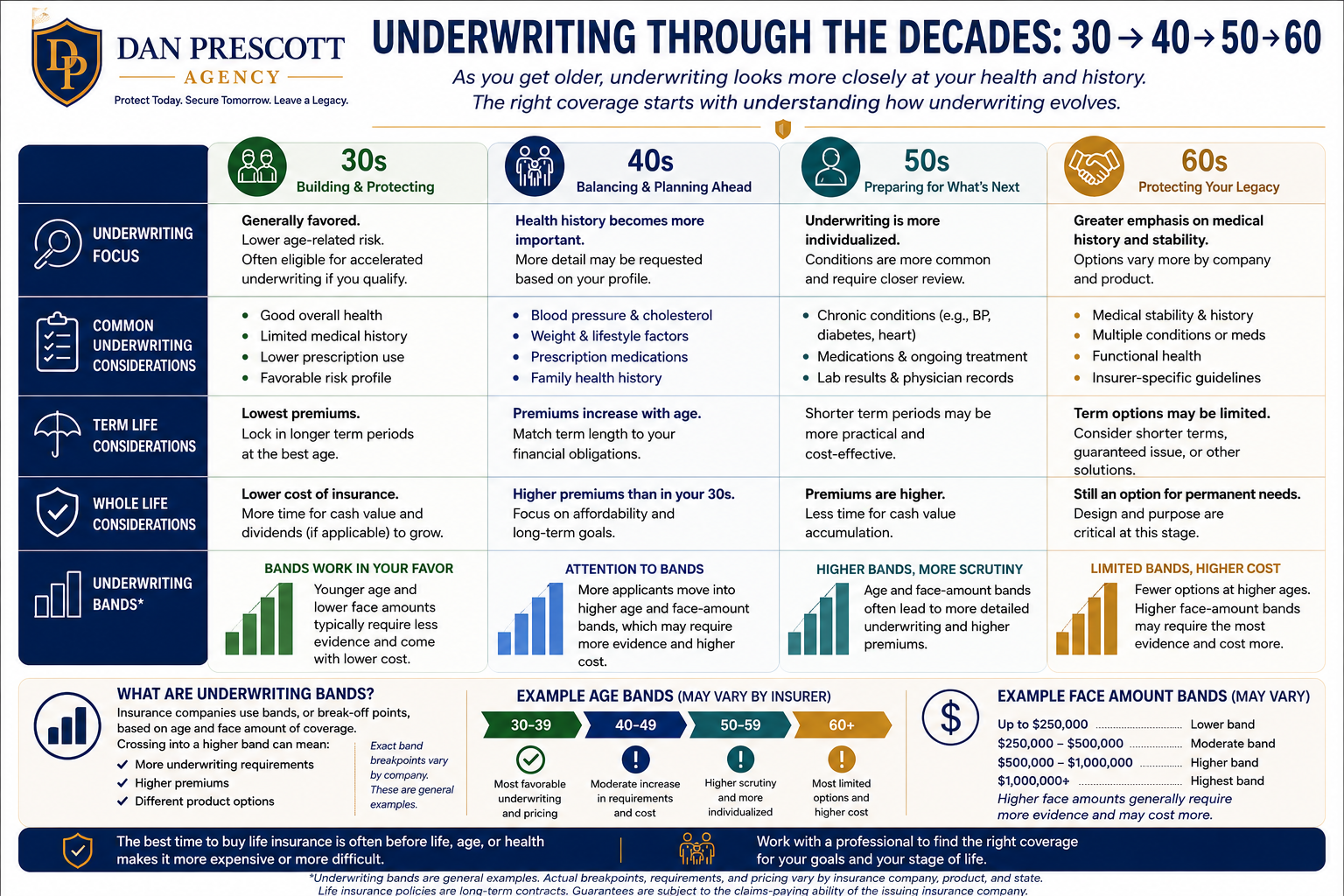
UNDERWRITING THROUGH THE DECADES: 30 → 40 → 50 → 60
Ages 30–39: Often a Favorable Underwriting Window
For many healthy adults, the 30s can provide favorable conditions for obtaining life insurance. Age-related mortality risk is comparatively lower, and qualified applicants may have access to accelerated underwriting programs.
The insurer may still review health history, height and weight, blood pressure, prescriptions, nicotine use, family history, driving records, and hazardous activities. Being young does not eliminate underwriting; it simply means age itself is generally less of a pricing obstacle.
For term insurance, the 30s can allow a consumer to lock in a longer level-premium period while protecting income, a mortgage, young children, or other long-term obligations. For whole life, starting younger generally means the policy is issued at a younger insurance age and provides more time for guaranteed cash values—and, on participating policies, any non-guaranteed dividends—to potentially contribute to policy values.
Ages 40–49: Health History Begins to Carry More Weight
During the 40s, many applicants remain healthy and may still qualify for favorable rates or accelerated underwriting. At the same time, medical histories often become more detailed. Blood pressure, cholesterol, weight, sleep apnea, blood-sugar trends, prescription use, and other conditions may receive greater attention.
A medical condition does not automatically mean an unfavorable decision. Underwriters commonly consider severity, treatment, control, stability, related conditions, and the overall risk profile.
For term insurance, both age and the requested term length begin to matter more. A 20- or 30-year term issued in the 40s extends coverage well into later ages. For whole life, the permanent nature of the need, premium commitment, guarantees, and policy design become increasingly important.
Ages 50–59: Underwriting Becomes More Individualized
By the 50s, applicants of the same age can have very different underwriting outcomes because their health histories may have developed in different directions. Insurers may take a closer look at cardiovascular health, diabetes, blood pressure, cholesterol, sleep apnea, weight-related conditions, cancer history, kidney or liver concerns, medications, and combinations of conditions.
Depending on the insurer, product, face amount, and applicant, additional medical records, laboratory testing, or other evidence may be requested. Healthy applicants can still qualify for attractive coverage, but carrier selection can become increasingly important.
For term insurance, the coverage period should correspond to the remaining financial obligation—for example, working years, income replacement, a mortgage, or spouse protection. For whole life, permanent needs may remain compelling, but premiums are higher than at younger issue ages and there is less time for cash value to develop before retirement.
Around Age 60: The Purpose of Coverage Often Changes
Age 60 is not a universal cutoff for life insurance, but the purpose of coverage often changes. The conversation may shift from protecting young children toward spouse protection, remaining income needs, debt, final expenses, legacy planning, business obligations, or other permanent needs.
Medical history may receive greater attention, and available term lengths, accelerated-underwriting pathways, risk classes, and coverage amounts can vary more noticeably among insurers. At this stage, matching the applicant to an appropriate carrier and product can be as important as comparing the initial quoted premium.
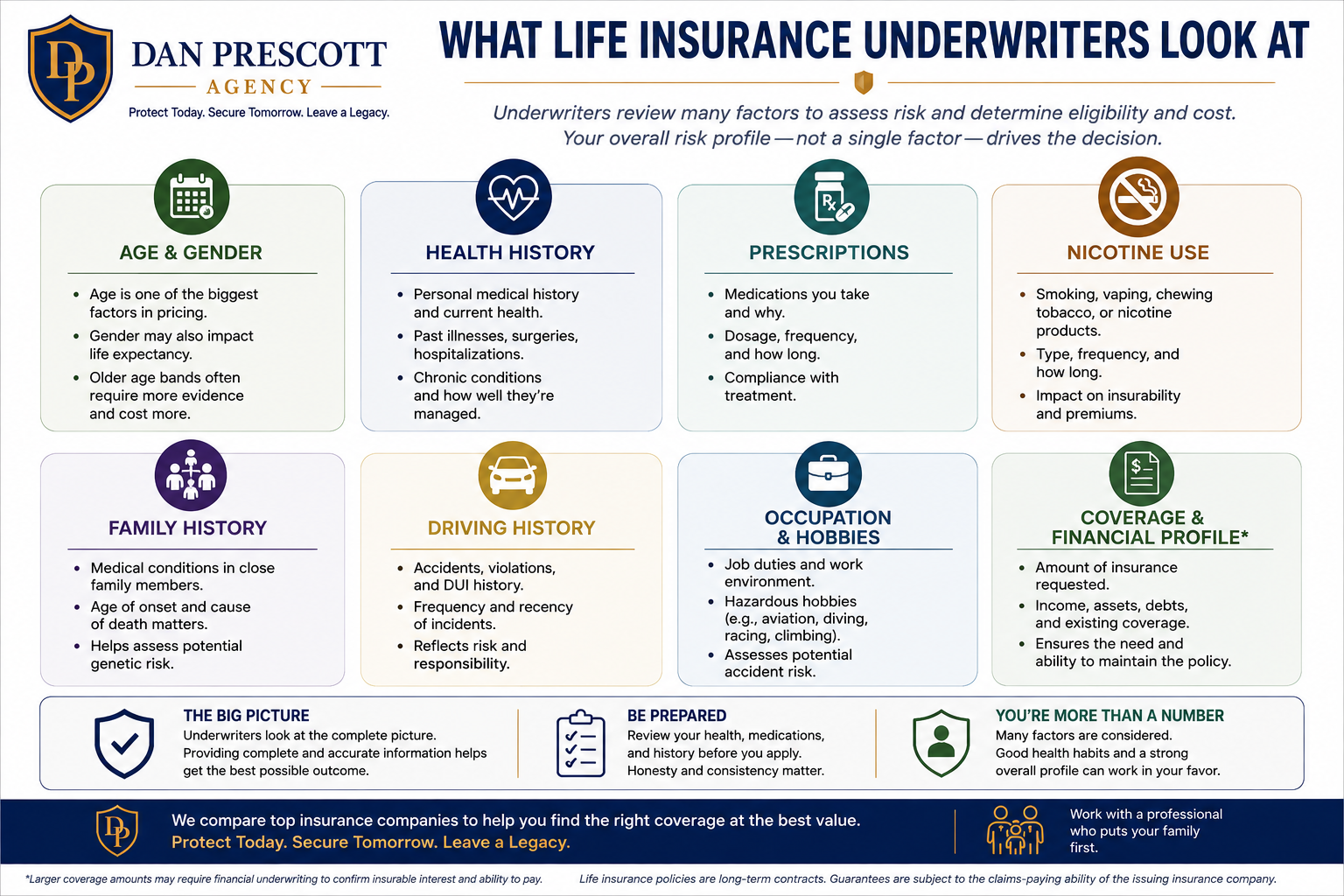
WHAT LIFE INSURANCE UNDERWRITERS LOOK AT
Traditional, Accelerated, and Simplified Underwriting
Traditional underwriting can involve a detailed application, medical records, a paramedical exam, and blood or urine testing. Accelerated underwriting uses application information, external data, and analytics to evaluate qualifying applicants more quickly and may waive some traditional medical requirements.
Accelerated underwriting is still underwriting. If the insurer does not have enough information—or the applicant falls outside the program's eligibility rules—the case may be moved to traditional underwriting.
Simplified underwriting generally uses fewer requirements and may avoid an exam, but product choices, coverage limits, and pricing can differ. The easiest application process is not automatically the best policy or the lowest long-term cost.

THREE PATHS THROUGH UNDERWRITING
Term vs. Whole Life: Does Underwriting Change?
The fundamental objective is similar: the insurer is evaluating mortality risk. The same applicant factors can affect both term and whole life. However, product-specific rules, face amount, age, financial justification, accelerated-underwriting eligibility, and available risk classes can differ.
Consumers should therefore avoid assuming that a rate offered on one product—or by one insurer—will automatically be duplicated on another.
What About Financial Underwriting?
Medical underwriting asks whether the applicant represents an acceptable mortality risk. Financial underwriting addresses a different question: Is the amount and purpose of insurance reasonably supported by the applicant's financial circumstances and the reason for the coverage?
For example, an insurer may consider income replacement, debts, business interests, estate needs, existing coverage, or other financial factors when a larger death benefit is requested. Because financial underwriting becomes a substantial topic of its own, this article only introduces the concept. A separate Learning Center Article can explain how insurers evaluate the financial justification for personal, business, and estate-planning coverage.
Why Underwriting Preparation Matters
The lowest advertised life insurance premium normally assumes a particular underwriting classification. Your actual rate is determined after the insurer evaluates the application.
Before applying, it can help to review current prescriptions, recent physician visits, medical history, existing coverage, family history, driving history, and any other issue likely to appear during underwriting. The objective is not to hide unfavorable information. It is to provide accurate, complete, and consistent information so the insurer can evaluate the case efficiently.
The Bottom Line
From age 30 to 60, life insurance generally becomes more expensive as age-related mortality risk increases, while underwriting can become more individualized as medical histories develop. At the same time, the purpose of coverage often changes—from protecting young families and future income toward retirement transitions, spouse protection, permanent needs, and legacy goals.
There is no single underwriting rule that applies to every company. Age bands, coverage bands, medical requirements, accelerated-underwriting eligibility, risk classifications, and premium breakpoints vary by insurer and product.
The better question is not simply, “Can I qualify for life insurance?” It is: What coverage fits my needs, and which insurer's underwriting approach and policy design may be a good fit for my situation?
Dan Prescott Agency can help you compare term and permanent life insurance options, prepare for underwriting, and understand how carrier guidelines, policy design, and coverage amount may affect your choices.
Protect Today. Secure Tomorrow. Leave a Legacy.
Educational information only. Life insurance underwriting requirements, risk classifications, accelerated-underwriting eligibility, medical requirements, coverage limits, premium bands, age limits, and policy availability vary by insurance company, product, state, coverage amount, and individual applicant. No particular underwriting classification, premium, or policy approval is guaranteed.