
Protect the Asset That Makes Everything Else Possible
EDUCATIONAL ARTICLE
8 min read | Category: Life Insurance Basics
Why Life Insurance Deserves a Different Conversation in Your 30s and 40s
We spend thousands of dollars every year insuring things because, in many cases, we have to.
A mortgage lender requires homeowners insurance to protect the property securing the loan. State laws generally require drivers to carry auto liability insurance. We accept those expenses as part of owning a home or driving a vehicle.
Those protections are important. But they protect property and financial interests.
There is another asset that often receives far less attention: you.
More specifically, your ability to earn an income, support a family, pay a mortgage, save for retirement, educate your children, and build financial security over the course of your working life.
No lender sends you a notice requiring you to protect decades of future income. No bank tells you that you must insure your Human Life Value. Because life insurance is usually a personal decision rather than a requirement attached to a home or vehicle, it can be easy to postpone.
We insure the things we are required to protect. The greater question is whether we are adequately protecting the person who makes those things possible.

You Protect What You Value
Your Most Valuable Asset May Be the One You Can’t See
Imagine a 35-year-old professional earning $100,000 per year.
If that person works until age 65, that is another 30 years of potential earnings. Without accounting for raises, promotions, inflation, taxes, or investment growth, that represents $3 million of future gross income.
That income does much more than provide a paycheck. It pays the mortgage. It buys groceries. It makes car payments. It pays for childcare and education. It funds vacations. It builds retirement savings. It pays insurance premiums. It creates opportunities for a family.
Your home does not pay for those things. Your car does not pay for those things. You do.
This is one reason understanding your Human Life Value can be so useful.Human Life Value is not intended to put a price on a person’s life. No financial calculation could do that. Instead, it is a way to estimate the economic value of income and financial contributions that could be lost if someone dies prematurely.
Once we look at life insurance from that perspective, the conversation changes. It is not simply another bill. It is a way of protecting the financial resource that makes many of the other parts of life possible.
Barrier #1: “Life Insurance Is Too Expensive”
Cost is one of the first concerns I hear, especially from people in their 30s and 40s. That makes sense.
At this stage of life, there may already be a mortgage, car payments, childcare expenses, student loans, retirement contributions, and dozens of other demands on a paycheck. Life insurance can feel like one more expense.
But there is an important question worth asking: Have you actually found out what appropriate coverage would cost, or have you assumed it will be expensive?
Life insurance pricing depends on many factors, including age, health, amount of coverage, type of insurance, policy duration, tobacco use, and underwriting. There is not one price for life insurance, and there is not one type of policy that is right for everyone.
The better approach is to first determine what you are trying to protect, understand the available options, and then decide what fits your budget.
You may still decide that other financial priorities come first. But make that decision based on information, not an assumption about what life insurance costs.
Barrier #2: “I’m Young and Healthy. I Have Plenty of Time.”
Being young and healthy can make life insurance seem unnecessary. Ironically, those same characteristics can make it a very good time to investigate your options.
Life insurance underwriting considers factors such as age, medical history, current health, medications, lifestyle, and other risk factors.
None of us knows what our health will look like ten or fifteen years from now. A healthy 34-year-old may have many options. At 44, that same person will be older and may also have health changes that affect pricing or available coverage.
Waiting does not guarantee that insurance will become unavailable. It simply means you are giving up two things you have today: your current age and your current health.
You cannot buy those back later.
How life insurance underwriting works.
Barrier #3: “I Already Have Life Insurance Through Work.”
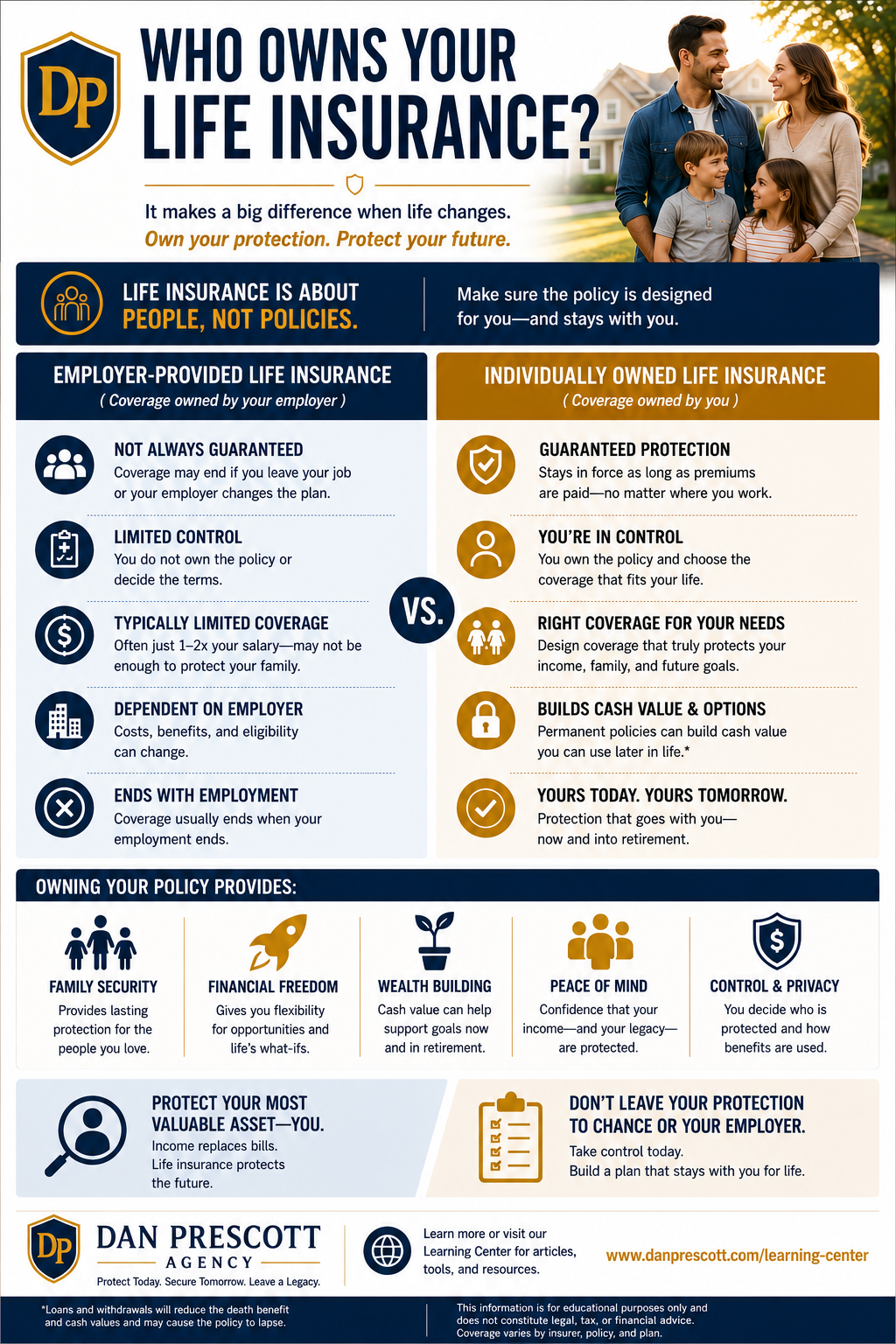
Employer-provided life insurance can be an excellent benefit.
If your employer provides basic coverage at little or no cost, take advantage of it. If reasonably priced supplemental group coverage is available and fits your needs, it may also be valuable.
Group insurance is not the problem. Depending on it as your entire long-term protection strategy can be.
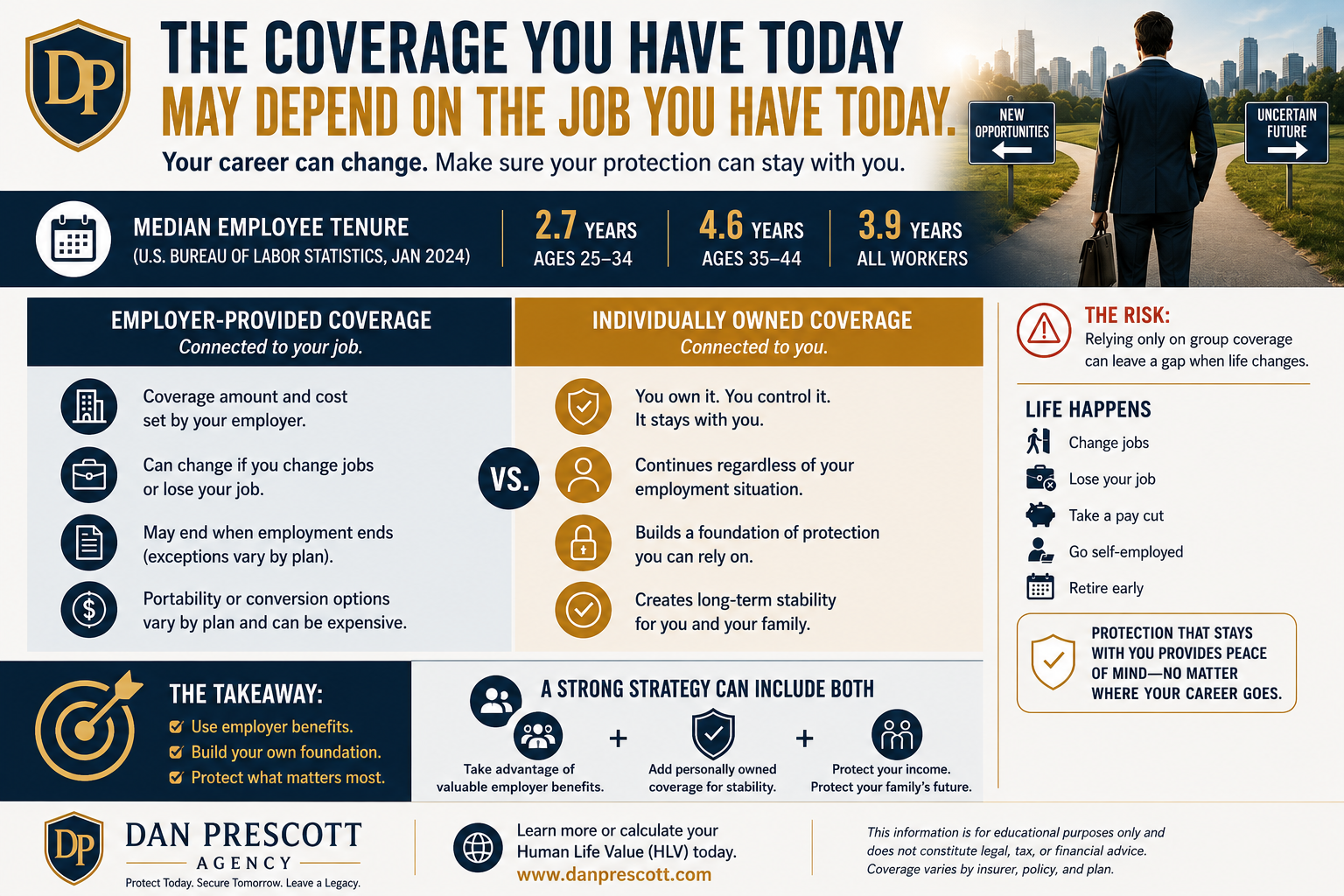
The distinction is important. Employer coverage is connected to your employment and the terms of the employer’s plan. Personally owned life insurance is connected to you.
That difference may not seem important when you are 32, healthy, employed, and building your career. It can become very important later.
How employer and personally owned coverage can work together
Careers Change. Your Need for Protection May Not.
According to the U.S. Bureau of Labor Statistics, median employee tenure in January 2024 was 3.9 years. For workers ages 25–34, median tenure was 2.7 years. For workers ages 35–44, it was 4.6 years.
Changing jobs is a normal part of a modern career, and every time employment changes, benefits can change too.
The next employer may offer excellent life insurance. It may offer less. There may be a period between jobs. A layoff may occur. Someone may become self-employed. Or a new employer’s plan may simply work differently.
Some group policies may offer portability or conversion options, but availability, cost, deadlines, and terms depend on the specific plan. That is why employees should read their actual benefit documents rather than assuming coverage automatically follows them.
The Coverage You Have Today May Depend on the Job You Have Today
The Problem May Not Appear Until Years Later
Consider someone who is 35 and relies primarily on employer life insurance. The coverage seems adequate, so purchasing an individual policy does not feel necessary.
Ten years pass. At 45, the person changes jobs or is laid off. Now the employer coverage is gone or substantially different.
But something else has changed too: the person applying for individual coverage is no longer 35.
Perhaps health has changed as well. Insurance that might have been available ten years earlier may now cost more. Depending on health and underwriting, some options may be limited or unavailable.
That is the potential group-life-insurance trap. It is not that group insurance is bad. It is assuming that coverage connected to today’s job will necessarily provide the protection you need throughout tomorrow’s career.
WHO OWNS YOUR LIFE INSURANCE?
Barrier #4: “Life Insurance Is Too Confusing.”
Term. Permanent. Whole life. Riders. Conversion privileges. Cash value. Underwriting classes. Death benefits.
It is easy to understand why someone who does not work with insurance every day might decide, “I’ll figure this out later.”
But you do not need to understand every insurance product before beginning. In fact, starting with products is often the wrong approach.
Start with your life.
Who depends on my income?
What financial obligations would continue if I were not here?
How long would those obligations exist?
What resources would my family already have?
What would happen to the plans we are building for the future?
Once those questions are understood, insurance becomes easier to evaluate.
The goal is not to become an insurance expert. The goal is to understand enough to make an informed decision.
Group Insurance and Individual Insurance Can Work Together
This does not have to be an either/or decision.
A protection strategy might include employer-provided insurance, supplemental group coverage, and personally owned insurance. The appropriate combination will be different for every person.
Someone may use individual term insurance to protect a mortgage, replace income during working years, or provide protection while children are financially dependent. Someone else may include permanent life insurance for lifelong protection, legacy planning, or other long-term financial objectives. Another person may use a combination.
The important question is not, “Which insurance product is best?” It is, “What am I trying to protect, for how long, and what combination of coverage accomplishes that responsibly?”
Understand the differences between term and permanent coverage.
Four Questions Worth Asking Today
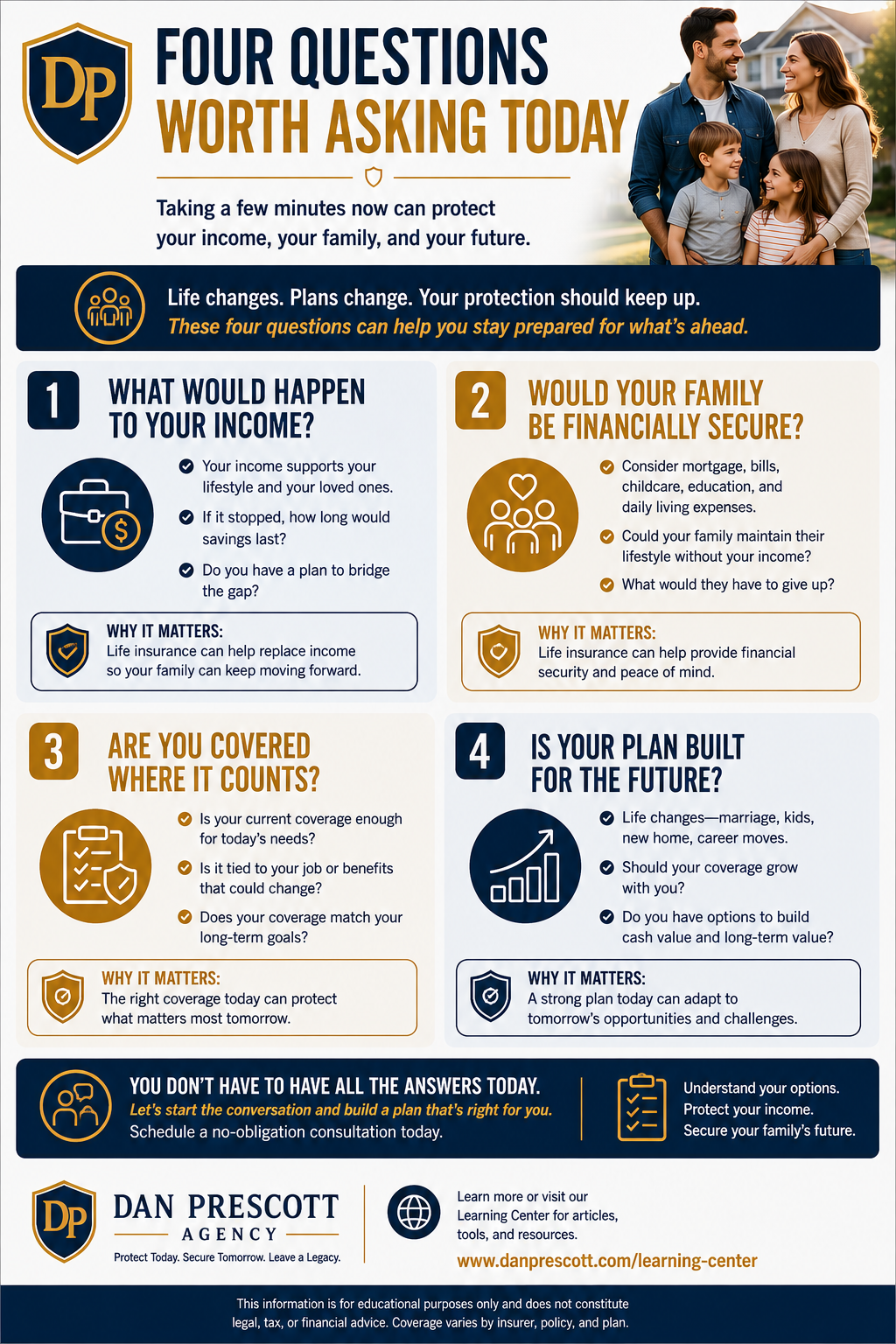
You do not need to purchase anything to begin evaluating your protection. Start by answering four questions:
1. How much life insurance do I actually have?
Do not guess. Look at your employer benefits and any personally owned policies.
2. What happens to my employer coverage if I leave my job?
Find out whether it terminates, can be continued, is portable, or can be converted — and what deadlines and costs may apply.
3. Would my current coverage actually replace the financial value my family depends on?
Think beyond final expenses. Consider income, mortgage obligations, debt, children, education, retirement savings, and future financial goals.
4. How much of my protection do I personally own?
If your employment changed tomorrow, what coverage would remain with you?
FOUR QUESTIONS WORTH ASKING TODAY
Protecting What Makes Everything Else Possible
Most of us would never intentionally leave our home uninsured. We would not drive without the coverage required to protect ourselves and others. We understand the financial consequences of losing or damaging those assets.
But those things can be replaced. Your future income cannot.
For someone in their 30s or 40s, decades of earning, saving, and providing may still lie ahead. Those future earnings can represent one of the largest financial resources a family will ever have.
That is why life insurance deserves to be considered differently. Not because everyone needs the same policy. Not because everyone needs the same amount. And certainly not because one insurance product is right for everyone.
It deserves consideration because you are the financial engine behind much of what you are working to build and protect.
Before deciding that life insurance is too expensive, that you are too young, that employer coverage is enough, or that the subject is simply too complicated, take the time to understand what you are protecting.
Your home matters. Your vehicles matter. Your savings matter. Your retirement matters. Your family’s future matters.
But the asset that makes so much of it possible is you.
Protect the Asset That Makes Everything Else Possible.
Not sure how much of your future income you are actually protecting? Start by estimating your Human Life Value, then compare that estimate with the coverage you currently have through work and any policies you personally own.
Educational Disclaimer: This article is for educational purposes only. Life insurance products, features, costs, underwriting requirements, portability, conversion provisions, and employer benefit terms vary by insurer, policy, and plan. Review your employer benefit documents and your individual circumstances before making insurance decisions.