
Financial Underwriting: Why the Amount of Life Insurance Matters
EDUCATIONAL ARTICLE
8 min read | Category: Life Insurance Basics
When people think about life insurance underwriting, they usually think about health: medical history, medications, height and weight, family history, and perhaps a medical exam.
But insurance companies also ask another important question: Does the amount of life insurance being requested make financial sense?
That part of the process is called financial underwriting.
Why Insurance Companies Review Your Finances
Life insurance is intended to protect against financial loss resulting from someone's death. Because of that, an insurance company must be able to reasonably link the requested amount of coverage to a legitimate financial need.
Current income
Age and remaining working years
Existing life insurance
Household income and financial obligations
Mortgage and other debts
Assets and net worth
Business interests
Estate or legacy-planning needs
The purpose of the proposed coverage
For larger policies, additional financial documentation may also be requested. The goal isn't to determine whether someone is "wealthy enough" to own life insurance. It is to determine whether the amount being requested is financially reasonable and supportable.

Financial Underwriting
Income Multiples Are Guidelines - Not One Universal Formula
For income-replacement coverage, carriers commonly use age-based income multiples as an initial guideline. A younger person generally has more future earning years to protect, so a larger multiple of current income may be financially justified. As someone gets older and has fewer remaining working years, the guideline generally decreases.
However, there is no single income-multiple formula used by every insurance company. Carrier guidelines differ, and an underwriter considers the applicant's overall circumstances. That is one reason selecting an appropriate carrier and establishing the purpose of the coverage before submitting an application can be important.
The following example shows how one carrier’s income-replacement guidelines can change with age. Other carriers use different multiples and underwriting criteria.
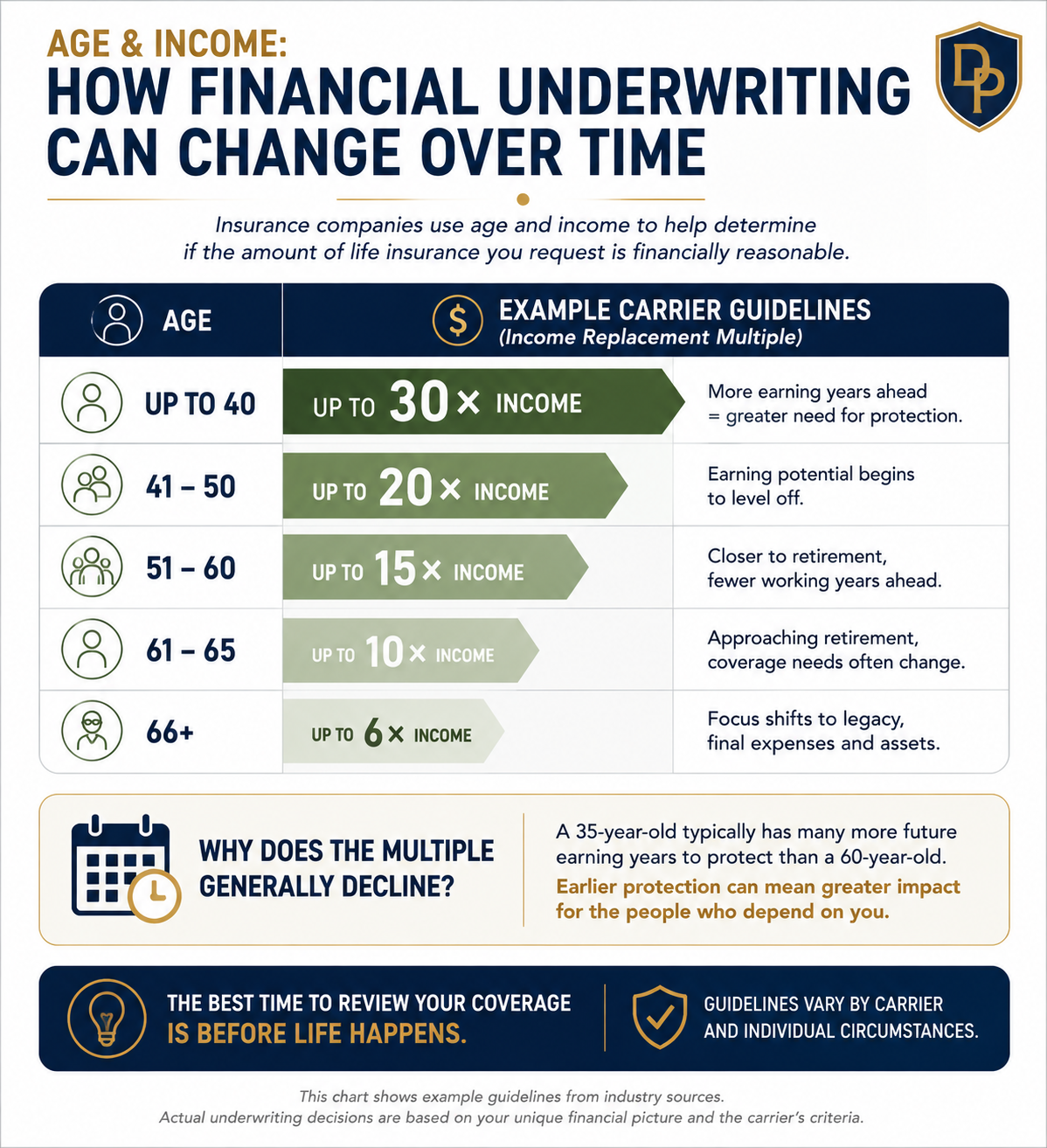
Financial Underwriting Over Time
What About a Stay-at-Home Spouse or Partner?
This is an important exception to the idea that life insurance is based only on someone's paycheck. A spouse or partner who does not earn an outside income may still make a substantial economic contribution to the household.
Childcare
Transportation and school responsibilities
Meal preparation and household management
Care for children or other family members
The working spouse's ability to continue working the same hours
Future family and education needs
Insurance companies recognize this financial value. Depending on the carrier and circumstances, coverage for a stay-at-home spouse may be evaluated in relation to the working spouse's coverage, household income, family obligations, net worth, mortgage needs, children, and the total amount of insurance already in force.
Some carriers may consider coverage comparable to the working spouse's amount in appropriate circumstances, while others use different limits or guidelines.
No paycheck does not mean no financial value to the family.
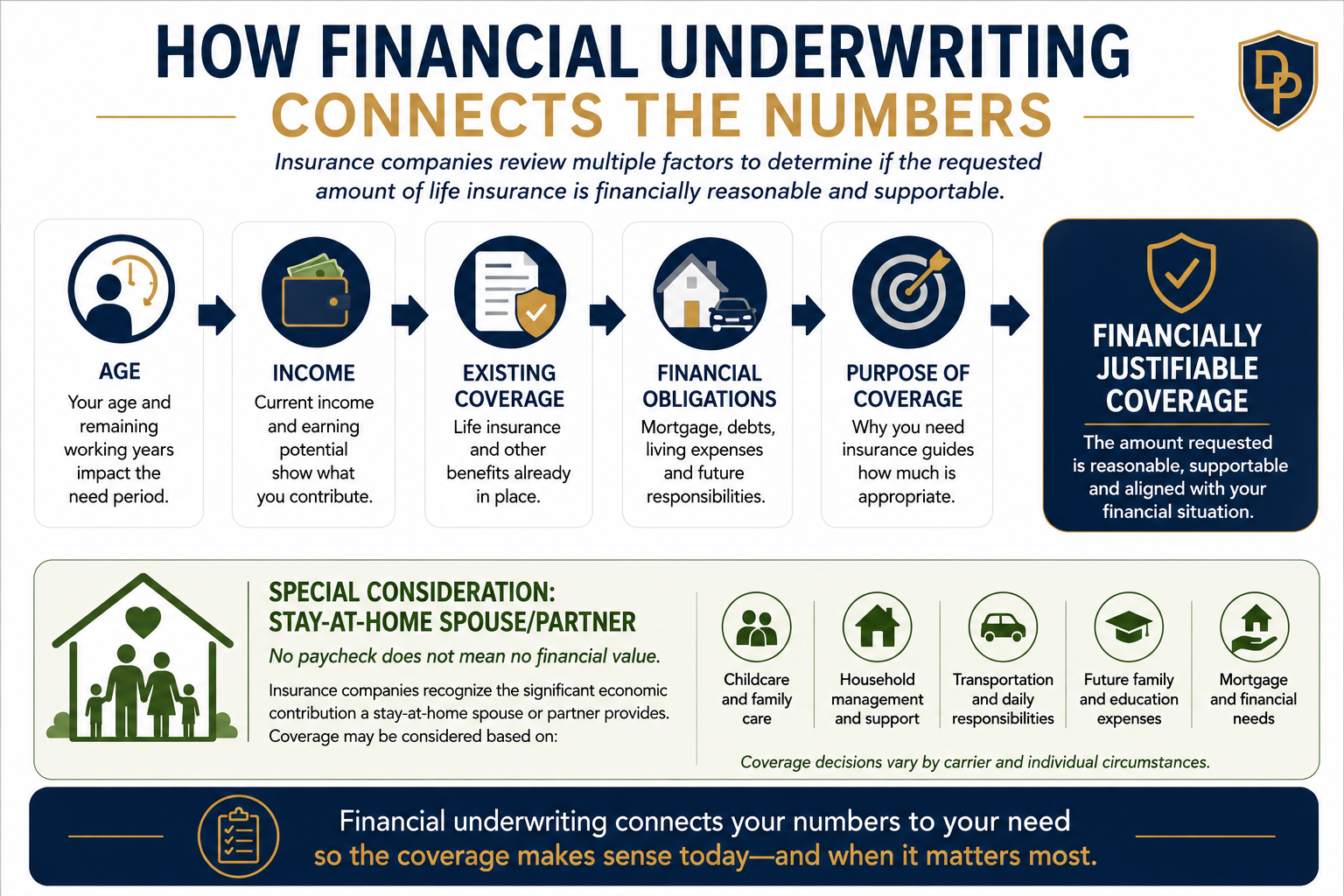
Financial Underwriting By The Numbers
Why Being Accurate Up Front Matters
Financial information on a life insurance application should be accurate and realistic. Requesting substantially more coverage than the financial circumstances appear to support can result in additional questions, requests for documentation, a reduction in the amount offered, or other underwriting complications.
Conversely, understating income, assets, existing coverage, or the purpose of the insurance can prevent the agent and carrier from properly evaluating the case.
The better approach is simple: Determine the need first. Then apply for an amount that can be clearly explained and financially supported.
Preparation Can Make Underwriting Easier
1. What are we protecting? Income, family obligations, a mortgage, business interests, retirement or estate needs?
2. How much protection is reasonable? The amount should connect logically to the financial need.
3. Can we explain the numbers? If an underwriter asks why a particular amount was requested, there should be a clear answer.
Financial underwriting shouldn't come as a surprise after an application has already been submitted. A little preparation at the outset can help establish realistic expectations, identify potential underwriting questions, and streamline the application process.
The Bottom Line
Life insurance companies evaluate both medical risk and financial justification. The objective is not simply to qualify for the largest policy possible. It is to establish an appropriate amount of protection for the people, income, responsibilities, and financial future that matter to you.
Start with the need. Understand the numbers. Then build the coverage around them.
Have questions about how financial underwriting may affect the amount of life insurance you can apply for? Contact Dan Prescott Agency before you apply. We can help you understand the process and prepare realistic expectations.
Educational Disclaimer
Life insurance underwriting guidelines vary by insurance company, product, age, financial circumstances, and purpose of coverage. Examples and guidelines presented here are for general educational purposes and do not guarantee that a particular amount of coverage will be approved.