
LISTEN TO THIS ARTICLE · Approx. 8 minutes
Audio narration generated from the written article using an automated voice-over
Life Insurance Is About More Than a Death Benefit
When most people hear the words life insurance, they think of one thing: money paid to their family when they die.
That remains the foundation of life insurance. A death benefit can help replace income, pay a mortgage, support children, reduce debt, and protect the financial future a family was building.
Depending on the policy type and benefits selected, life insurance may also provide financial protection while you are living.
That changes the question from simply
“How much life insurance do I need?” to a broader question: “What financial risks am I trying to protect against throughout my life?”
Protecting the Life Your Family Is Living
For many working adults, one of their largest financial assets is not their home or retirement account. It is the income they have not yet earned.
We insure our homes. We insure our cars. We insure many of the things we've worked hard to acquire. But what about the person whose income makes those things possible?
For many families, the ability to earn income may be worth considerably more over a lifetime than the house they live in or the car they drive. Cost matters, and life insurance has to fit the household budget. But viewing coverage only as another expense can make it easy to overlook what is actually being protected: one of the family's most valuable financial assets - the ability to earn income.
That future income helps pay for housing, daily expenses, education, retirement savings, debt repayment, and the lifestyle a family is building.
Life insurance cannot replace a person, but it can help replace part of the financial value that person would continue to provide.
This is also the idea behind Human Life Value: understand what could be financially lost before deciding which insurance approach may be appropriate.
Term Insurance: Protection During High-Responsibility Years
Term life insurance generally provides death-benefit protection for a specified period. For a younger family, those years may coincide with some of its greatest financial responsibilities: a mortgage, young children, college funding, household debt, retirement savings, and many years of income still ahead.
Although the insured does not personally receive the death benefit, term insurance protects the family's current financial life and the one it plans to continue.
And term and permanent insurance do not necessarily have to be an either/or decision.
Permanent Protection + Temporary Protection
Some permanent life insurance policies can be supplemented with a term rider. A term rider adds temporary death-benefit protection to the permanent policy. Availability, cost, duration, renewal terms, and conversion options vary by policy and carrier.
A simplified example:
$150,000 Permanent Life Insurance
+ $850,000 Term Protection
= $1,000,000 Total Death-Benefit Protection
Illustrative example only. The purpose is to show how permanent and temporary protection may be layered—not to recommend a specific coverage amount.
A family's need for a large amount of protection today may decline over time as the mortgage balance decreases, children become independent, savings grow, retirement assets accumulate, and fewer working years remain to be protected.
The larger lesson: Term insurance and permanent insurance can complement one another rather than compete.
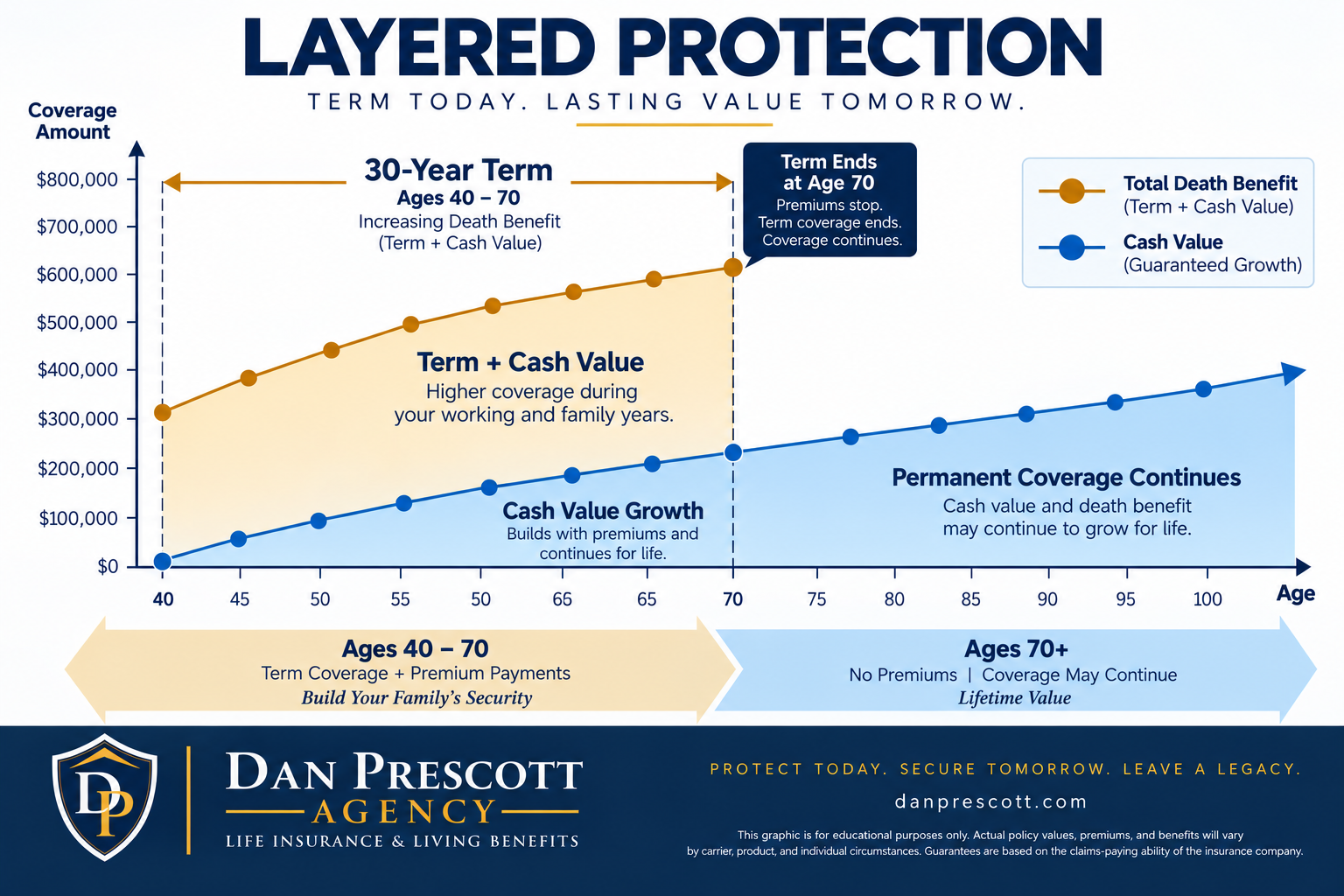
Permanent Protection + Temporary Protection
What If You Live?
Premature death is not the only financial risk a family may face. What happens if you develop a serious illness, need long-term care, face an unexpected financial need, live well into retirement, or need additional financial flexibility later in life?
Depending on the policy, life insurance may address some of these risks through living-benefit provisions, riders, and cash value.
Living Benefits: Financial Protection During Your Lifetime
The term “living benefits” is commonly used to refer to certain life insurance benefits that may become available before death. These benefits vary by policy and should not be confused with traditional health insurance.
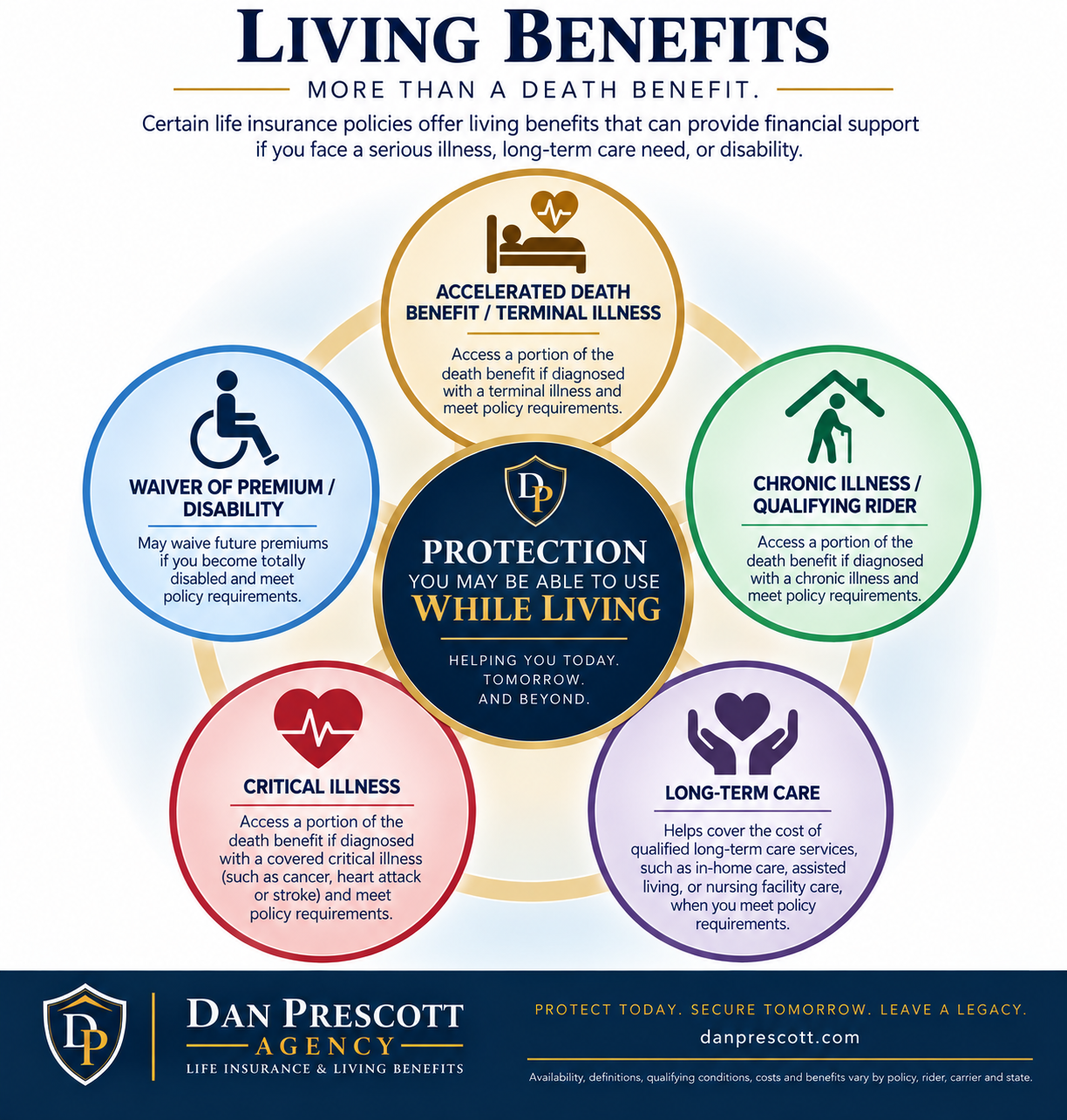
Financial Protection During Your Lifetime
Permanent Life Insurance May Build Cash Value
Whole life, universal life, and variable life insurance may include cash value, but how that value develops, what is guaranteed, and how policy risk is allocated vary by product and contract. Depending on the policy, cash value may provide additional financial flexibility.
Emergency or unexpected financial needs
Temporary cash-flow requirements
Financial opportunities
Potential supplemental retirement needs
Other long-term financial objectives
This means a permanent policy may serve two functions: death-benefit protection and the accumulation of policy value.
But the two are connected. Policy loans and withdrawals can reduce cash value and may reduce the amount ultimately paid to beneficiaries. Access to cash value is a capability—not free money.
A Different Kind of Financial Tool
Permanent life insurance can play a distinct role in an overall financial plan. Depending on policy type, design, and applicable tax law, potential characteristics include:
Tax-deferred growth of policy value
Access to cash value through withdrawals or policy loans
Death benefits that are generally excluded from a beneficiary's gross income, subject to exceptions
Potential supplemental retirement cash flow
Policy values that may behave differently from market-based investments, depending on the product
Life insurance should not automatically replace a 401(k), IRA, or Roth IRA, personal investments, emergency savings, or other appropriate financial assets. It may instead provide another financial bucket with different characteristics and rules.
Using Policy Value in Retirement
Permanent life insurance is sometimes structured so accumulated policy value can be accessed later in life. That may provide an additional source of financial flexibility within a broader retirement strategy alongside Social Security, employer retirement plans, IRAs and Roth accounts, personal savings and investments, and, when available, pensions.
Life insurance is not automatically a retirement plan, and policy distributions are not automatically tax-free. Policy loans, withdrawals, cost basis, Modified Endowment Contract rules, lapse, surrender, and policy performance can materially affect the outcome.
Your Whole Life Coverage
“Your Whole Life Coverage” does not mean Whole Life Insurance is appropriate for everyone. It means thinking about protection across your whole financial life.

Whole Life Coverage
Life Insurance Is About Life
Life insurance will always have one fundamental purpose: protecting against the financial consequences of death.
But its usefulness does not necessarily begin at death.
Depending on how coverage is designed, life insurance may combine family protection, income protection, health-related financial protection, cash-value accumulation, access to financial resources, supplemental retirement flexibility, and legacy planning.
For some families, straightforward term insurance may be exactly what is needed. Others may benefit from combining temporary and permanent protection. Still others may have a reason to consider specific living-benefit or long-term-care provisions.
A Good Place to Start
Before deciding which type of life insurance may fit, consider the financial value of what you are protecting.
Educational Disclaimer: This article is for general educational purposes only and is not intended as individualized insurance, tax, legal, or financial advice. Policy features, guarantees, riders, cash values, loans, withdrawals, and tax treatment vary by insurer and contract. Policy guarantees are subject to the terms of the contract and the claims-paying ability of the issuing insurance company.
Sources & References
NAIC — general Life Insurance consumer guidance
IRS — life-insurance proceeds/tax treatment
IRS Publication 525 — distributions, surrender, accelerated benefits
Washington OIC — general life insurance consumer guidance