
When the Time to Rebuild Becomes Shorter
For much of our working lives, the financial goal is to build: earn income, save, and give assets time to grow. By our 50s and 60s, that goal often begins to change. We may have a well-funded retirement account, a pension, home equity, or savings accumulated over decades. But the years available to replace a financial loss through future earnings are shrinking.
A major financial setback in retirement can be different from one experienced at age 35. Savings may already be supporting household expenses, and the ability to rebuild them can be limited. That makes a question increasingly important: how much future financial gain are we willing to trade for greater contractual certainty and protection?
For some households, participating whole life insurance deserves consideration—not because it is the highest-returning investment, but because a carefully designed insurance contract may combine guaranteed values, permanent protection, and access to money during life. Those benefits come with real costs and limitations, and they are not appropriate for every household.

Diversification Means More Than Pursuing Growth
For someone approaching retirement, diversification can also mean having financial resources that behave differently, carry different guarantees, and are accessed in different ways. Traditional participating whole life can complement—not replace—liquid reserves, retirement accounts, or other investments.
Contractual cash values are not priced daily against stock or bond indexes. The insurer invests general-account assets to support its obligations, so interest rates and investment experience can influence future dividend scales. Thus, policy cash values are not accurately described as completely “uncorrelated returns”: guarantees differ from market pricing, but dividends are not immune to financial conditions.
Cash value inside qualifying life insurance generally grows without annual personal income tax. A properly structured non-MEC policy may allow generally tax-free loans while it remains in force and withdrawals up to adjusted basis under applicable rules. Taxes may arise on other distributions or after surrender or lapse with outstanding debt. Unlike taxable bank interest, qualifying internal policy growth is generally not taxed annually; unlike the post’s broad market comparison, unrealized stock gains generally are not taxed annually either.
During a downturn, available policy cash value may provide an alternative source of money rather than requiring immediate sales of depressed investments. Borrowing costs, remaining collateral, lapse risk, and the possibility that markets do not recover must be considered. The value of the option lies in added flexibility—not a promise of superior investment performance.
The Value of a Guarantee—And Its Price
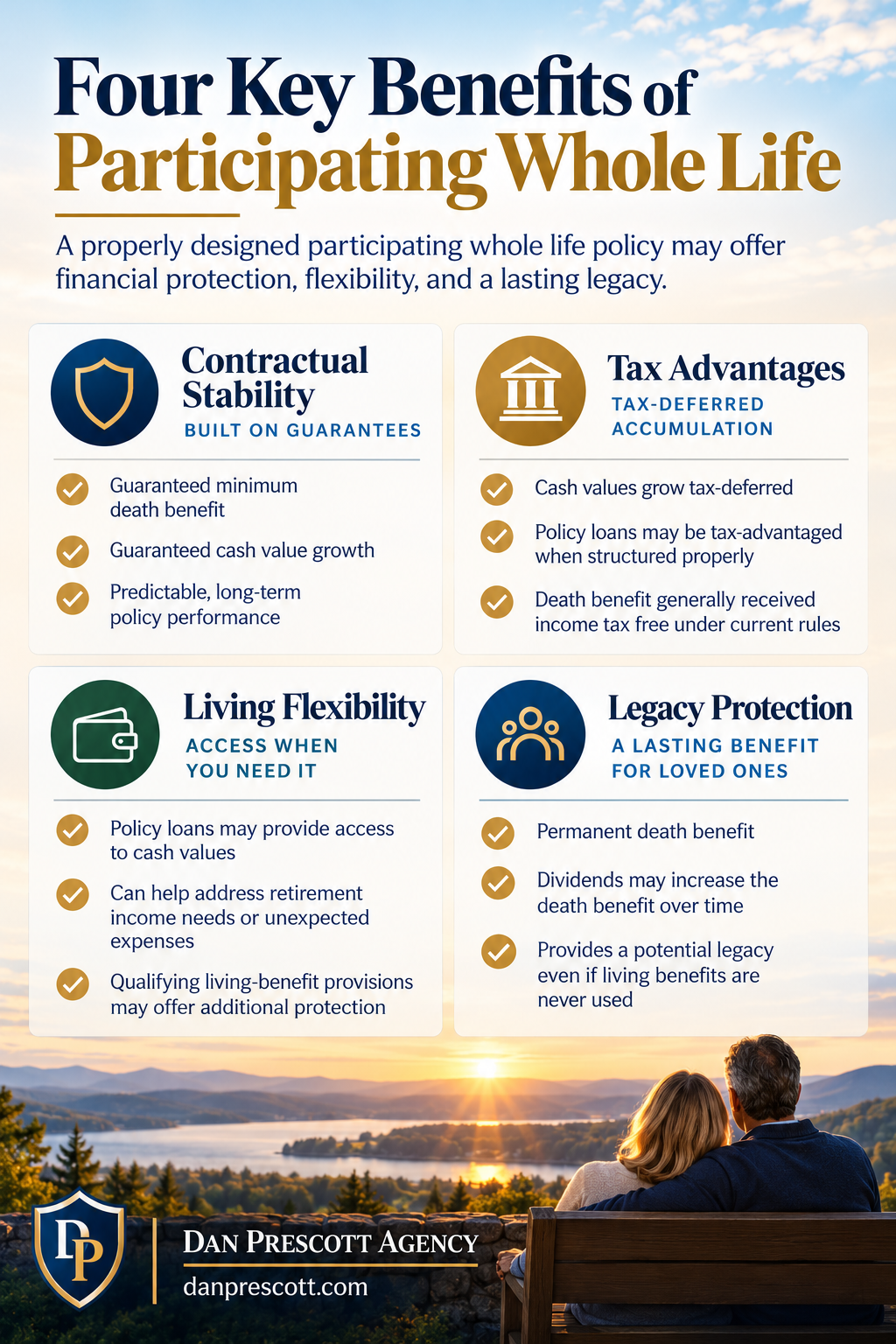
Traditional whole life generally establishes a premium arrangement, a guaranteed minimum cash-value schedule, and a guaranteed base death benefit, provided policy conditions are met. A participating policy may also pay dividends, which are not guaranteed. Contractual guarantees depend on the issuing insurer’s claims-paying ability.
The distinction matters: guaranteed cash values are not the same as guaranteed profit, and early surrender values can be lower than premiums paid. A policy is not a bank savings account, and its liquidity may involve loans, interest, or surrender consequences. The value proposition is protection and predictability relative to the commitments required—not a promise of superior investment performance
The Design Matters More Than the Product Name
Two participating whole life policies can have similar initial death benefits yet very different cash-value development and funding requirements. Base coverage, premium duration, paid-up additions, and available riders all affect the result. A design emphasizing early accessibility may differ substantially from one emphasizing the highest guaranteed death benefit.
At age 55 or 60, there is less time before retirement for a new policy to accumulate value. An established in-force policy may offer different options than a newly issued policy. A meaningful comparison therefore starts with the same goals and examines guaranteed cash surrender values, non-guaranteed projections, required premiums, and the remaining death benefit at later ages
When Cash Becomes Available Later in Life
An inheritance, a home downsizing, or proceeds from selling a business may create cash that was not part of an earlier financial plan. The first questions are practical: how much must remain accessible, what insurance protection is still needed, and how long could premium commitments be comfortably supported? Receiving a lump sum does not automatically make permanent insurance the right destination for it.
A newly funded single-premium policy is generally a modified endowment contract (MEC), which usually subjects loans and withdrawals to less favorable income-first tax treatment. A multi-year funding arrangement may be designed to avoid MEC status if applicable requirements are satisfied. A qualifying Section 1035 exchange may allow one existing life insurance contract—including some whole life, universal life, or variable life contracts—to be exchanged for another without immediate recognition of gain. Exchanges, existing debt, and MEC history need individual review; a 1035 exchange cannot automatically turn newly received cash into non-MEC single-premium funding.
An existing whole life, universal life, or variable life contract may in some situations be exchanged for another eligible life insurance policy under Section 1035 without immediate gain recognition. Such exchanges require review of coverage, existing loans, tax basis and MEC status; they are not a shortcut for placing new windfall proceeds into a single-premium non-MEC policy.
A Cash Windfall: Preserve Access While Funding Protection
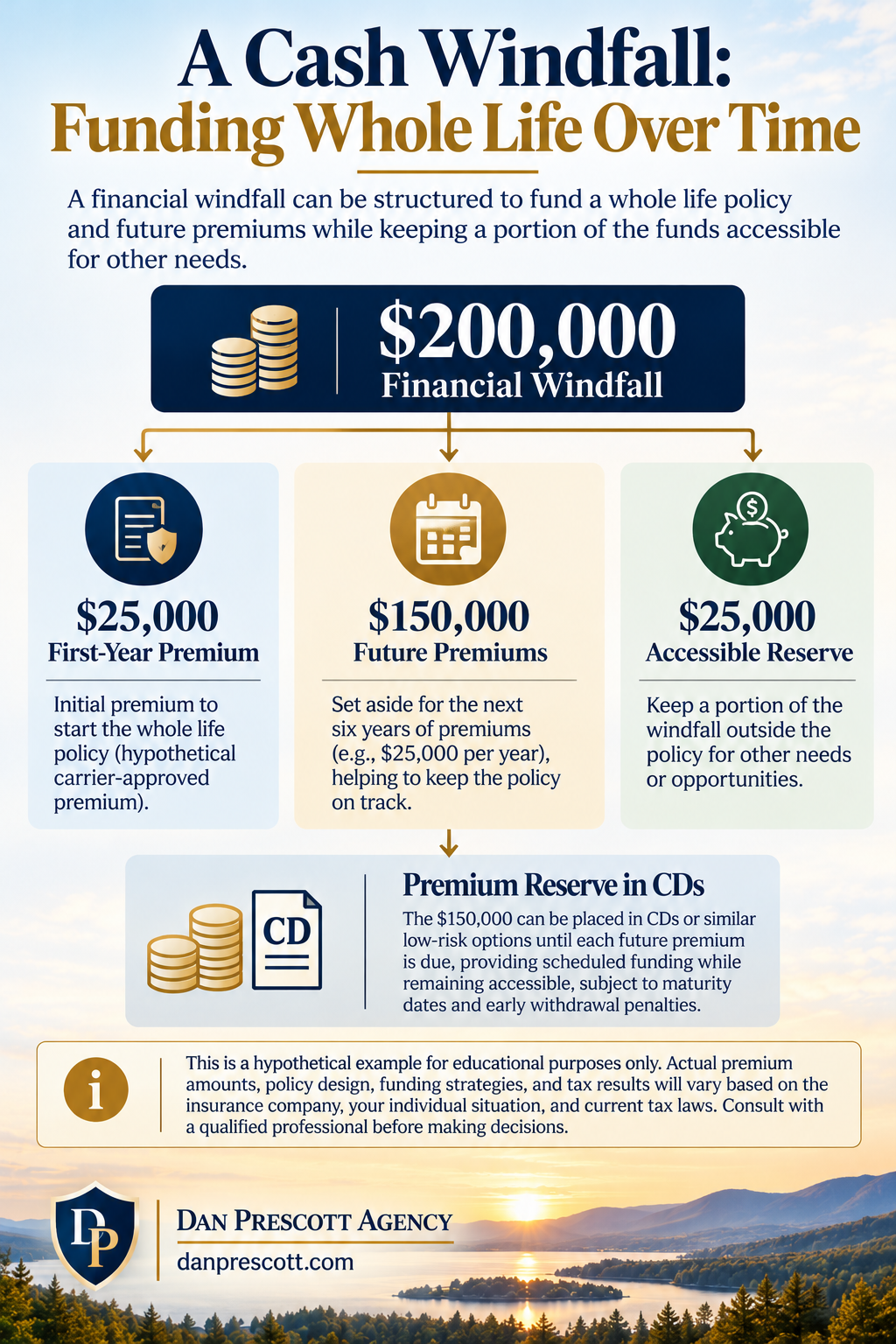
Consider a hypothetical $200,000 inheritance. Suppose a carrier verifies a non-MEC design permitting seven annual $25,000 premiums. The owner pays the first $25,000 into the policy and can hold $150,000 for six future premiums in a staggered certificate-of-deposit ladder, leaving $25,000 of the original principal outside the planned funding arrangement. Interest, taxes, and any expenses are not included in this simplified illustration.
The future-premium reserve remains owned outside the policy and may be accessible while the life insurance builds, but CDs can carry maturity restrictions and early-withdrawal penalties. Using those reserves for another purpose could prevent completion of the funding plan. The seven-pay MEC test is not a requirement to pay exactly seven premiums; every payment must comply with the carrier’s policy-specific cumulative limits, and later contract changes may trigger renewed testing.
This is an example of coordinating conservative premium reserves with policy funding—not a recommendation to commit a fixed share of a windfall to insurance. Annuity funding introduces separate surrender and tax considerations and should not be assumed interchangeable with CDs
What the Contract May Provide During Life
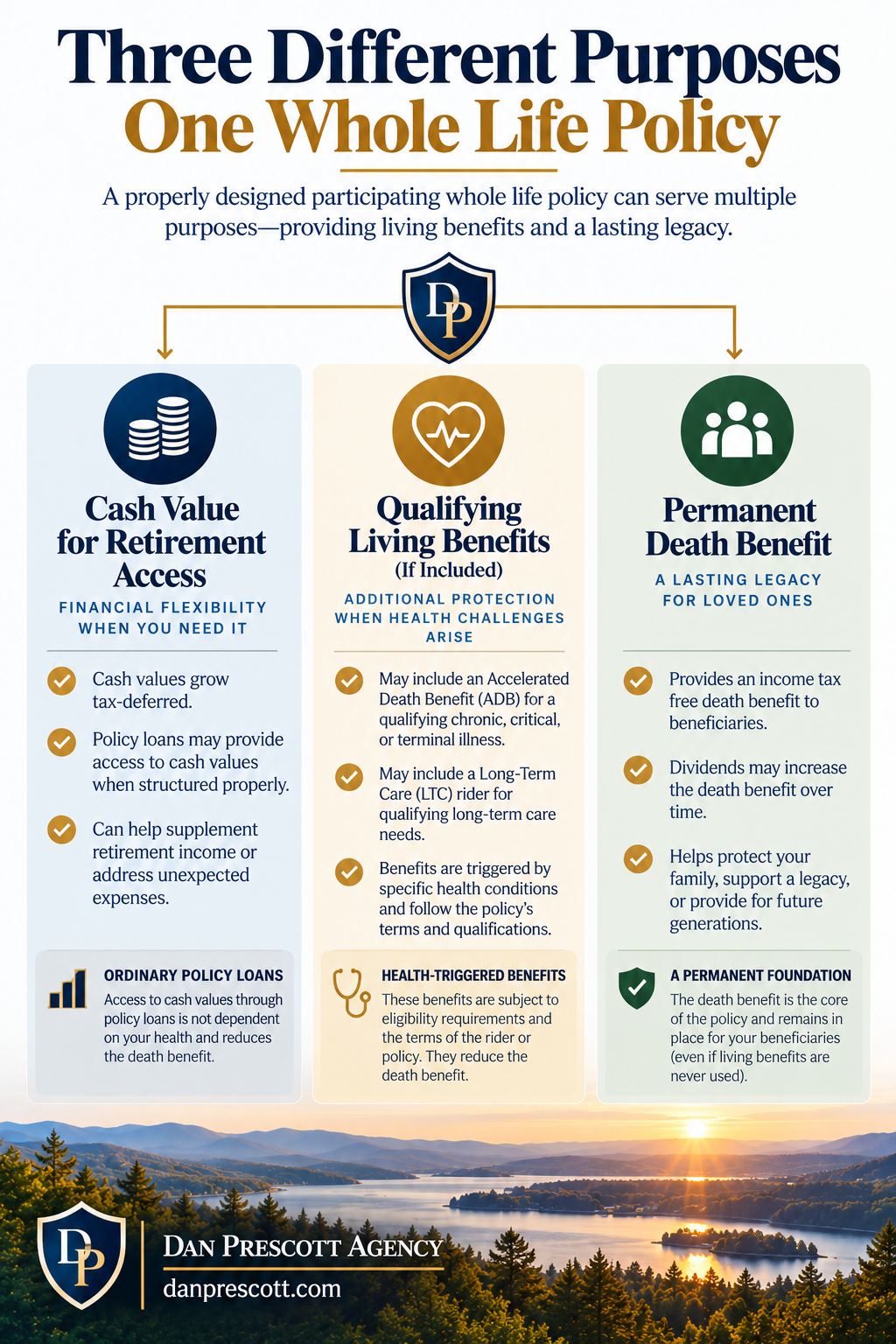
The principal living uses fit three different needs: cash-value access for retirement flexibility; specified health-related benefits for qualifying events where the policy or rider provides them; and a permanent death benefit that may remain for beneficiaries. Ordinary borrowing against cash value is not the same as an accelerated death benefit for illness.
A Retirement Cash-Flow Example: Policy Loans
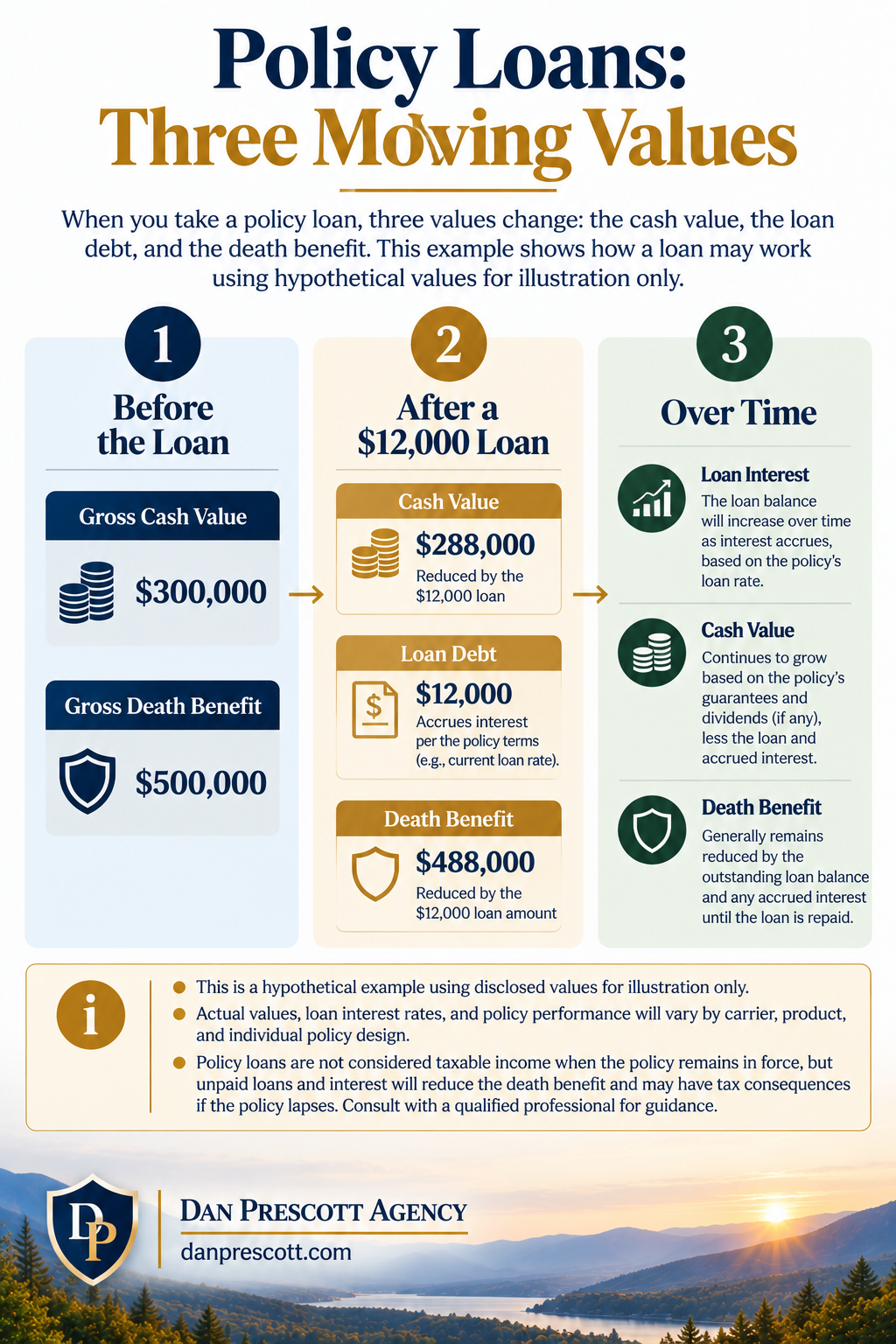
Consider a hypothetical policyowner who retires at age 65 with $300,000 of gross policy cash value and a $500,000 gross death benefit. The contract may permit a $12,000 loan in the first year—equivalent to $1,000 per month. This is a hypothetical illustration of mechanics, not a projection of an actual policy or a recommended borrowing amount.
The insurer advances funds secured by eligible cash value; the policyowner has not surrendered the same amount of insurance. The policy continues under its terms. But loan interest accrues, net cash value available for surrender or additional borrowing declines, and unpaid principal and interest generally reduce the death benefit payable to beneficiaries.
In a non-direct recognition participating policy, outstanding loans generally do not themselves change dividend treatment of loan-secured values; direct recognition policies adjust that treatment. Neither arrangement makes borrowing free or guarantees future dividends. Repeated loans can eventually cause lapse and a significant tax liability. A non-MEC loan is generally not currently taxable while the contract remains in force, but loans are not guaranteed retirement income.
Another Retirement Choice: Receive Cash Dividends
Some participating policies let the owner change a dividend election—from purchasing paid-up additions during working years to receiving future declared dividends in cash during retirement. Cash dividends do not create loan debt, but are not guaranteed. Taking them instead of purchasing additional paid-up insurance generally lowers future accumulation and death-benefit growth compared with continued reinvestment.
Participating life policy dividends are generally treated as a return of premium for federal income-tax purposes to the extent of adjusted basis; different consequences may arise after basis is recovered. Dividend elections and tax treatment depend on the contract and circumstances. A policyowner may also choose other available dividend uses, including premium or loan-interest reduction.
Tax-Deferred Accumulation Is a Feature, Not the Whole Answer
Cash value inside qualifying life insurance generally develops without annual personal income taxation. That may improve compounding compared with assets whose interest is taxed annually. However, not all securities gains are taxed each year, insurance protection has costs, and policy surrender or lapse may produce taxable income. The right comparison looks at actual accessible after-tax values and insurance benefits, not merely a projected dividend rate or a single illustrated internal rate of return.
This article does not recommend reallocating securities or replacing retirement accounts. Our earlier Learning Center article, “Supplement Your Retirement Income with Whole Life,” explains the complementary roles of taxable savings, retirement accounts, and permanent insurance.
What to Check Before Making a Long-Term Commitment
What financial protection or legacy need does the policy meet?
What resources must remain immediately available outside the policy?
What premiums must be paid, and what is guaranteed at years 5, 10, and 20?
Will the policy be a MEC, and what are the consequences of distributions?
What living-benefit riders are actually included, and what triggers them?
How do cash dividends, policy loans, interest, and loan recognition work?
What happens to the policy and net death benefit at ages 75, 85, and 95 under guaranteed and nonguaranteed assumptions?
Financial Flexibility Today. A Legacy Tomorrow.
An often overlooked feature is that a policyowner does not have to use every available living benefit. If cash-value loans, cash dividends, or health-related accelerated benefits are not needed, a properly maintained whole life policy may preserve a meaningful permanent death benefit for beneficiaries. Paid-up additions purchased with past dividends may increase that benefit, although future dividends are not guaranteed.
If living benefits are used, the tradeoff becomes visible: loans and interest generally reduce the net death benefit, and accelerated benefits reduce the amount ultimately payable. Whether used or left untouched, these choices make design—guaranteed values, funding obligations, riders, and liquidity—central to the protection-versus-gain discussion.
The Bottom Line
As the ability to replace lost earnings declines, protecting what has already been built may become as important as growing it. Participating whole life offers one possible combination of contractual values, financial flexibility, optional health-related benefits, and lasting death-benefit protection. The decision is not simply protection versus growth: it is whether the specific protections, guarantees, accessibility, and costs serve the policyowner’s changing needs.
The best starting point is education and an illustration designed around the individual—not a product label or an attractive projected return. Learn more at danprescott.com or contact Dan Prescott Agency to discuss the insurance features you want to understand.
Sources & References
26 U.S.C. § 7702A — Modified Endowment Contracts: https://www.law.cornell.edu/uscode/text/26/7702A
26 U.S.C. § 1035 — Certain Exchanges of Insurance Policies: https://www.law.cornell.edu/uscode/text/26/1035
IRS Publication 550 — Investment Income and Expenses: https://www.irs.gov/publications/p550
NAIC — Consumer guidance on life insurance: https://content.naic.org/insurance-topics/life-insurance
MassMutual — Dividend option change form: https://www.massmutual.com/efiles/life/pdfs/f6612.pdf
Lafayette Life — Whole Life products and policy design: https://www.westernsouthern.com/lafayette/products/life-insurance/whole-life-insurance
Additional IRS background: https://www.irs.gov/publications/p525
Educational information only. Not individualized insurance, legal, tax, or securities advice. Policy guarantees depend on the issuing insurer’s claims-paying ability and contract terms. Dividends are not guaranteed. Loans accrue interest, reduce available values and benefits, and can create tax consequences if a policy lapses or is surrendered.