
How Whole Life Insurance Can Supplement Your Retirement Income
When most people think about retirement planning, they immediately think of 401(k)s, IRAs, pensions, and Social Security. While these are often the foundation of a retirement strategy, they're not the only tools available.
For some individuals and families, participating whole life insurance can serve as a valuable supplement to traditional retirement savings. Although it isn't designed to replace investment accounts, it can provide financial flexibility, tax diversification, and lifelong protection when used as part of a broader financial plan.
The illustration below shows the basic path from funding a whole life policy to potentially using accumulated cash value as an additional source of retirement flexibility.
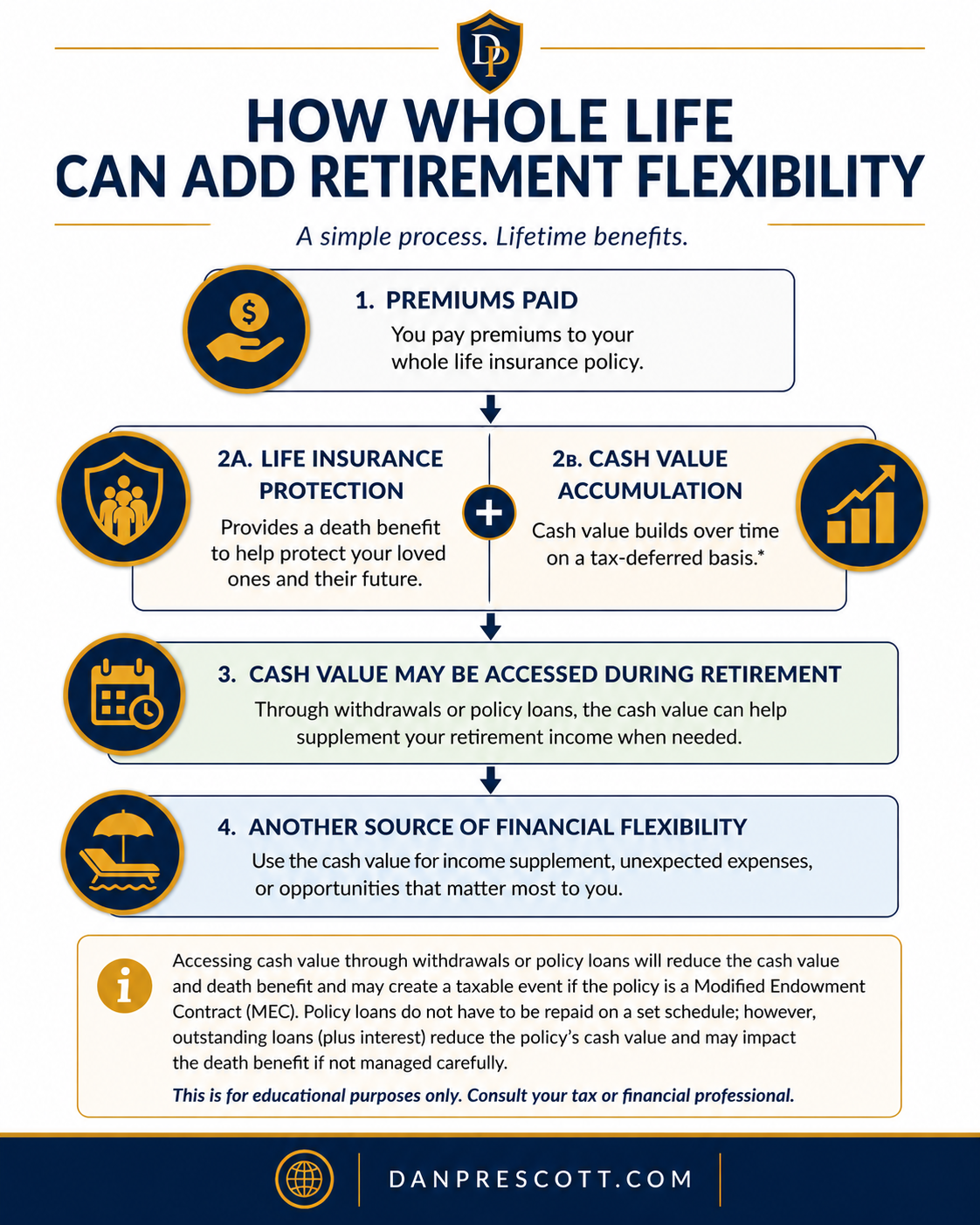
Whole Life Retirement Flexibility
Is Whole Life Insurance?
Whole life insurance is a type of permanent life insurance that provides lifelong coverage as long as required premiums are paid. Unlike term life insurance, whole life policies also build cash value over time.
Each premium you pay generally goes toward three purposes:
Providing the life insurance benefit
Covering the insurer's costs
Building cash value that grows over time
If the policy is issued by a mutual insurance company, it may also be eligible to receive dividends. While dividends are not guaranteed, many mutual insurers have paid them consistently over long periods.
How Can Whole Life Insurance Help During Retirement?
One of the unique features of whole life insurance is that its cash value can become a financial resource later in life.
As cash value accumulates over many years, policyowners may be able to access a portion of it through policy loans or withdrawals, depending on the policy's provisions. Many retirees use this feature to supplement other income sources, giving them additional flexibility in managing their finances.
Rather than relying solely on taxable retirement account withdrawals, some retirees appreciate having another source of available funds when needed.
Retirement income doesn't have to come from a single source. Different types of assets can provide different tax treatment, access, and flexibility.
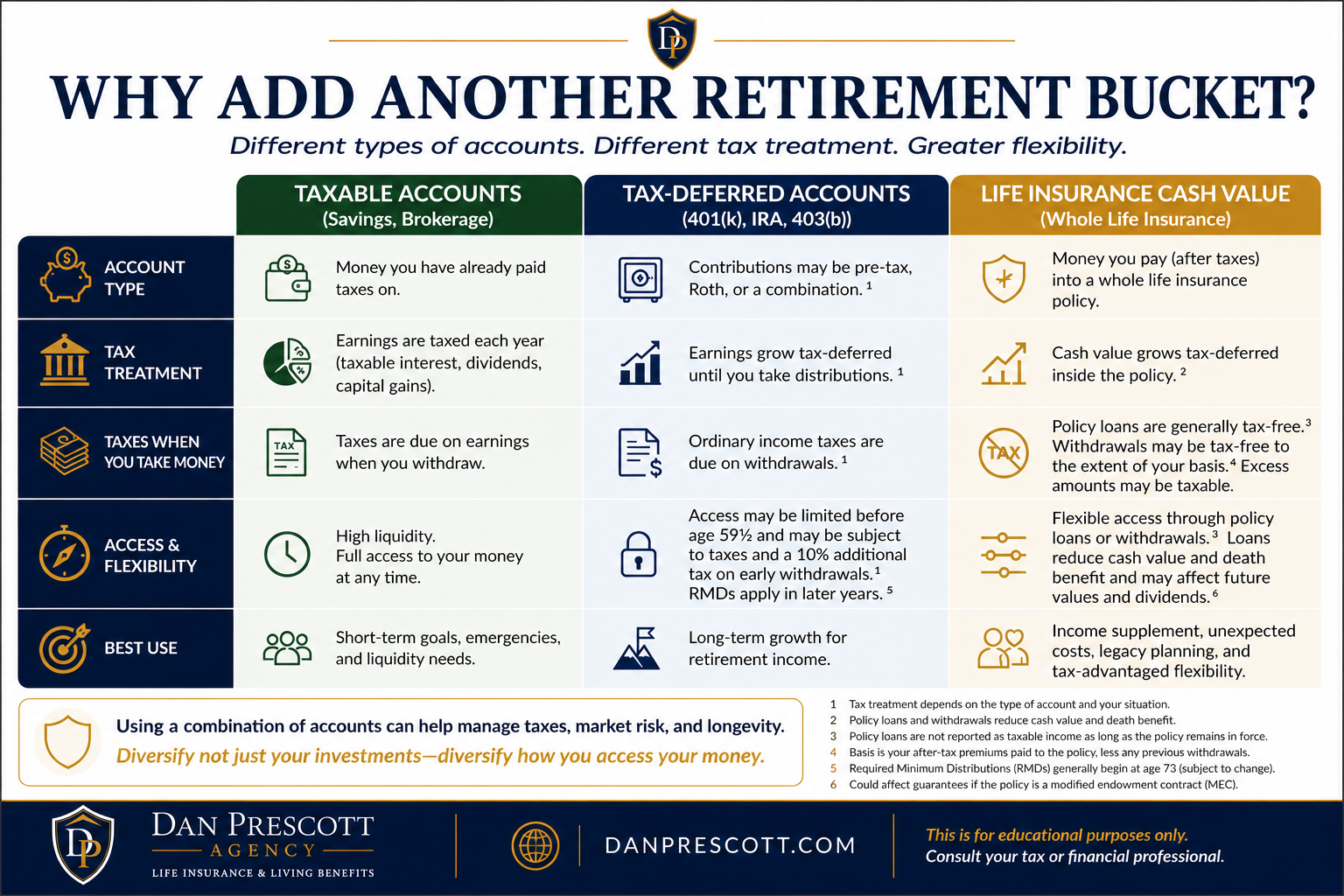
Retirement Buckets
Four Ways Whole Life Insurance May Complement Retirement
1. It Provides Tax Diversification
Many retirement accounts, including traditional IRAs and 401(k)s, are funded with pre-tax dollars. Withdrawals during retirement are generally subject to ordinary income tax.
Cash value from a properly structured whole life policy may be accessed through policy loans, which generally are not taxable as income as long as the policy remains in force. This can provide another option when planning retirement income.
2. It Is Not Directly Tied to Stock Market Performance
Market downturns can significantly affect retirement portfolios, particularly during the early years of retirement.
Whole life insurance offers guaranteed cash value growth under the terms of the policy, and its value does not fluctuate directly with daily stock market movements. This stability can provide peace of mind for people who want a portion of their assets in a more predictable vehicle.
3. It Can Increase Retirement Flexibility
Imagine the stock market experiences a significant decline just after you retire.
Instead of selling investments at reduced values, you may have the option of using policy loans from your whole life insurance to help cover living expenses. This flexibility may allow your investment portfolio more time to recover before you need to withdraw from it.
Every retirement situation is different, but having multiple income sources can expand your options.
4. It Leaves a Financial Legacy
Even if you access some of your policy's cash value during retirement, your beneficiaries may still receive a death benefit, depending on the amount borrowed and the policy's structure.
For many families, this means they can enjoy financial flexibility during retirement while still leaving a legacy for loved ones.
A Simple Example
Consider a couple in their early forties who purchase a participating whole life policy and consistently pay premiums throughout their working years.
By the time they retire in their mid-sixties, they have several potential income sources:
Social Security benefits
Retirement savings from a 401(k) or IRA
Personal savings and investments
Cash value accumulated within their whole life policy
During years when the investment markets are down, they may choose to use policy loans rather than selling investments at depressed prices. During stronger market years, they can rely more heavily on their investment portfolio.
This approach illustrates how multiple financial resources can work together rather than relying on a single source of retirement income.
Is Whole Life Insurance Right for Everyone?
No.
Whole life insurance is often best suited for people who:
Have a long-term planning horizon
Want lifelong life insurance protection
Value guarantees and financial stability
Are interested in building tax diversification
Have the financial ability to consistently pay premiums
On the other hand, individuals whose primary goal is maximizing investment growth or obtaining the largest death benefit for the lowest premium may find other financial products more appropriate.
Important Considerations
Like any financial strategy, whole life insurance has trade-offs.
Policy loans accrue interest and reduce the available death benefit if they remain unpaid. Excessive borrowing can cause a policy to lapse, potentially creating unexpected tax consequences. Cash value also takes time to accumulate, making whole life insurance a long-term planning tool rather than a short-term savings account.
Before purchasing any policy, it's important to understand how it fits within your overall financial objectives.
The Bottom Line
Retirement planning isn't about finding one perfect solution—it's about building a diversified strategy that can adapt to changing circumstances.
For the right individual, whole life insurance can provide more than lifelong protection. It can become another financial resource that complements retirement savings, offers tax diversification, provides stability during market volatility, and helps preserve a legacy for future generations.
Because every person's financial situation, family needs, and retirement goals are unique, there is no one-size-fits-all whole life policy. The way a policy is designed—including premium structure, dividend options, riders, and long-term funding strategy—can significantly impact how it performs over time. At Dan Prescott Agency, we work closely with clients to understand their goals and design a customized whole life insurance strategy that aligns with their retirement and legacy objectives. If you're ready to explore whether whole life insurance could play a role in your financial future, contact Dan Prescott Agency for a personalized consultation and professional guidance tailored to your needs.