
Permanent life insurance can become confusing long before a consumer ever compares two policies. Insurance companies use product names, crediting strategies, riders, dividend options, and marketing language to distinguish one design from another.
The marketing names change. The underlying insurance mechanics are much easier to understand.
At a fundamental level, the major choices differ in four areas: how guarantees work, how much premium flexibility the policy provides, how cash value may grow, and how much investment risk or ongoing policy management the owner accepts.
The purpose of this article is not to identify a universally “best” permanent policy. It is to give you a simple map of the major product families so you can recognize what you are looking at before the terminology becomes complicated
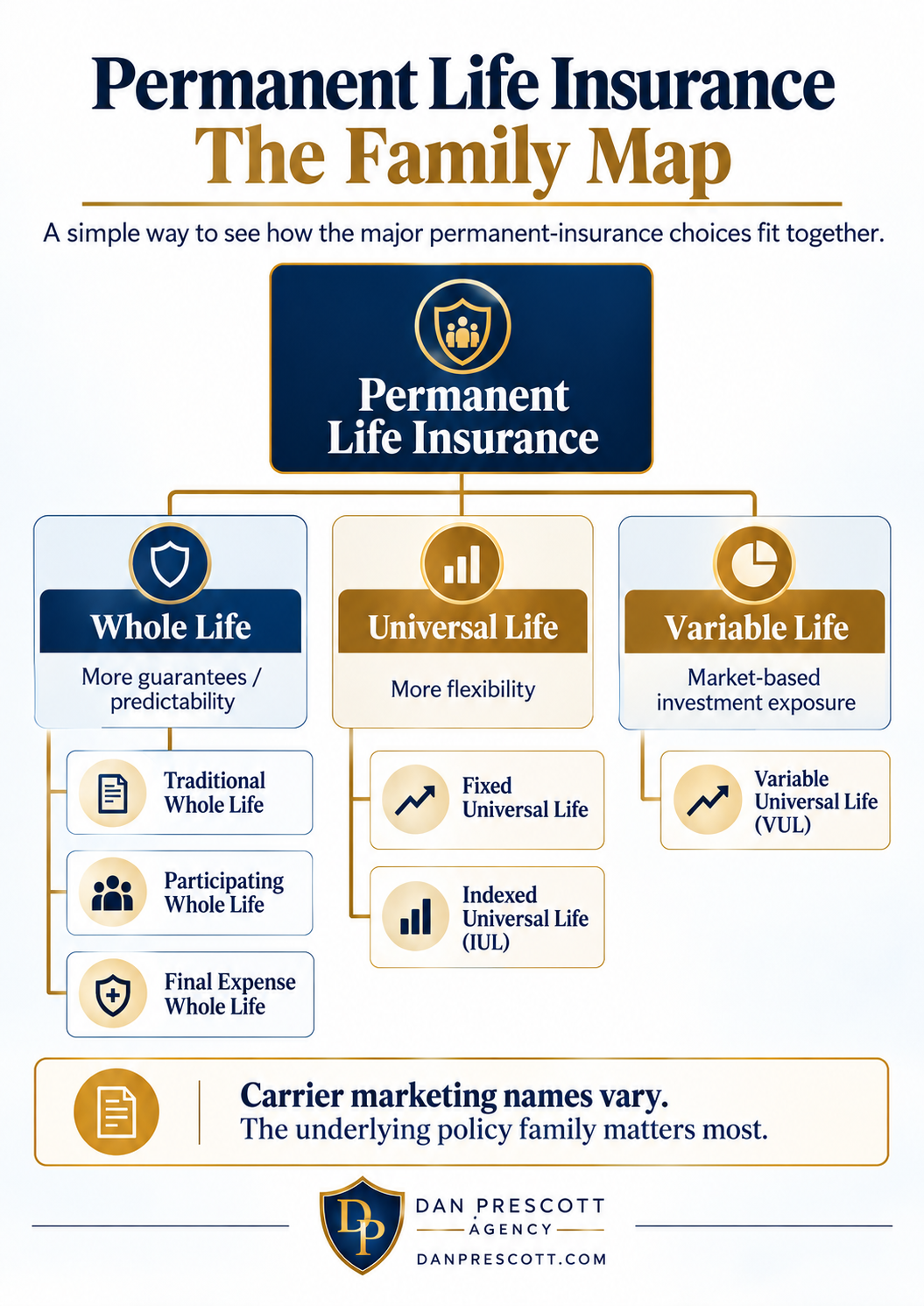
1. Traditional Whole Life Insurance
Traditional Whole Life is the foundation from which many permanent insurance concepts are easiest to understand. The basic structure has been used for well over a century, which is one reason its guarantees, reserve requirements, and long-term pricing approach are so established. You do not need the history to understand the product; the important point is that this is not a new financial concept created by recent marketing.
A traditional Whole Life policy is generally built around scheduled premiums, a guaranteed base death benefit, and guaranteed cash values. Its strength is predictability. Its tradeoff is that it offers less premium flexibility and less direct participation in market performance than newer permanent-insurance designs.
Best fit for: A client who says, “I want permanent protection, predictable guarantees, and very little ongoing policy management.”
Simple takeaway: Traditional Whole Life = maximum predictability.
2. Participating Whole Life Insurance
Participating Whole Life uses the same basic Whole Life foundation but adds the possibility of dividends when declared by the insurer. Dividends are not guaranteed. Depending on the policy, they may be taken in cash, used to reduce premium, accumulated, or used to purchase paid-up additional insurance.
This distinction matters because many discussions about “Whole Life” are actually describing participating Whole Life. The contractual guarantees and the dividend component should always be evaluated separately.
Best fit for: A long-term client who values Whole Life guarantees but also wants the potential for dividends and additional policy growth.
Simple takeaway: Participating Whole Life = Whole Life guarantees + potential dividends.
3. Fixed Universal Life
Fixed Universal Life is permanent insurance with a different architecture from Whole Life. It generally uses an account value that receives interest credits while the insurer deducts policy charges and the cost of insurance. Premiums may be more flexible than in traditional Whole Life.
That flexibility can be useful, but it also creates responsibility. “Flexible premium” does not mean the policy can be underfunded indefinitely. Crediting rates, charges, funding, and account value should be reviewed over time.
Best fit for: A client who wants permanent coverage and more funding flexibility, prefers fixed-interest crediting rather than direct market exposure, and is comfortable reviewing policy performance periodically.
Simple takeaway: Fixed Universal Life = permanent coverage + flexible funding + fixed-interest crediting.
4. Indexed Universal Life (IUL)
Indexed Universal Life, or IUL, is a form of Universal Life in which interest credits are linked to an external market index through a formula. The policy is generally not directly invested in the index. Crediting may be affected by caps, participation rates, spreads, floors, and other contract terms.
IUL can provide index-linked growth potential, but illustrated future values are not guaranteed. A zero-percent index floor also does not mean the account value can never decline because policy charges still apply.
Best fit for: A client who wants permanent insurance with index-linked growth potential, understands that illustrations are assumptions rather than guarantees, and is willing to monitor crediting terms and policy performance.
Simple takeaway: IUL = Universal Life with index-linked interest crediting.
5. Variable Life / Variable Universal Life (VUL)
Variable life insurance combines permanent insurance with investment choices. Cash value varies in part with the performance of investment options selected by the policyowner, commonly separate-account investment portfolios. Variable Universal Life, or VUL, adds the flexible premium structure of Universal Life.
Unlike traditional Whole Life or fixed-crediting Universal Life, the policyowner accepts direct investment risk. Values can rise or fall, and the policy generally requires more active monitoring.
Best fit for: A client with a permanent insurance need who understands markets, accepts investment volatility, has a long time horizon, and is willing to monitor both investments and policy sustainability.
Simple takeaway: Variable Life / VUL = permanent insurance + direct market investment risk.
6. Final Expense Whole Life
Final Expense usually describes the purpose and size of the coverage rather than a completely different insurance architecture. Many Final Expense policies are smaller Whole Life contracts with simplified underwriting and relatively modest death benefits.
They are commonly used for funeral and burial costs, final medical bills, modest debts, or a small legacy. Because underwriting may be simplified, the cost per dollar of death benefit can be higher than fully underwritten coverage.
Best fit for: A client who primarily needs a smaller permanent death benefit, values simplified qualification, or may have difficulty qualifying for larger fully underwritten coverage.
Simple takeaway: Final Expense Whole Life = smaller permanent coverage designed primarily for end-of-life expenses.
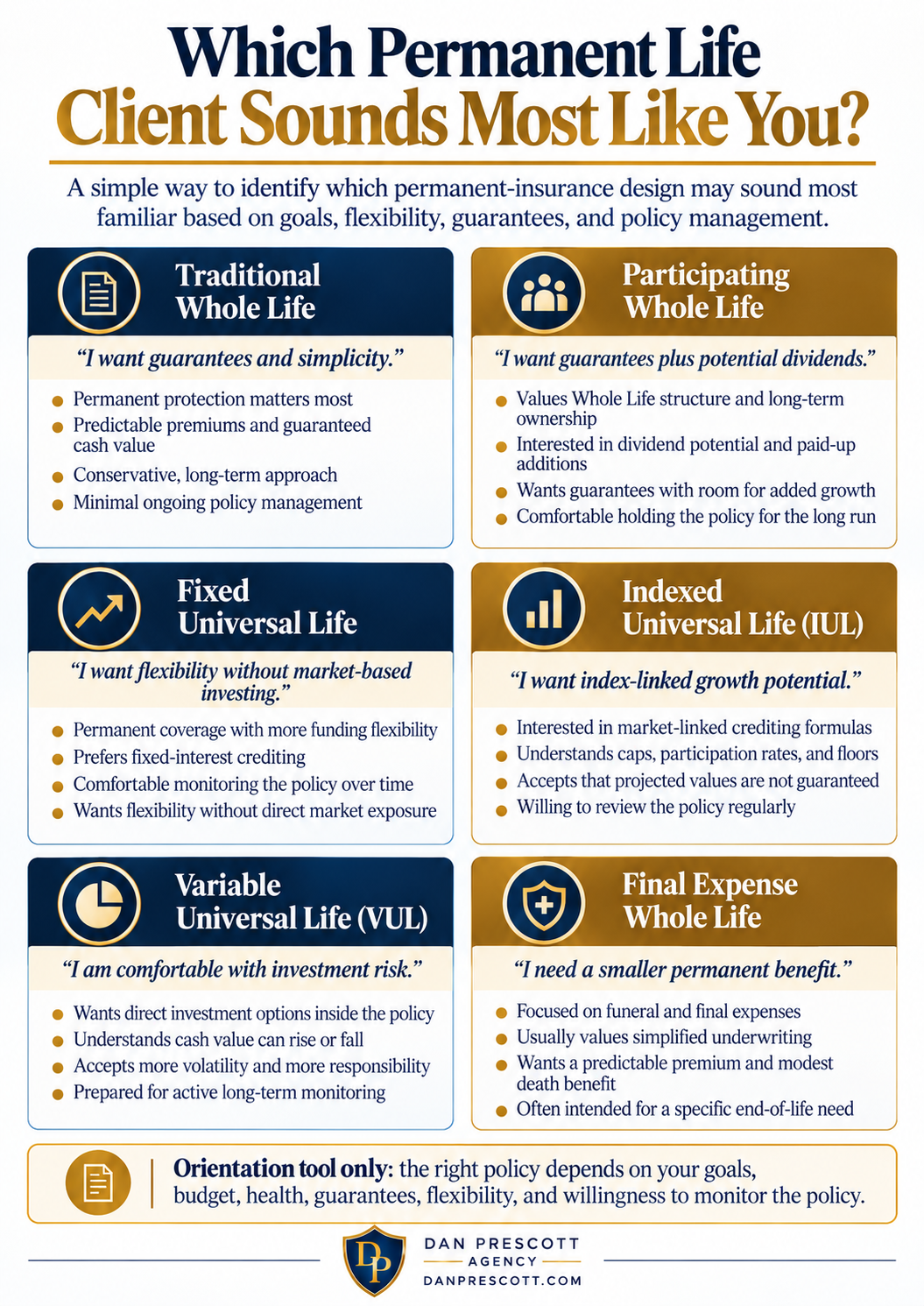
The most important question comes before the product name
Before comparing carrier illustrations or marketing names, define the job the insurance needs to perform. Is the priority a guaranteed lifelong death benefit? Long-term cash value? Premium flexibility? Market-linked growth potential? Simplified final-expense coverage?
Once that objective is clear, the product family becomes much easier to evaluate. The same permanent-insurance category can contain very different levels of guarantees, risk, flexibility, and owner responsibility.
There is no universally “best” permanent policy. The appropriate design depends on what the client needs the insurance to accomplish, how much certainty is important, how much risk is acceptable, and how much ongoing policy management the client wants.
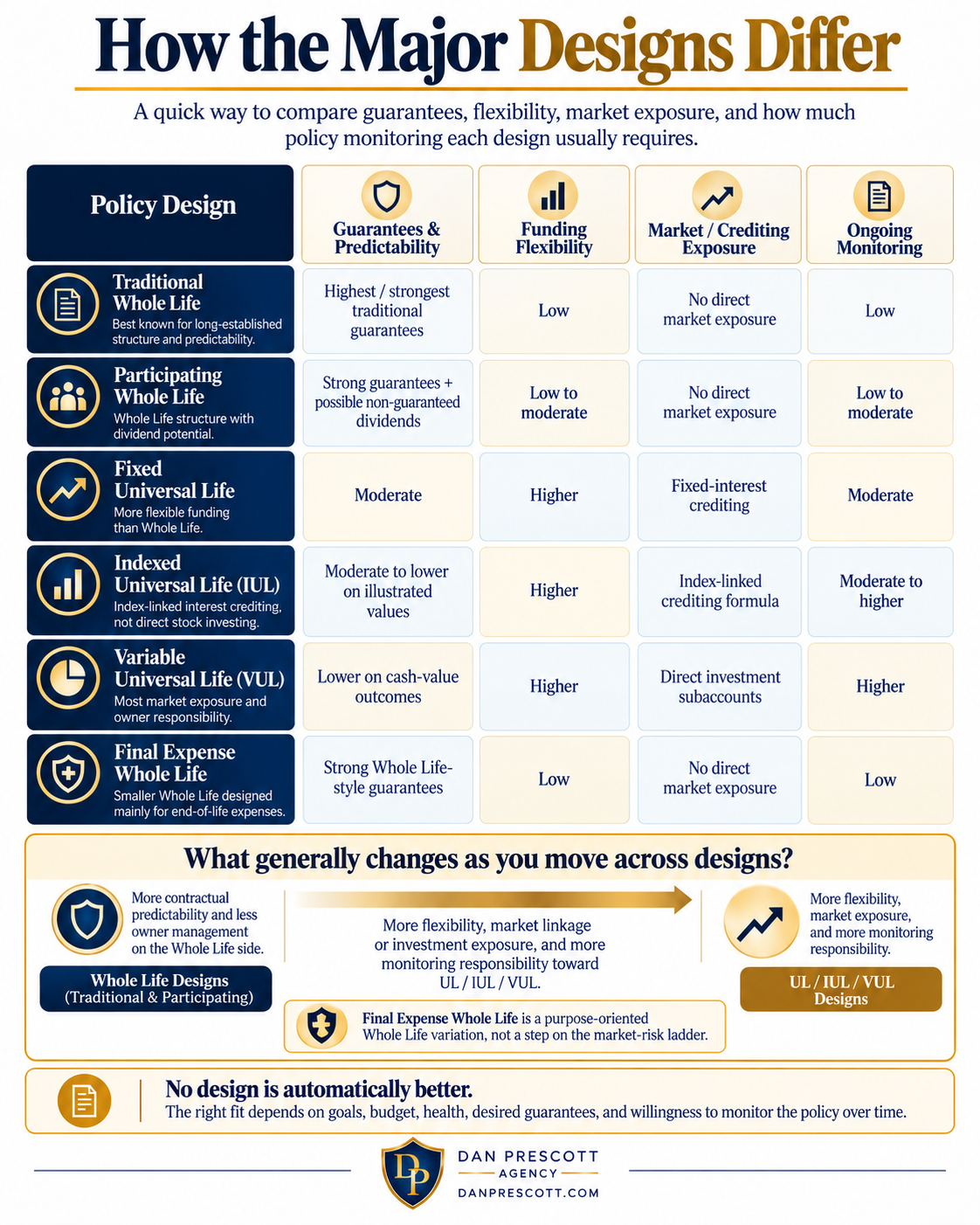
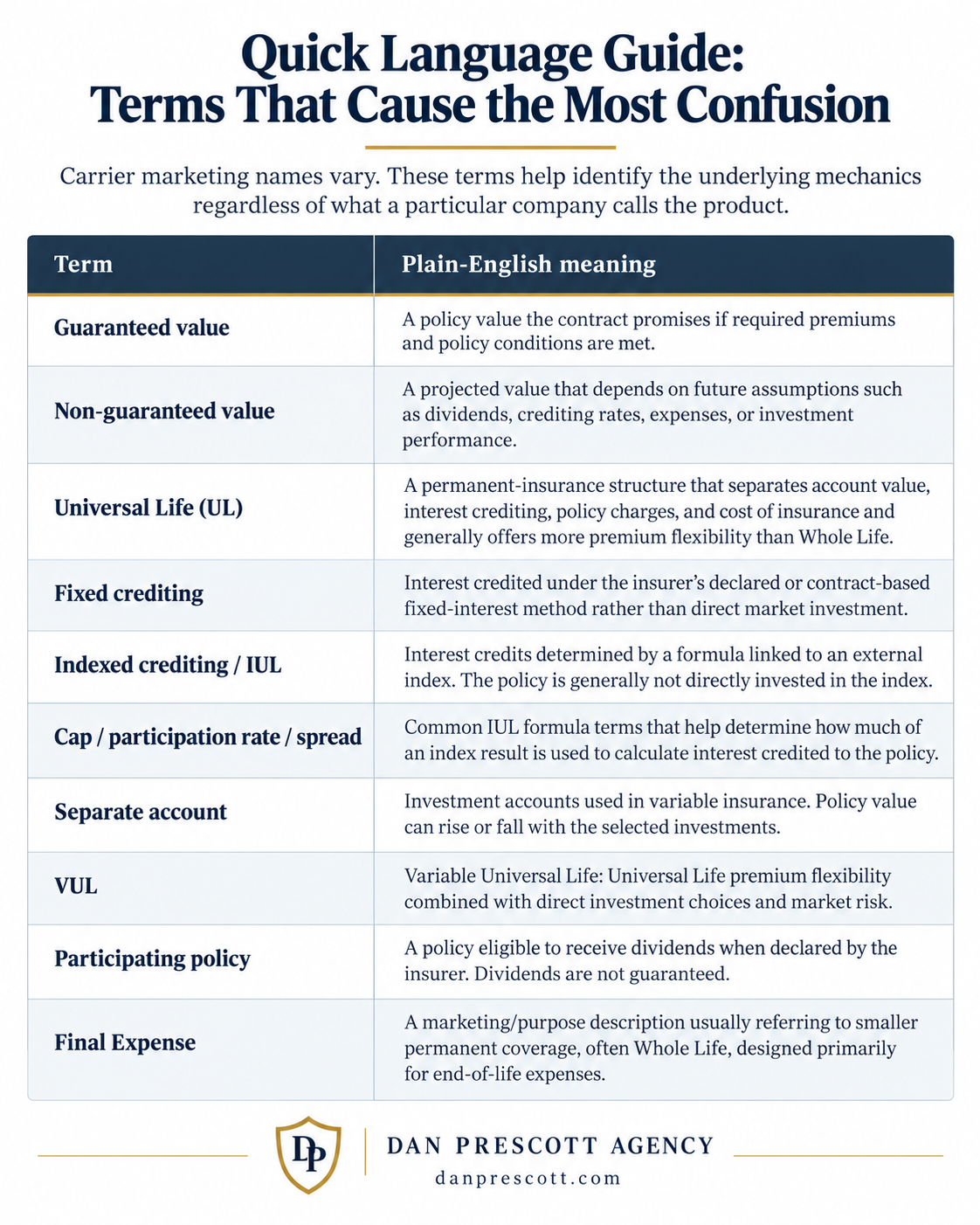
A simple way to use this article
When you encounter a carrier product name, ask three questions:
What basic permanent-insurance family is this?
What is guaranteed and what is only illustrated?
How much risk, flexibility, and ongoing monitoring does this design place on the policyowner?
Those three questions usually cut through most of the marketing language and make the product easier to compare.
Sources & References
National Association of Insurance Commissioners — Life Insurance
NAIC — 2026 Valuation Manual (definition of Indexed Universal Life)
Washington Office of the Insurance Commissioner — Funeral Insurance
Educational Disclaimer
This article is provided for general educational purposes and is not intended as individualized insurance, investment, legal, or tax advice. Product names, features, guarantees, premiums, crediting methods, dividends, riders, and benefits vary by insurer and contract. Guarantees are subject to the claims-paying ability of the issuing insurance company. Non-guaranteed values may change. Variable life insurance involves investment risk. Review the actual policy contract and, where appropriate, consult qualified insurance, tax, legal, or investment professionals before making financial decisions.
Explore the Learning Center at danprescott.com/learning-center. Have questions about permanent life insurance choices? Call or Text Us, or use the Contact page at danprescott.com/contact.