
Whole Life Insurance: Separating Fact from Frustration
Why does Whole Life Insurance provoke such strong opinions?
Search for Whole Life Insurance online and you will encounter very different accounts. One person values predictable lifetime protection. Another describes surrendering a policy after several years and receiving much less than the premiums paid. Some criticize high-pressure sales presentations or illustrations promising an appealing retirement strategy. Others conclude that every Whole Life policy must be a bad deal.
These reactions deserve examination rather than dismissal. Some concerns arise from the real cost and limitations of permanent insurance. Others reflect policies that were poorly matched to a household, were designed around the wrong priority, or were explained in misleading ways. Still other online claims are so absolute that they obscure what the contract actually provides.
To separate fact from frustration, start with a fundamental question: What is the insurance company promising to do, and for how long?
First, understand the two different insurance promises
Term Life Insurance generally provides a guaranteed death benefit if the insured dies during a specified period, such as 10, 20, or 30 years, while the coverage is in force. If the insured survives the period and the policy expires without renewal or conversion, the insurer no longer owes a death benefit under that coverage. The lower initial premium makes term useful for substantial temporary needs—income protection while children are dependent, a mortgage, or other obligations with a foreseeable end date.
Traditional Whole Life Insurance is different. Subject to required premiums and contract terms, it is designed to remain in force for the insured’s lifetime. It typically combines a guaranteed base death benefit, a schedule of guaranteed cash values, and a defined premium arrangement. Participating policies may also pay dividends, but dividends are not guaranteed.
The products can carry the same initial face amount yet fulfill different promises. Comparing only the monthly premium for $500,000 of term and $500,000 of Whole Life misses the length and character of the commitments being purchased.
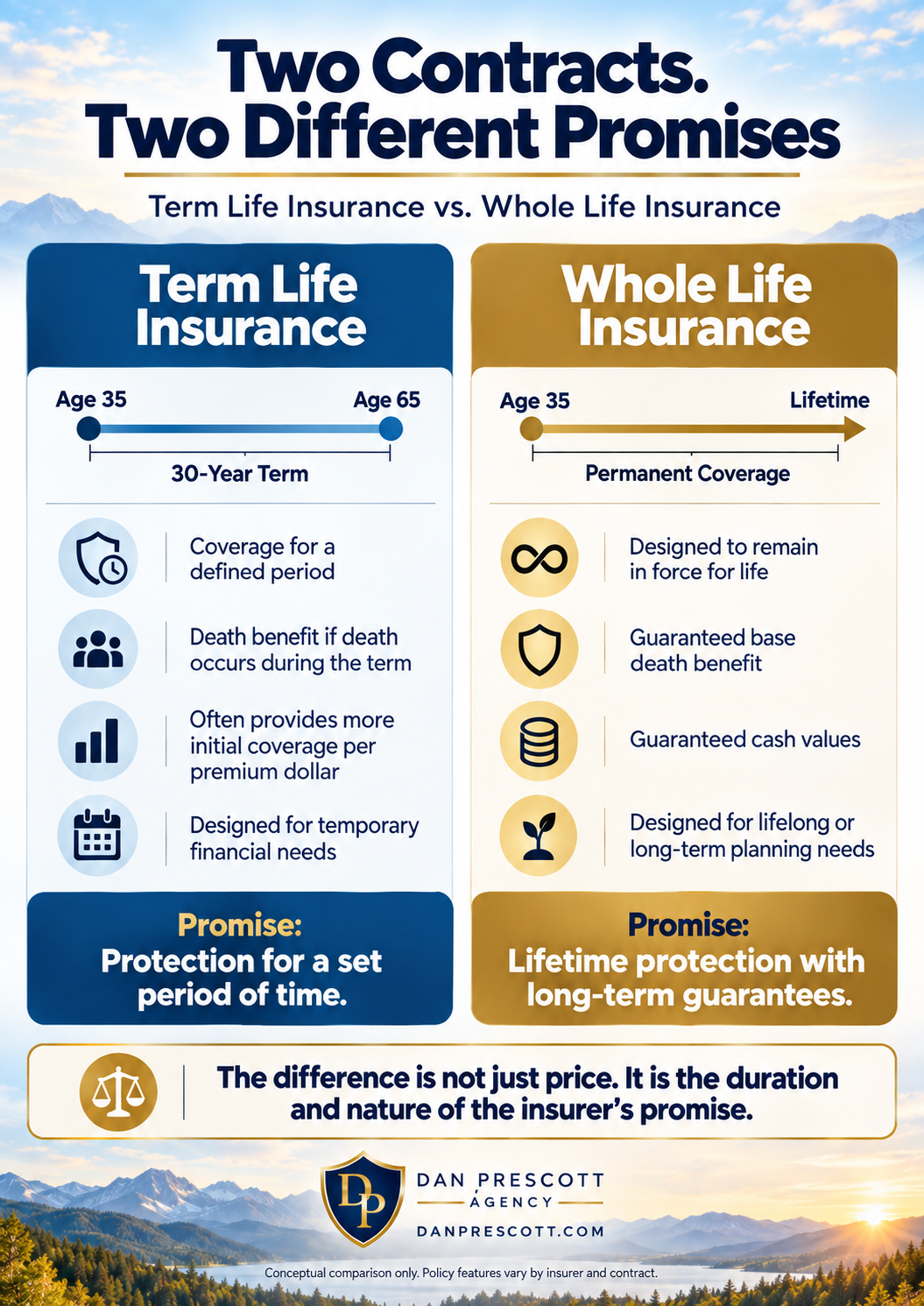
Two Contracts. Two Different Promises
Why does Whole Life cost more? Death is certain; the timing is not.
Every human life eventually ends, but no insurer can know the date of one individual’s death. The insurer’s obligation under term depends on whether death occurs during the covered period. Under a Whole Life contract that remains in force, the insurer is preparing for the eventual covered death claim, even if that occurs many decades after issue. The extended duration of protection is a principal reason its premiums differ.
That is not the entire price explanation. A Whole Life premium also supports guaranteed cash values, the cost of issuing and servicing the policy, insurer capital and reserve needs, and other pricing assumptions. Premiums are not a one-for-one deposit into a separate savings account. Cash value and death benefit are integrated features of an insurance contract.
For a young family whose immediate goal is the largest affordable death benefit during working years, term can provide more initial coverage per premium dollar. For a person whose need truly continues throughout life, permanent coverage addresses a different horizon. The most appropriate comparison starts with the need rather than an assumption that one product should serve every purpose.
The science behind the promise: how insurers understand mortality
Life insurers draw on generations of mortality records, modern insured-life experience studies, and actuarial models to estimate claims across large groups of people. They use age, underwriting and health information, smoking classification, and other permitted factors to estimate probabilities of death. No mortality table predicts one individual’s lifespan with certainty; it helps estimate how many claims may arise across a large block of policies and when.
Insurers combine these mortality estimates with assumptions about investment income, expenses, persistency, and policy features to develop premiums and manage future liabilities. Mortality experience is not frozen in time: actuaries monitor emerging data and update methods. This is why term and Whole Life can both be priced scientifically yet have different premium structures: the coverage horizons and policy guarantees differ.
The Society of Actuaries publishes individual-life mortality experience studies, including research comparing actual insured mortality with industry tables. These studies illustrate the depth of statistical work behind life-insurance pricing—not an insurer’s ability to foretell a particular person’s death.
The financial responsibility behind the guarantee
An insurer’s promise must be supported financially, not simply written into a policy. State insurance laws require life insurers to calculate statutory policy reserves for future contractual obligations. These reserves are accounting liabilities supported by insurer assets; they are not necessarily cash locked in a vault. Principle-based reserving uses product-specific risks and assumptions to help determine appropriate reserves.
Insurers also face risk-based capital requirements tied to the size and risk profile of their assets and operations. Regulators review financial statements and have authority to intervene if capital falls below prescribed thresholds. These safeguards are relevant to long-duration coverage, but they do not make any insurer immune to insolvency or guarantee the performance of non-guaranteed policy elements.
Banks, too, have capital, liquidity, supervisory, and deposit-insurance rules. A bank’s reserve requirement is not directly comparable to an insurer’s policy reserve, so it would be misleading to use a simple percentage comparison to declare one industry universally safer. For a Whole Life buyer, the practical lesson is to review the actual issuing insurer’s financial strength and the contractual guarantees, rather than rely on a broad comparison between industries.
State regulators enforce insurance law and monitor financial condition; the government does not directly guarantee every life insurer’s obligations. State life and health insurance guaranty associations provide limited protection for eligible policyholders if a licensed insurer fails, subject to state-specific coverage limits and conditions.
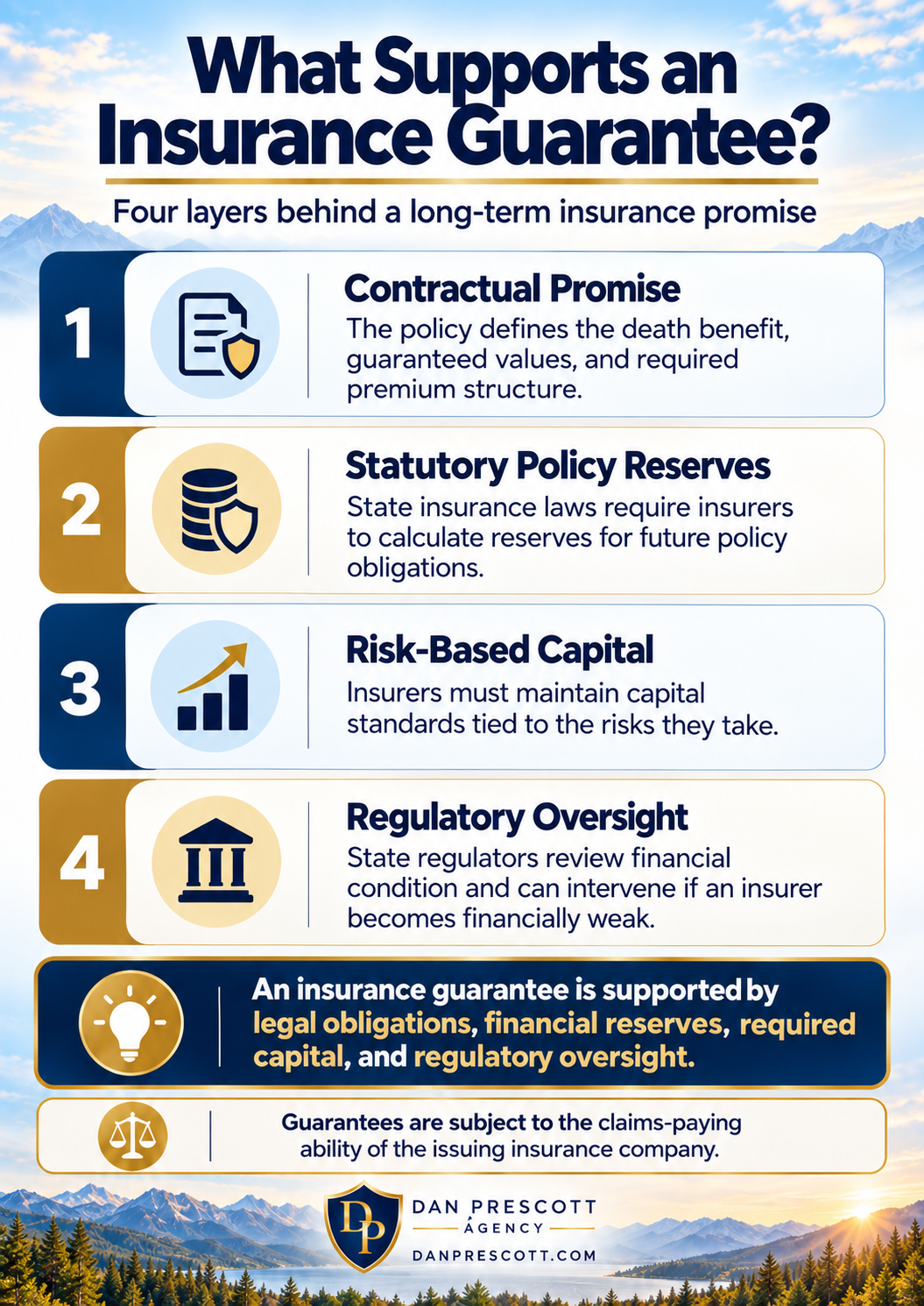
What Supports an Insurance Guarantee
Guarantees have a cost. But they also have a value.
Much of the online debate asks how much more Whole Life costs than term or what its premiums could earn in another investment. Those are legitimate questions. But an equally important question is: What does the buyer receive in return for that cost?
In traditional Whole Life, scheduled guaranteed premiums, guaranteed cash-value schedules, and the guaranteed base death benefit are contractual provisions, subject to the policy remaining in force under its terms. These are different from an investment projection that depends on future market returns or an illustration that assumes a non-guaranteed dividend scale.
The guarantees are obligations of the issuing insurance company, supported by its assets and subject to insurance regulation—not a promise that the government will make every contract whole. Buyers should distinguish the guaranteed column of an illustration from the non-guaranteed column and recognize that participating dividends can change.
A guaranteed outcome can be useful to a household seeking a known base of lifetime coverage or predictable cash values. It also has an opportunity cost, and higher premiums may make it unsuitable when a household needs much more immediate protection. The question is not simply what a guarantee costs. It is what the guarantee accomplishes for the family—and whether the family can comfortably maintain it.
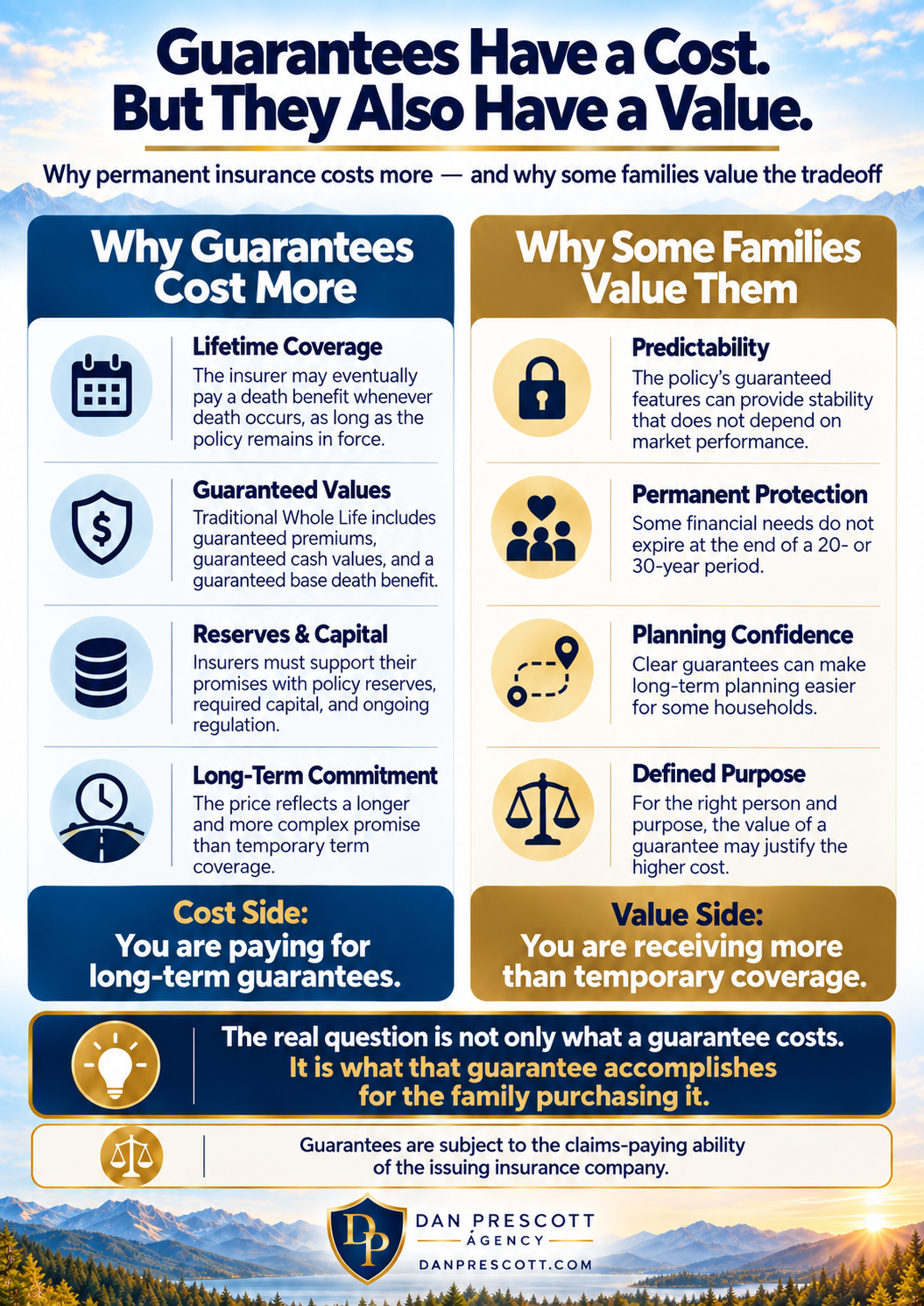
Guarantees Have a Cost. But They Also Have a Value
Where critics have a valid point
Whole Life generally costs substantially more than term for the same initial face amount. A household that needs significant income replacement may become underinsured if it spends most of its protection budget on a comparatively small permanent policy. A large temporary need should be measured first, not forced into a preferred product.
Early cash surrender values can be substantially below premiums paid. For someone who expects to need the money in the first few years, Whole Life is not a substitute for a liquid emergency fund. Its economics are sensitive to how long the contract is held and funded. The possibility of an early surrender loss should be shown before the sale.
Opportunity cost matters, too. Premiums cannot also be invested in a retirement account, pay down debt, or cover another need. Equity investing may offer higher long-run growth potential, but it brings market risk and is not a direct contractual substitute for a lifetime death benefit. A fair comparison names the goal, risk, time horizon, taxes, cash flows, and insurance protection being compared.
Policy loans also have genuine costs. They normally involve insurer lending against policy value, with interest charged according to the contract. Outstanding borrowing can reduce available value and the amount paid to beneficiaries; unmanaged loans can lead to lapse. A lapse or surrender with taxable gain, including one involving outstanding loans, may create an unexpected tax result. Favorable federal treatment in some circumstances does not make policy loans free money.
When the policy design—not just the product—is the problem
Two Whole Life contracts from the same insurer can serve different objectives. One may emphasize base death benefit. Another may use permitted design features, such as paid-up additions, to emphasize a different pattern of cash value and coverage. Premium periods, riders, dividend elections, underwriting, and loan provisions all affect the outcome. Not every rider is available from every insurer, and designs must remain within applicable tax limits.
Consider a household with children and a mortgage. If its primary need is a large death benefit for the next 20 or 30 years, buying only a small permanent policy may leave the family exposed. One possible design separates the jobs: permanent coverage for a genuine lifetime need and term coverage for the temporary need. A layered approach is an option to evaluate, not a standard solution everyone must purchase.
An illustration can also look appealing on paper while being unrealistic for the owner’s cash flow. A premium that cannot be maintained through a job change or family emergency raises the prospect of surrender before longer-term benefits develop. A design should begin with the amount of coverage needed, an affordable funding commitment, the intended time horizon, and the guaranteed results.
Replacing an existing permanent policy deserves special scrutiny. An older contract may contain guarantees, accumulated values, or tax characteristics that cannot be recreated on the same terms. A replacement comparison needs the old policy’s current in-force illustration, charges, loans, surrender values, and the actual proposed new contract—not just a new sales illustration.
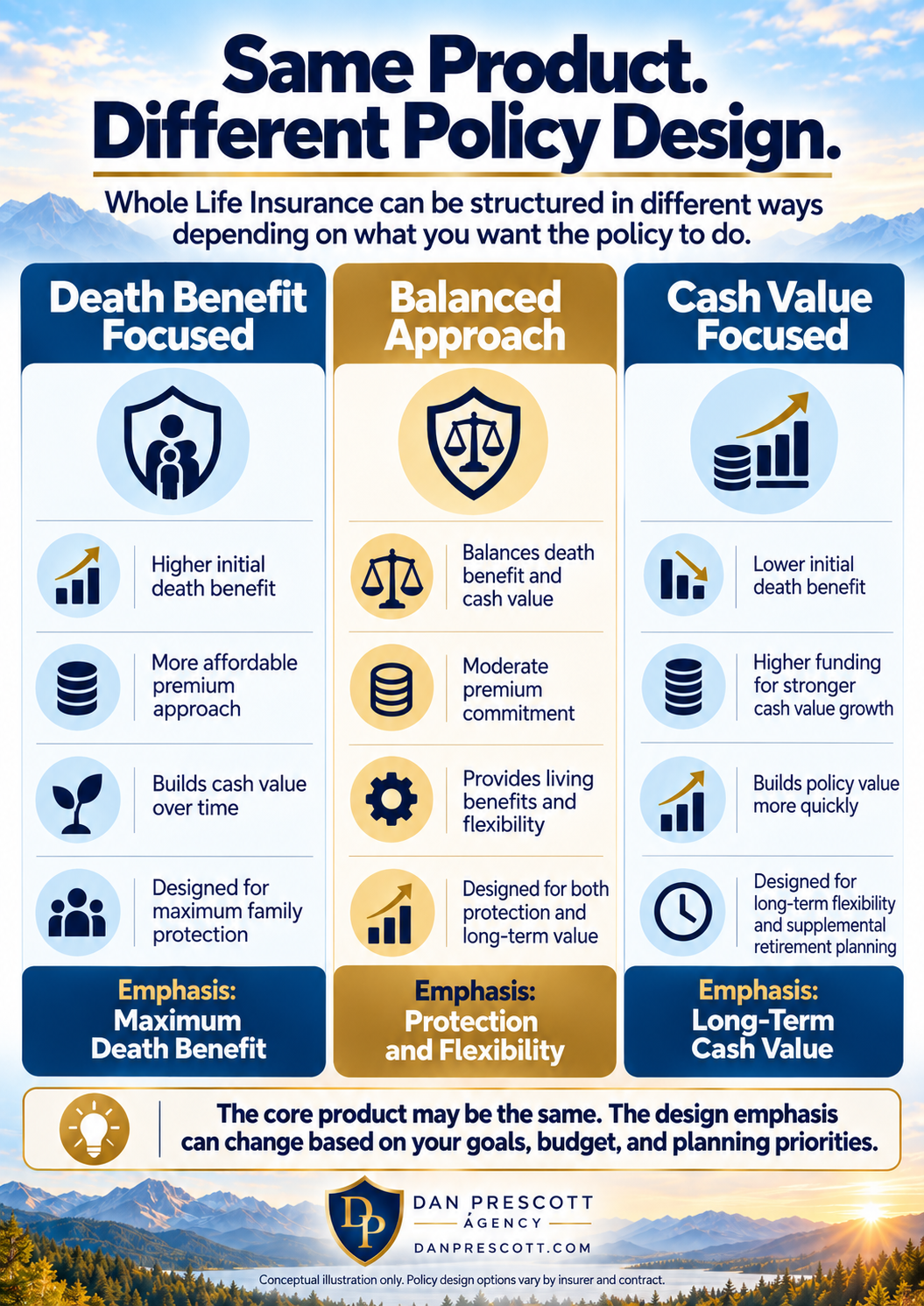
Same Product. Different Policy Design
When the sales pitch gets ahead of the contract
Permanent life insurance can involve substantial first-year sales compensation. That is a legitimate reason for buyers to ask how the agent is paid, what alternatives were considered, and why a particular design was selected. Commission does not independently establish suitability, but vague answers and rushed decisions are warning signs.
Marketing phrases can make a complicated product sound simpler than it is. “Be your own bank” is a metaphor, not evidence that a loan has no interest cost. “Earn the dividend rate” confuses an insurer’s dividend-interest-rate component with the policyholder’s own rate of return. A claim that premiums will disappear may depend on future dividends rather than a contractual paid-up provision. None of those claims should replace examination of the policy’s actual illustration and contract terms.
Descriptions of “tax-free retirement income” also need qualification. Federal rules distinguish non-Modified Endowment Contracts from Modified Endowment Contracts, or MECs. Withdrawals, loans, lapse, surrender, and death benefits can have different tax consequences. Tax outcomes depend on policy history and individual circumstances; a numerical retirement strategy should receive individualized tax review.
A responsible proposal should show what happens under guaranteed assumptions, identify every non-guaranteed value, and explore what happens if dividends are lower than illustrated, the owner needs liquidity early, or borrowing continues for many years. Buyers should never be expected to take optimistic illustrations on faith.
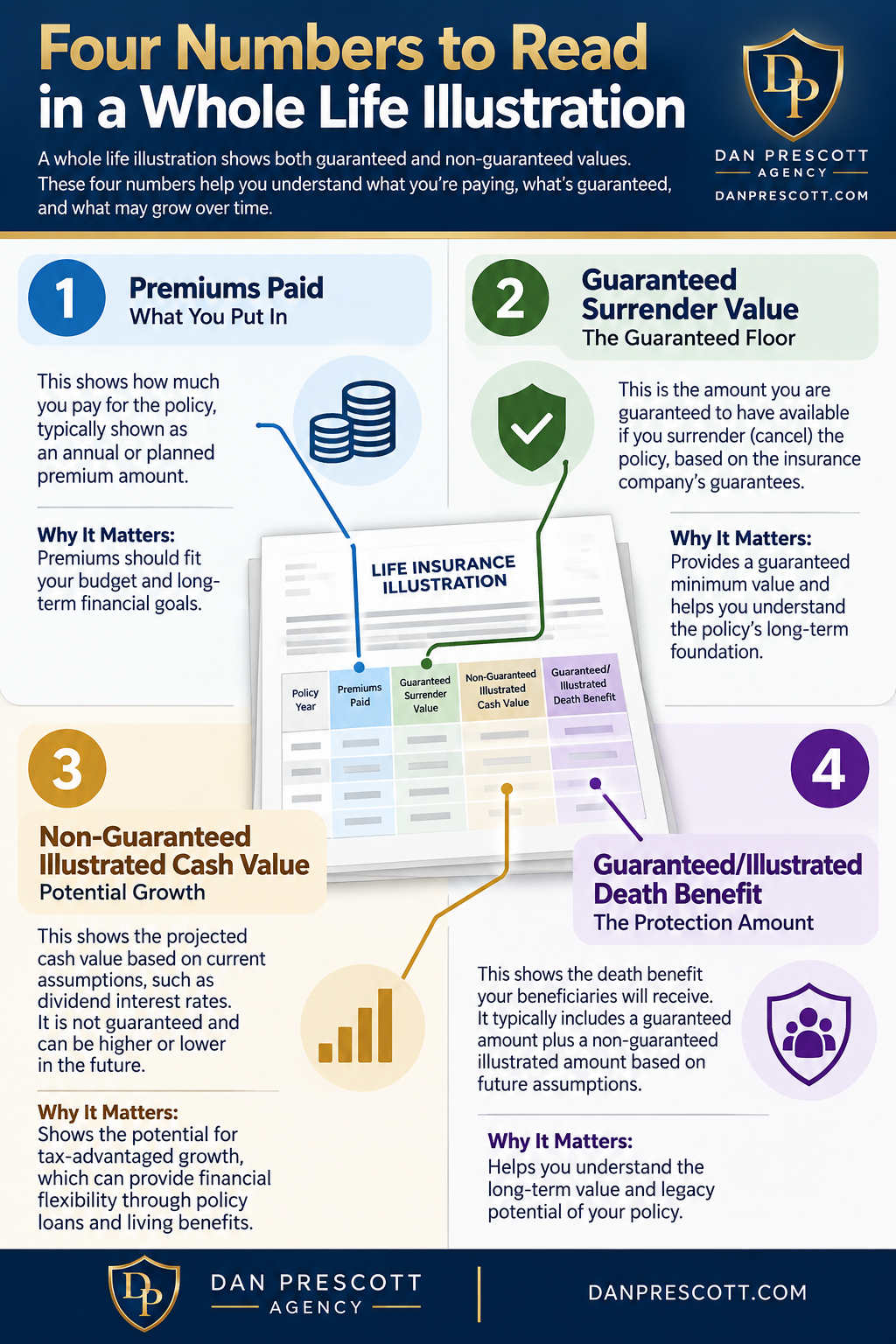
Four Numbers to Read in a Whole Life Illustration
What sweeping online claims leave out
“Whole Life is a scam.” That slogan does not describe a specific contract. Whole Life is a regulated form of insurance with enforceable contractual provisions, but a legitimate product can still be unsuitable, too expensive for a household, or sold with misleading expectations. Critique the recommendation and the contract actually offered.
“Term is always better.” Term can be extremely useful for large temporary protection needs. But a term policy that expires does not itself solve a lasting need for life insurance. Conversely, the existence of a possible lifelong need does not mean a household can or should buy an unaffordable permanent policy today.
“Whole Life is a terrible investment.” The comparison becomes confused if the insurance component disappears from the analysis. Whole Life is not a stock portfolio, and its cash-value growth should not be marketed as a guaranteed way to beat one. Evaluate protection, guaranteed contract values, liquidity, fees implicit in the product, alternative uses of money, and the buyer’s real objective.
“The insurance company keeps your cash value when you die.” In a conventional Whole Life contract, cash value is part of the mechanism supporting the death benefit rather than a second account automatically paid on top of the stated death benefit. Depending on the dividend option, paid-up additional insurance may increase the total death benefit. The policy’s schedule and current in-force statement show what beneficiaries would actually receive, net of applicable loans.
“Dividends are guaranteed.” They are not. Participating policy dividends depend on company experience and declarations. The guaranteed base values should stand on their own in a buyer’s evaluation; non-guaranteed values can be considered as possible outcomes, not promises.
Personal stories are useful signals about dissatisfaction and sales behavior, but they cannot alone establish how all policies perform or how all owners feel. A better response to any strong internet claim is to ask for its underlying contract, time horizon, guarantees, assumptions, and alternatives.
Where Whole Life can have a legitimate role
Permanent protection can be relevant to objectives that do not disappear at retirement: a surviving spouse’s needs, care for a lifelong dependent, estate or business liquidity, final expenses, or an intentional legacy. The right death-benefit amount still requires an assessment of actual financial need, existing resources, and affordability.
Its guaranteed cash-value schedule can provide a predictable component within a wider financial plan. Policy loans or permitted withdrawals may provide flexibility, subject to interest, charges, policy requirements, and tax consequences. Participating dividends, when declared, can be used in several ways, including buying paid-up additional insurance, but are not guaranteed.
Some contracts include optional accelerated-death-benefit, chronic-illness, or long-term-care-related riders. The qualifying definitions, benefit reductions, costs, waiting periods, and tax implications vary; these should not be presented as features every Whole Life contract automatically includes. A rider must be assessed on its own terms.
The credible conclusion is not that every person needs Whole Life. Some may need term only; some may benefit from combining term and permanent insurance; some may need to establish an emergency reserve before considering a long-term premium commitment. A good recommendation should survive comparison with realistic alternatives.
Seven questions before signing a policy
What financial loss am I protecting against, how large is it, and how long will it exist?
Can I maintain the premiums if income falls or family expenses rise?
What are the guaranteed death benefits and cash surrender values in years 5, 10, 20, and later?
Which illustrated outcomes rely on non-guaranteed dividends or future assumptions?
How do surrender, withdrawals, loans, interest, policy lapse, and MEC status affect access and taxes?
What would term coverage, a layered approach, or a different use of these premium dollars accomplish?
Who is the issuing insurer, how is its financial strength evaluated, how is the agent compensated, and when will the policy be reviewed?
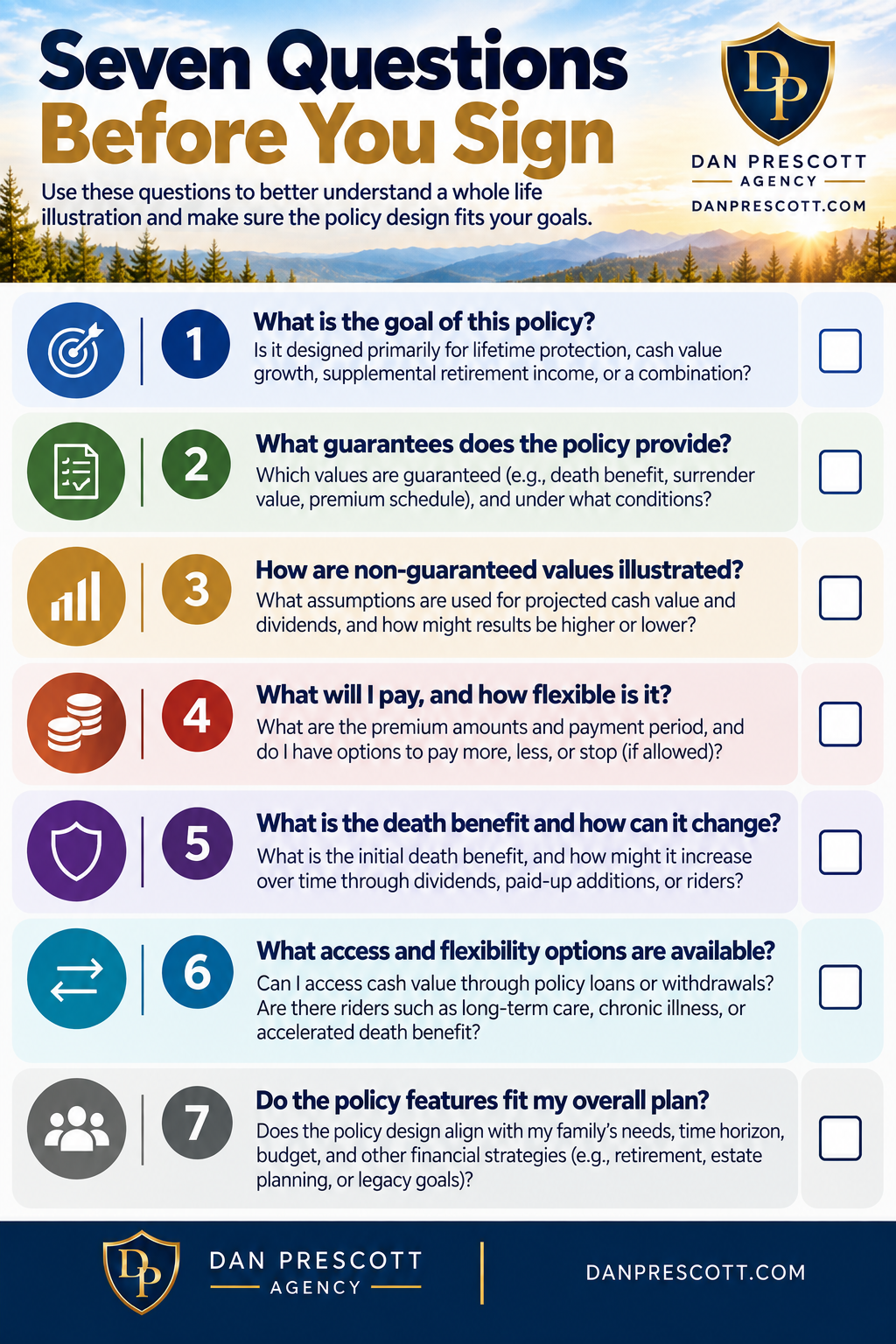
Seven Questions Before You Sign
A better way to approach the debate
The frustration surrounding Whole Life Insurance cannot be dismissed. High premiums, slow early surrender-value growth, opportunity cost, policy-loan risk, unsuitable sales, and overstated illustrations are real concerns. A buyer deserves clear explanations of those issues before purchasing.
But criticism of a poor sale or a poorly designed contract should not become a blanket claim about every permanent policy. Whole Life is built around a particular promise: permanent death-benefit protection with specified contractual guarantees, supported by mortality science, insurer assets, reserves, capital requirements, and regulatory oversight. Those guarantees cost money; their value depends on the financial job they accomplish for the buyer.
Separate the product, the design, and the sales pitch. Ask what is guaranteed, what is merely illustrated, what happens when plans change, and what alternative approach meets the same need. Better questions—not louder slogans—make for better insurance decisions.
Sources & References
National Association of Insurance Commissioners — Life Insurance Illustrations — https://content.naic.org/insurance-topics/life-insurance-illustrations
NAIC — Principle-Based Reserving — https://content.naic.org/insurance-topics/principle-based-reserving
NAIC — Risk-Based Capital — https://content.naic.org/insurance-topics/risk-based-capital
Society of Actuaries — Individual Life Mortality Experience Studies — https://www.soa.org/research/topics/indiv-mort-exp-study-list/
Society of Actuaries — 2012–2019 Individual Life Mortality Experience Report — https://www.soa.org/resources/research-reports/2024/ilec-mort-2012-19/
Internal Revenue Service — Publication 525, Taxable and Nontaxable Income — https://www.irs.gov/publications/p525
NAIC — Life Insurance Buyer’s Guide — https://content.naic.org/sites/default/files/publication-lig-lp-consumer-life.pdf
Explore the Learning Center at danprescott.com/learning-center. Have questions about a policy’s guarantees or design? Call or Text Us, or use the Contact page: danprescott.com/contact.
Educational Disclaimer
This article is provided for general educational purposes and is not intended as individualized insurance, investment, legal, or tax advice. Policy features, guarantees, premiums, dividends, riders, and benefits vary by insurer and contract. Guarantees are subject to the claims-paying ability of the issuing insurance company. Dividends are not guaranteed. Consult a qualified insurance professional and, where appropriate, your tax or legal advisor before making financial decisions.