
Common Insurance Riders: How to Customize Your Life Insurance Coverage (Copy) (Copy)
EDUCATIONAL ARTICLE
10 min read | Category: Life Insurance Basics
The Common Thread
Life insurance is not always a one-size-fits-all product. A base policy provides the core death benefit, but optional provisions called riders can help tailor that policy to a family’s needs, financial responsibilities, health concerns, and long-term goals.
Riders may add temporary coverage, protect a policy during disability, cover a spouse or children, create opportunities to purchase more insurance later, or provide access to a portion of the death benefit while the insured is still living. Some riders are included automatically, while others require additional underwriting or premium.
The most important point is that rider names can sound similar even when their definitions, costs, triggers, and benefit calculations are very different. The actual insurance contract—not the marketing name—determines how a rider works.
Riders can strengthen a policy, but adding every available rider is rarely the goal. The better approach is to identify the risks that matter most, compare the contract details, and add only the features that serve a clear purpose.
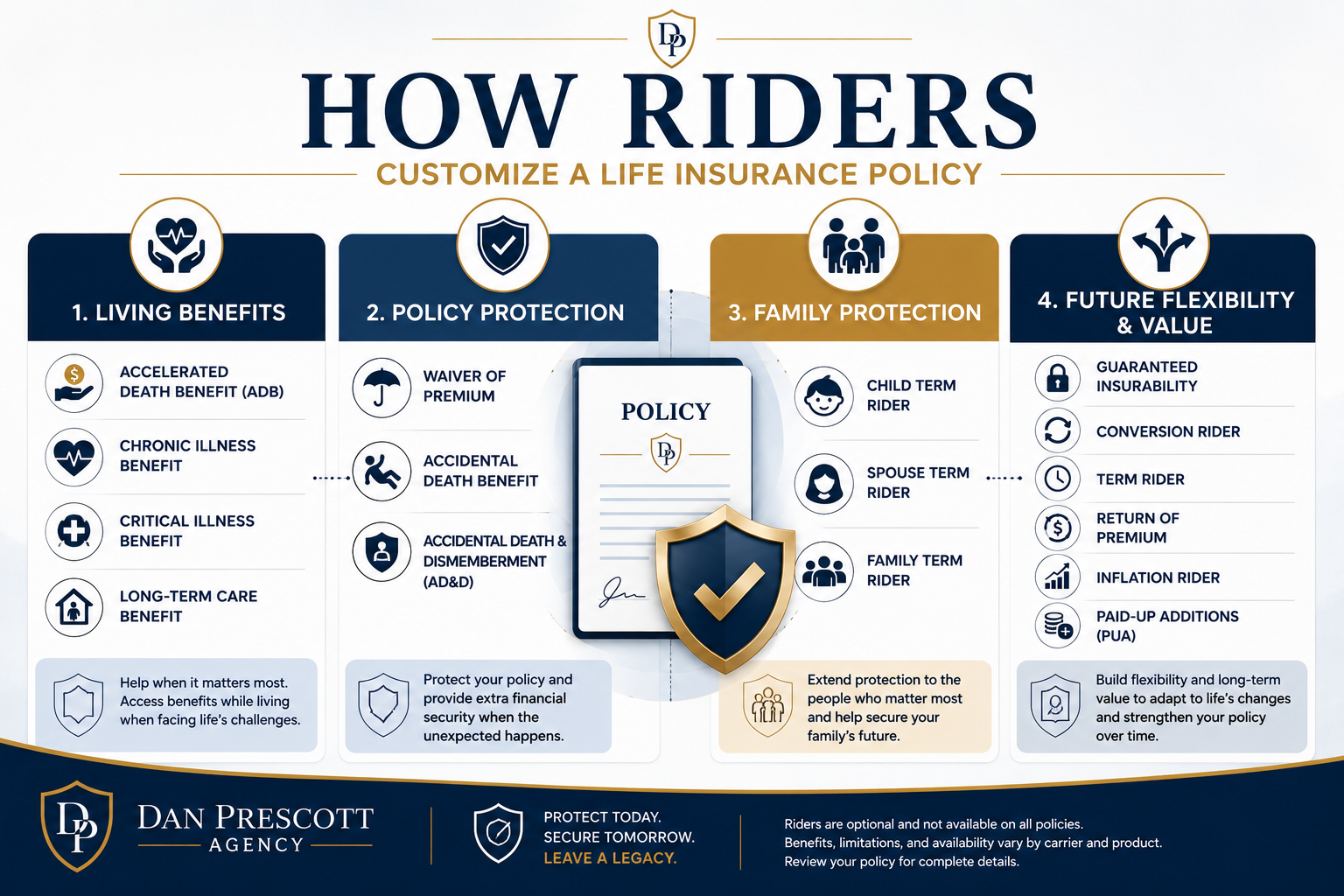
Four categories of common life insurance riders.
Accelerated Death Benefit and Chronic-Illness Riders
Accelerated Death Benefit (ADB) riders—often called living-benefit riders—allow an eligible policyowner to receive part of the life insurance death benefit while the insured is living after a qualifying event. Traditional ADB provisions commonly address terminal illness. Newer rider designs may also cover chronic illness and, depending on the contract, critical illness.
Chronic-illness ADB riders have become especially important in today’s market because they give some consumers a life-insurance-based way to address potential care needs. Instead of buying a completely separate stand-alone long-term care policy, a client may choose life insurance with a chronic-illness rider or a combination life/LTC design. Industry research describes a broad continuum of current options, ranging from chronic-illness riders to full traditional long-term care insurance.
This can be a compelling alternative for clients who want a death benefit if care is never needed, but it should not be described as automatically equal to comprehensive long-term care insurance. A chronic-illness ADB rider generally accelerates an existing death benefit; using it reduces the amount remaining for beneficiaries and may reduce other policy values. Eligibility definitions, permanence requirements, waiting periods, maximum monthly benefits, discount factors, liens, and documentation rules vary substantially.
For many clients, an ADB or chronic-illness rider is now a key alternative to stand-alone LTC insurance—not because the products are identical, but because it combines life insurance protection with a source of funds that may become available after a qualifying chronic illness. A careful comparison is essential.
Long-Term Care Rider
A true Long-Term Care (LTC) rider generally allows access to policy benefits for qualified long-term care services after the insured meets the rider’s eligibility requirements. A common trigger is the inability to perform at least two activities of daily living—such as bathing, dressing, eating, toileting, transferring, or continence—or the presence of severe cognitive impairment, subject to certification and policy terms.
LTC riders classified as qualified long-term care coverage are designed under long-term care rules and may provide broader or more structured care benefits than a chronic-illness acceleration rider. Some designs reimburse eligible expenses; others pay an indemnity benefit. Clients should compare covered services, elimination periods, benefit periods, inflation options, residual death benefits, and whether benefits can continue after the original death benefit has been fully accelerated.
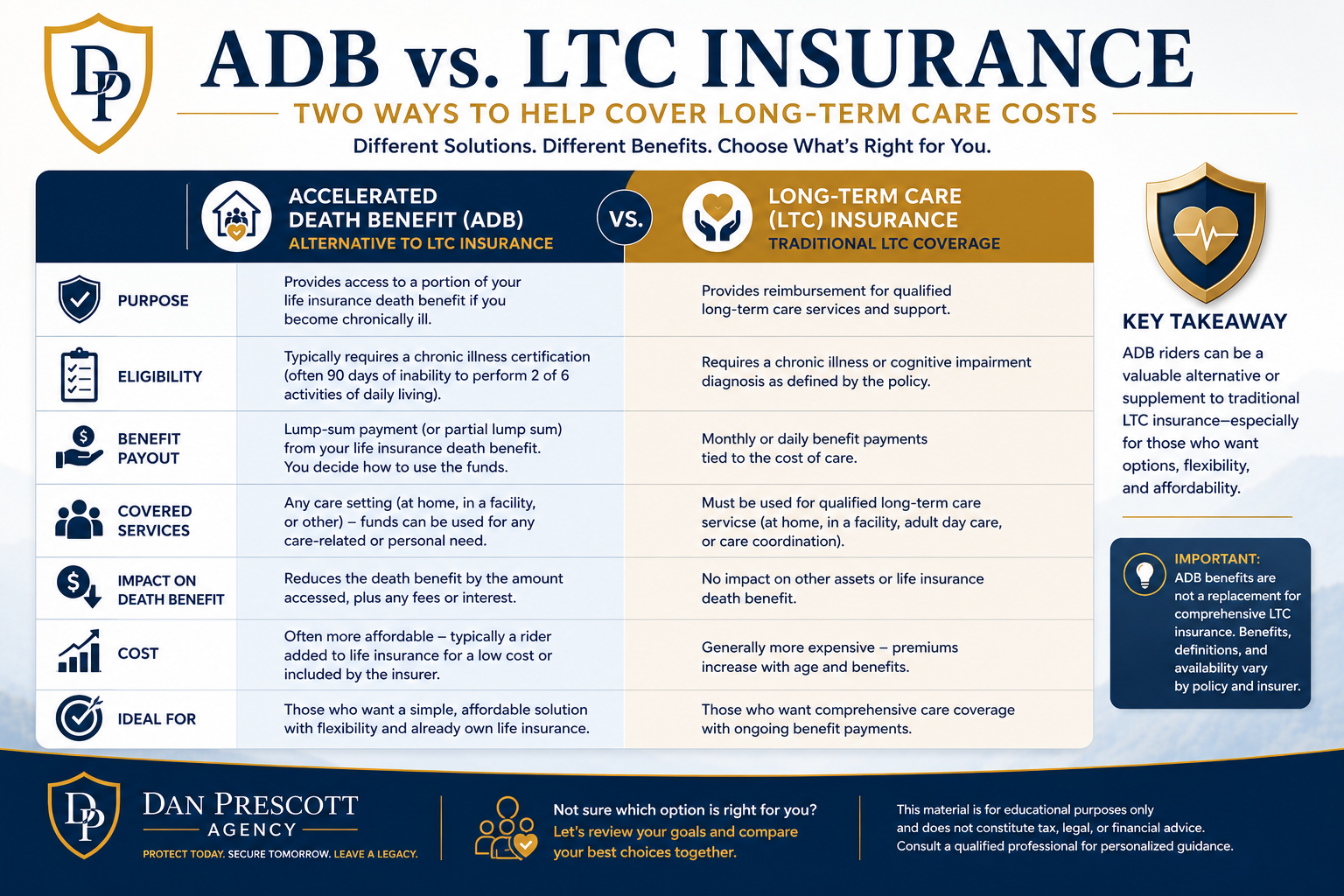
ADB VS. LTC COMPARISON
IMPORTANT: Neither category should be judged by label alone. Review the policy illustration, rider specification page, definitions, exclusions, benefit formula, and state-approved contract.
Critical Illness Rider
A Critical Illness Rider may provide a lump-sum or accelerated benefit after diagnosis of a covered condition such as certain cancers, heart attack, stroke, or major organ failure, as specifically defined by the policy. The benefit may help with medical bills, lost income, travel, home changes, or other needs. Covered conditions, severity standards, survival periods, and payment methods vary.
Terminal Illness Rider
A terminal-illness benefit is a common form of ADB that allows early access to part of the death benefit when a physician certifies that the insured meets the policy’s life-expectancy requirement. The funds are generally unrestricted, but acceleration reduces the amount ultimately payable to beneficiaries.
FAMILY PROTECTION RIDERS
Child Term Rider
A Child Term Rider adds a limited amount of term life insurance for eligible dependent children under a parent’s policy. One rider may cover all eligible children, although ages, coverage amounts, and definitions vary by insurer.
The benefit can help a family manage funeral costs, time away from work, counseling, medical debt, and other expenses after a child’s death. Many child riders also include a conversion privilege that may allow an eligible child to obtain permanent coverage later without new medical underwriting. This future-insurability feature can be particularly valuable if the child develops a health condition.
Spouse Term Rider
A Spouse Term Rider adds term insurance on the policyowner’s spouse or eligible partner. It can provide economical supplemental protection within one policy and may be useful when the spouse needs a modest amount of coverage.
A spouse rider is not always a substitute for a separately owned policy. Separate coverage can offer a larger benefit, longer duration, independent ownership, and more flexibility if employment, marriage, or financial circumstances change.
Family or Other-Insured Rider
Some insurers use broader names such as family rider, additional insured rider, or other-insured term rider. These designs may provide term coverage for a spouse, partner, or other person with an insurable interest. Eligibility, ownership, conversion rights, and coverage limits are product-specific.
POLICY PROTECTION AND FLEXIBILITY RIDERS
Waiver of Premium Rider
Waives eligible future premiums if the insured becomes totally disabled and satisfies the contract’s definition, waiting period, age limits, and continuing-proof requirements. It can help keep coverage in force when income is interrupted.
Guaranteed Insurability Rider
Provides scheduled opportunities to buy additional coverage without new evidence of insurability. Option dates may be tied to specified ages or life events. The rider preserves an opportunity—not an obligation—to increase coverage, subject to limits.
Convertible Term Feature or Rider
Allows eligible term insurance to be converted to permanent insurance during a defined period without new medical underwriting. Conversion is often a built-in policy provision rather than a separately priced rider. Available permanent products and deadlines can change, so the conversion language should be reviewed at purchase and again well before expiration.
Term Insurance Rider
Adds temporary term coverage to a permanent life policy. It can create a blended design with permanent base protection and a larger temporary death benefit during high-obligation years.
Return of Premium Rider
Available with some term policies, this rider may return eligible premiums if the insured survives the full term and all contract conditions are satisfied. It generally costs more than comparable level term coverage without the rider.
Inflation or Benefit Increase Rider
Most common in long-term care and disability insurance, this feature increases eligible benefits over time to help offset rising costs. Simple and compound increases can produce materially different future benefits.
Accidental Death Rider
Pays an additional amount if death results from a covered accident within the stated time period. Exclusions and definitions are important, and accidental death coverage does not replace adequate base life insurance.
Accidental Death and Dismemberment Rider
Pays scheduled benefits for covered accidental death or losses such as a limb, sight, hearing, or speech. The schedule of losses and exclusions varies by contract.
Paid-Up Additions Rider
Available on certain participating whole life policies, a Paid-Up Additions rider allows additional premium to purchase small amounts of fully paid permanent insurance. This can increase guaranteed cash value and death benefit, while dividends, if declared, may add further value. Funding limits, tax classification, and policy design must be monitored.

Riders Through Life’s Changing Stages
HOW TO EVALUATE A RIDER
Before adding a rider, ask the following questions:
What exact risk or planning goal does the rider address?
Is the rider included automatically, or does it add premium or policy charges?
What event triggers the benefit, and who must certify eligibility?
Does the condition have to be permanent, terminal, or expected to last a specified period?
Is the benefit reimbursement, indemnity, discounted acceleration, lien-based, or a fixed percentage?
How does using the rider affect the remaining death benefit, cash value, loans, guarantees, or dividends?
Are there waiting periods, age limits, exclusions, maximum monthly benefits, or expiration dates?
Would a separate policy provide stronger or more flexible protection?
What conversion, continuation, or portability rights apply?
How might the benefit be taxed, and should a tax or legal professional be consulted?
The Right Rider Starts With the Right Question
A rider should solve a specific problem—not simply make a policy look more complete. The right combination depends on your family structure, income, health, existing insurance, care concerns, budget, and long-term goals.
As an independent insurance agent, Dan Prescott Agency can help you compare policy designs, identify the riders that may add meaningful value, and understand the tradeoffs before you apply.
Not sure which riders fit your goals?
Compare your options with Dan Prescott Agency.
Disclaimer: Rider availability, terminology, underwriting, costs, benefit triggers, exclusions, and tax treatment vary by insurer, policy, and state. Benefits paid under an accelerated benefit or long-term care rider may reduce the policy’s death benefit and cash value. This material is for general educational purposes and is not tax, legal, or investment advice. Review the actual policy contract and consult qualified professionals as appropriate.